Nepal’s foreign policy sees continuity despite Prime Minister Shah changing tack
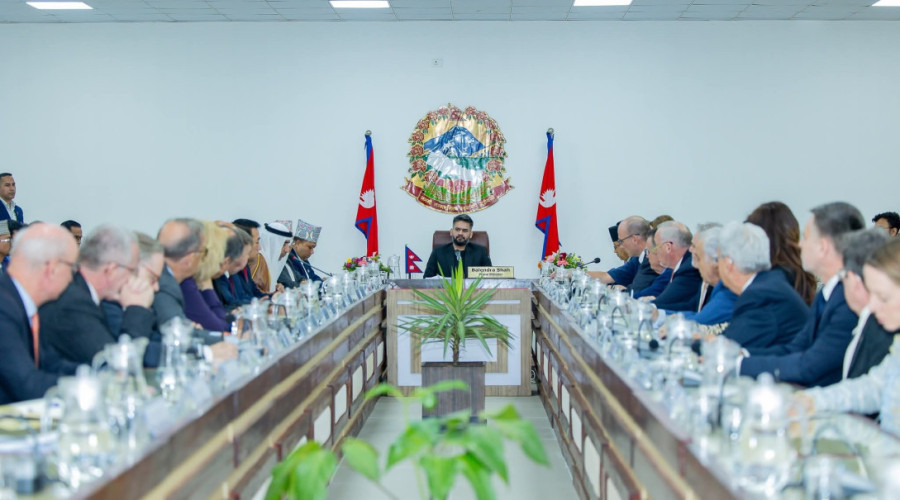
The new government has broken with long-standing diplomatic conventions, but Nepal’s foreign policy priorities remain largely intact. Twenty-three European Union ambassadors and deputy heads of mission, in Kathmandu for an annual meeting, along with some other Kathmandu-based ambassadors, jointly called on Prime Minister Balendra Shah at his office in May, 2026. Photo: Courtesy of Prime Minister’s Office
The formation of one of the most powerful governments in Nepal’s recent history raised expectations of sweeping reforms, bold policy shifts and institutional changes.
It also put Prime Minister Balendra Shah’s foreign policy under close scrutiny. As the government completes its honeymoon period of 100 days, the Rastriya Swatantra Party administration seems to have adopted some departures but only partially.
While Shah has broken with long-standing diplomatic practices by limiting direct engagement with ambassadors and visiting dignitaries, Nepal’s core foreign policy priorities remain largely unchanged. Relations with India and China continue to dominate Kathmandu’s external engagements with Foreign Minister Shisir Khanal paying familiarisation visits to two neighbouring countries with more focus on assuring them that the new government respects their sensitivity.
While there have been some departures, they are less strategic but more procedural. For instance, unlike his predecessors, he has declined to hold one-on-one meetings with Kathmandu-based ambassadors, opting instead for group interactions. He has also avoided receiving several visiting foreign officials, signalling an effort to standardise protocol and reduce personalised diplomacy.
Shah broke with convention by standardising a protocol of not meeting Kathmandu-based diplomats. He also declined to meet several visiting US officials, including President Donald Trump’s special envoy Sergio Gor, and did not agree to receive Indian Foreign Secretary Vikram Misri during his planned visit to Kathmandu.
Misri’s visit was eventually postponed. While the immediate trigger was renewed tensions after China and India agreed to resume the Kailash Mansarovar pilgrimage route through Lipulekh, Nepal’s area long occupied by India, diplomatic sources also cited Shah’s unwillingness to meet the Indian foreign secretary as a contributing factor.
Since the new government took office, Nepal-India relations have been marked by recurring friction. Disputes have ranged from Nepal’s decision to impose customs duties on goods worth more than Rs100 brought from India, to New Delhi’s repeated restrictions on tea imports from Nepal, alongside a series of other irritants that have prevented ties from returning to a more cordial footing.
Amid the strained bilateral ties, India invited Rastriya Swatantra Party President Rabi Lamichhane, who received a warm welcome from the ruling Bharatiya Janata Party and the government of Prime Minister Narendra Modi. During the visit, Lamichhane outlined proposals for expanding practical Nepal-India cooperation, both in his meetings and in an opinion article published in The Hindustan Times, underscoring what he described as a “development diplomacy” approach.
Shah’s aides say the prime minister wants institutions, not the individuals, to drive the country’s foreign engagement. However, foreign affairs experts do not see fundamental changes in the foreign policy.
“There has not been much departure in Nepal’s foreign policy,” says Lok Raj Baral, former ambassador to India and a veteran foreign policy scholar. “The fundamentals remain the same. What has changed is the style.”
Baral says both India and China initially struggled to understand the new administration, largely because Shah remains an unusually reserved political leader who rarely explains his decisions publicly.
“India appeared confused in the beginning, while China was also not fully convinced about the new government,” he says. “But gradually both have started engaging with it.”
Within weeks of the new government’s formation, Kathmandu hosted a series of senior US officials, marking one of the busiest periods of bilateral engagement in recent years. The engagements were more at the foreign ministry level.
Foreign Minister Shisir Khanal also held a virtual meeting with Allison Hooker, the US under secretary of state for political affairs, during which both sides discussed expanding economic cooperation, investment and institutional reforms.
Unlike previous years, when strategic issues often dominated bilateral discussions, the recent engagements centred on attracting American investment, promoting Nepal’s digital economy and creating a more favourable business environment.
Officials familiar with the discussions said Washington emphasised smooth implementation of the Millennium Challenge Corporation (MCC) projects, legislative reforms to encourage investment, artificial intelligence, information technology, data centres, entrepreneurship and digital infrastructure. Starlink and broader technological cooperation also figured in the conversations.
For the Shah government, the engagement offered an opportunity to reinforce its stated foreign policy objective of prioritising economic diplomacy over ideological alignment. That emphasis has become the defining message of Foreign Minister Khanal’s first three months in office.
Whether speaking in Parliament, addressing diplomats or giving interviews during his visits to New Delhi and Beijing, Khanal has repeatedly argued that Nepal’s diplomacy should be judged not merely by political symbolism but by its ability to generate tangible economic outcomes.
His ministry has identified attracting foreign direct investment, increasing exports, promoting tourism, expanding labour markets and mobilising the Nepali diaspora as its principal objectives.
“Our diplomacy must ultimately contribute to Nepal’s economic transformation,” Khanal has repeatedly said in public forums.
The shift in language reflects a broader recognition that Nepal’s foreign policy can no longer remain confined to traditional political engagement. With remittance growth slowing, foreign investment remaining weak and climate change posing increasing threats to the country, diplomacy is expected to deliver economic dividends.
The government has also announced plans to improve services delivered by Nepali missions abroad, strengthen protection mechanisms for migrant workers, create dedicated channels for investment from the diaspora and institutionalise regular dialogue with development partners.
These priorities are neither new nor controversial. Successive governments have spoken of economic diplomacy for years. The challenge, diplomats say, lies in implementation.
One of the government’s early decisions appeared designed to signal a break from past practices. Instead of distributing ambassadorial appointments exclusively through political patronage, the Foreign Ministry invited open applications for ambassadorial positions. More than 4,000 individuals applied, an unprecedented response that officials describe as evidence of growing public interest in diplomatic service.
After an initial screening, around 2,700 applicants remained under consideration. The move was welcomed as an attempt to make appointments more transparent, although questions remain over whether merit will ultimately prevail over political considerations.
Government sources say discussions are already underway among Shah, Foreign Minister Khanal and senior leaders of the ruling party over appointments to strategically important missions, including India, China and the United States.
Even if the selection process proves more open than in the past, the appointments have taken longer than expected. That delay has exposed one of the government’s biggest contradictions.
Another major passport controversy has emerged for the government and the Ministry of Foreign Affairs even before the government completes its first hundred days in office. The alleged efforts by German and French companies to secure the passport contract, and the manner in which the Prime Minister’s Office and the Ministry of Foreign Affairs have come into direct confrontation, have raised serious questions about the government’s diplomacy, service delivery, and the future course of passport distribution. This issue has now emerged as a significant challenge.
While ministers speak of strengthening economic diplomacy, Nepal’s diplomatic network is operating with significant institutional weaknesses.
Seventeen Nepali missions abroad are currently without ambassadors, with several more expected to fall vacant in the coming months.
For countries competing to attract investment, expand exports and promote tourism, ambassadors often serve as the principal face of the state. Their prolonged absence inevitably limits Nepal’s diplomatic outreach.
The shortage is compounded by another long-standing problem: resources.
Diplomatic officials acknowledge that many Nepali missions continue to operate with limited budgets, making it difficult to undertake meaningful investment promotion or public diplomacy. Economic diplomacy requires specialised personnel, stronger commercial engagement and sustained interaction with investors—capacities that many missions currently lack.
Analysts say these institutional shortcomings will ultimately determine whether the Shah government’s foreign policy ambitions can be translated into concrete results. Nepal also confronts a more complicated international environment than previous governments.
Strategic competition between India, China and the United States has intensified, leaving Kathmandu with little room for diplomatic missteps. Every decision—from infrastructure financing to digital technology and border connectivity—is increasingly viewed through the geopolitical lens.
The government has therefore continued to reiterate Nepal’s long-standing commitment to maintaining balanced relations with both neighbours while preserving constructive ties with development partners.
That balancing act extends beyond bilateral diplomacy.
Nepal remains engaged with multilateral institutions, international financial organisations and regional initiatives, while climate diplomacy has emerged as an increasingly important component of its foreign policy. As one of the countries most vulnerable to the impacts of climate change, Nepal has sought greater international support for mountain conservation, disaster risk reduction and climate finance.
These issues received less public attention during the government’s first 100 days than relations with India or China, but officials insist they remain integral to Kathmandu’s long-term diplomatic agenda.
For all the debate surrounding Shah’s unconventional style, analysts caution against drawing sweeping conclusions from the government’s first three months.
One hundred days is rarely enough to fundamentally reshape a country’s foreign policy, particularly in Nepal, where external relations have traditionally been guided more by structural realities than individual leaders.
“Our efforts will focus on maintaining balanced relations with both neighbouring friendly countries, India and China, as well as with all other partners; emphasising economic diplomacy; and advancing a new style of diplomacy centred on national interests while fostering constructive and cooperative relations with all,” Khanal said at the Yadu Nath Khanal lecture organised by the ministry earlier this week.
Anil Giri is a Chief Sub Editor covering diplomacy, international relations and national politics for The Kathmandu Post. Giri has been working as a journalist for more than two decades, contributing to numerous national and international media outlets.




 14.7°C Kathmandu