Six years after Bhuji disaster, survivors still await homes and safety
As this year's monsoon revives fears of fresh disasters, many families remain without permanent housing, damaged infrastructure has yet to be restored, and authorities have failed to relocate settlements in high-risk areas.
As this year's monsoon gathers pace, many survivors of the devastating Bhuji river landslide in Dhorpatan Municipality are once again living with uncertainty.
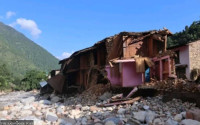
Nearly six years after a devastating landslide swept through the Bhuji river area of Dhorpatan Municipality in Baglung, many families are still waiting for permanent homes, damaged infrastructure remains unrepaired, and authorities have yet to relocate communities living in high-risk areas.
On September 2, 2020, at the height of the Covid-19 pandemic, a massive landslide and flash flood along the Bhuji river devastated wards 7, 8 and 9 of Dhorpatan Municipality. The disaster washed away 126 houses, killed 22 people and left 17 others missing.
Many families who received the first instalment of government housing assistance have been unable to access subsequent payments after failing to meet reconstruction standards. Instead of building earthquake and disaster-resilient houses required under government guidelines, many constructed traditional rural homes, making them ineligible for additional funding.
Local officials said many affected families remain unaware of the government support available to them and the procedures required to access it.
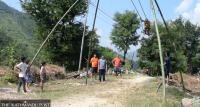
Infrastructure damaged by the disaster also remains incomplete. Nearly 10 kilometres of road linking wards 8 and 9 were destroyed by the landslide. Although basic repair work began only in May-June this year, local residents said the route remains unsafe.
“The river carved its way along the road after the landslide, and it still hasn't been properly secured,” said Yam Bahadur Kayat, principal of Gyanodaya Secondary School. “There has been little concern for building a safe and durable road.”
Construction under the Dhorpatan-Saljhandi road project has also been delayed, adding to local frustration.
Residents fear that even a modest rise in the river level could once again wash away sections of the road.
Senior Soil Conservation Officer Sher Bahadur Shrestha warned that the Bhuji river remains highly vulnerable to future floods and landslides.
He recommended prohibiting settlements within 100 metres on either side of the river.
The concerns extend beyond Dhorpatan.
Last year, floods and landslides struck wards 9 and 10 of Badigad Rural Municipality, killing 11 people in a single day. Many affected families have yet to rebuild their homes and continue to face uncertainty as another monsoon season begins.
Authorities have still not finalised long-term resettlement plans for victims of major disasters in the district.
Tamankhola Rural Municipality had proposed building an integrated settlement for displaced families, but the plan stalled after conflicting with federal forest legislation.
“We wanted to establish a planned settlement because extending roads to scattered villages is far more expensive,” said Rural Municipality Chair Joklal Budha. “But the Forest Act made it difficult to proceed.”
Amar Thapa, chief of the District Coordination Committee, said local governments had failed to educate communities about safe land use.
“We have not succeeded in explaining where people should farm and where they should build their homes,” he said. “Local governments now need to enforce stricter planning.”
He said houses should no longer be built immediately beside rivers, reservoirs or roads, describing the Bhuji river disaster as a stark example of the consequences of poor settlement planning.
The District Disaster Management Committee said increasingly erratic weather driven by climate change has intensified floods and landslides in recent years, but officials argued that poor planning remains a major factor behind the scale of destruction.
“Most of the damage is caused by human activities,” said Chief District Officer Krishna Prasad Acharya, who also chairs the committee. “Unless poorly constructed rural roads are properly managed, rivers will continue changing course and disaster risks will increase.”
He said local governments have been instructed to ensure that engineers incorporate disaster risk reduction and safety measures into infrastructure projects from the planning stage.
Jagannath Acharya, president of the Nepal Red Cross Society's Baglung chapter, said Nepal continues to prioritise disaster response over prevention.
“We only start looking for solutions after disasters strike, and that is the wrong approach,” he said. “The cost of rescue and recovery is hundreds of times higher than the cost of preparing in advance.”
District Administration Office records show that 16 people died and 14 were injured in flood and landslide incidents across Baglung during the last fiscal year.
The office distributed Rs196.7 million in relief to victims of 47 disaster incidents during the same period.
Studies cited by local officials rank Nepal among the world's 20 most disaster-prone countries, with experts identifying human error as the leading factor behind the country's vulnerability.
Data from the past three decades show that floods, landslides and other natural disasters have increased by around 13 percent, while the damage they cause has risen by nearly two-thirds.
According to the National Disaster Risk Reduction and Management Authority, disasters in 2021 alone caused 48 percent more damage than in previous years. On average, around 300 people lose their lives to natural disasters in Nepal every year.




 22.41°C Kathmandu
.jpg)