How Nepal became the developing world’s bridge builder
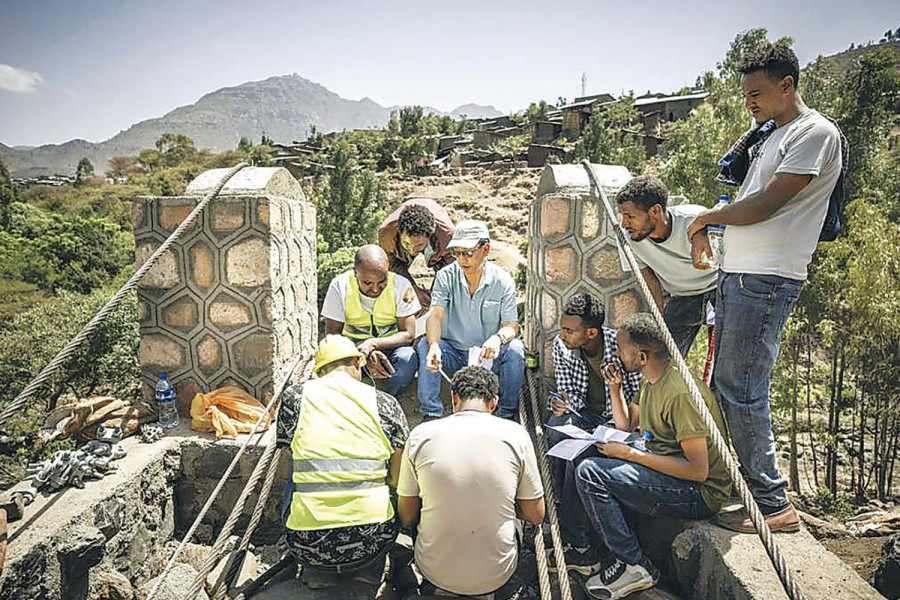
For decades, foreign experts helped Nepal solve its infrastructure problems. Today, Nepali engineers are exporting the fix and connecting communities across Asia, Africa and Central America with a low-cost bridge system perfected in Nepal. A photo of Nepali engineers working with locals in Ethiopia. Photo: Courtesy of Ansu Tumbahangfe
When Padam Gurung was 13, a river stood between him and school.
Growing up in a small village in Sindhupalchok, crossing the river was part of daily life. Then one monsoon, torrential flooding swept away the wooden bridge his community depended on. For the next seven months, there was no safe way across, and school became unreachable.
Eventually, villagers strung a steel cable across the river and attached a wooden box to it. To reach the opposite bank, Gurung had to pull himself hand over hand through the air. “You had to pay to cross each time,” he recalled. “It was very risky, and parents would worry every day that their children would not return home.”
A year later, a suspension bridge was built, replacing the makeshift crossing.
More than four decades later, Gurung’s journey has come full circle. The boy who once struggled to cross a river now spends his time helping other countries build bridges of their own.
Since joining the trail bridge programme run by Helvetas, a Swiss development organisation, in 1996, Gurung has worked on hundreds of suspension bridges across Nepal. He has also taken his expertise abroad, supporting projects in countries including Burundi, Cameroon, and Ethiopia, where he has trained engineers, advised governments, and helped communities overcome the same barriers he once faced as a child.
His story reflects a remarkable, if little-known, shift in Nepal’s place in international development. For decades, foreign engineers travelled to Nepal to help solve problems of rural isolation. Today, Nepali engineers are boarding flights to Ethiopia, Tanzania, and Guatemala to teach other countries how to solve many of those same challenges.
That transformation took institutional form in 2008, when Helvetas established the South-South Cooperation Unit, now known as TRAC4Change. Rather than building bridges for other countries, the initiative set out to help governments build their own by transferring the knowledge, engineering standards and training systems Nepal had developed over decades.
Through TRAC4Change, Nepali engineers have since helped governments in 11 countries, including Bhutan, Ethiopia, Tanzania, Indonesia, Guatemala and Afghanistan, develop their own trail bridge programmes using Nepali engineering, Nepali manuals, and Nepali experience.
“We don’t want to build a bridge and leave,” said Ansu Tumbahangfe, director of TRAC4Change. “We want to capacitate the people.”
Nepal’s ability to export that expertise did not emerge overnight. In the 1960s, the Swiss Agency for Technical Assistance (SATA), working through Helvetas, partnered with Nepal to address the country’s challenges with rural isolation. Across hills and mountains, rivers frequently cut communities off from schools, health facilities, and markets. During the monsoon, crossings became even more dangerous, and entire villages could find themselves isolated for days or even weeks.
Swiss and Nepali engineers found the solution not in Europe but in Nepal itself. They looked to communities in districts such as Baglung who had built rudimentary chain bridges for generations using local materials and traditional knowledge.
“The Swiss and Nepali engineers took this indigenous technology and upgraded it,” said Tumbahangfe.
Unlike conventional bridges, trail bridges could be built without heavy machinery, with materials carried by hand, and with much of the construction completed by local communities.
“The engineering quality is robust, but the design is much simpler,” Tumbahangfe said. “We estimate that it costs at least ten times less than conventionally designed bridges.”
Nepali engineers also moved away from designing every bridge individually. Instead, they developed standardised modular designs that could be adapted to different locations, dramatically reducing both design time and construction costs.
Over time, the programme expanded beyond bridge construction. Engineers developed 16 technical manuals covering surveying, design, construction, maintenance, and quality control, while trail bridge engineering became part of university and technical education across Nepal.
“What we are exporting is not just a bridge,” Tumbahangfe said. “We are exporting a system.”
By the time Helvetas ended its direct support in 2023, more than 11,000 trail bridges had been built across Nepal that handle over one million crossings each day. Studies found that the bridges increased school attendance by 16 percent and antenatal healthcare access by 31 percent.
For Gurung, however, the impact of a bridge has never been measured only in statistics.
Gurung recalls a village in Burundi where residents once paid boat operators to cross the river. When the bridge opened, the entire community gathered to celebrate.
“They started singing,” he recalled. “I asked my interpreter what they were saying. He said they were singing, ‘Take the boat away. The bridge has freed us.’ I felt very proud.”
The celebration reminded Gurung of his own childhood in Sindhupalchok, where parents worried each day whether their children would make it safely across the river.
Through TRAC4Change, Nepali trail bridge experts and engineers like Gurung spend four or five months at a time working alongside local governments, consultants, contractors, and technicians. Training programmes combine classroom teaching, field visits, and on-the-job mentoring. Some courses run for more than a month. Ethiopian officials say that approach distinguishes Nepal’s assistance from more conventional development projects.
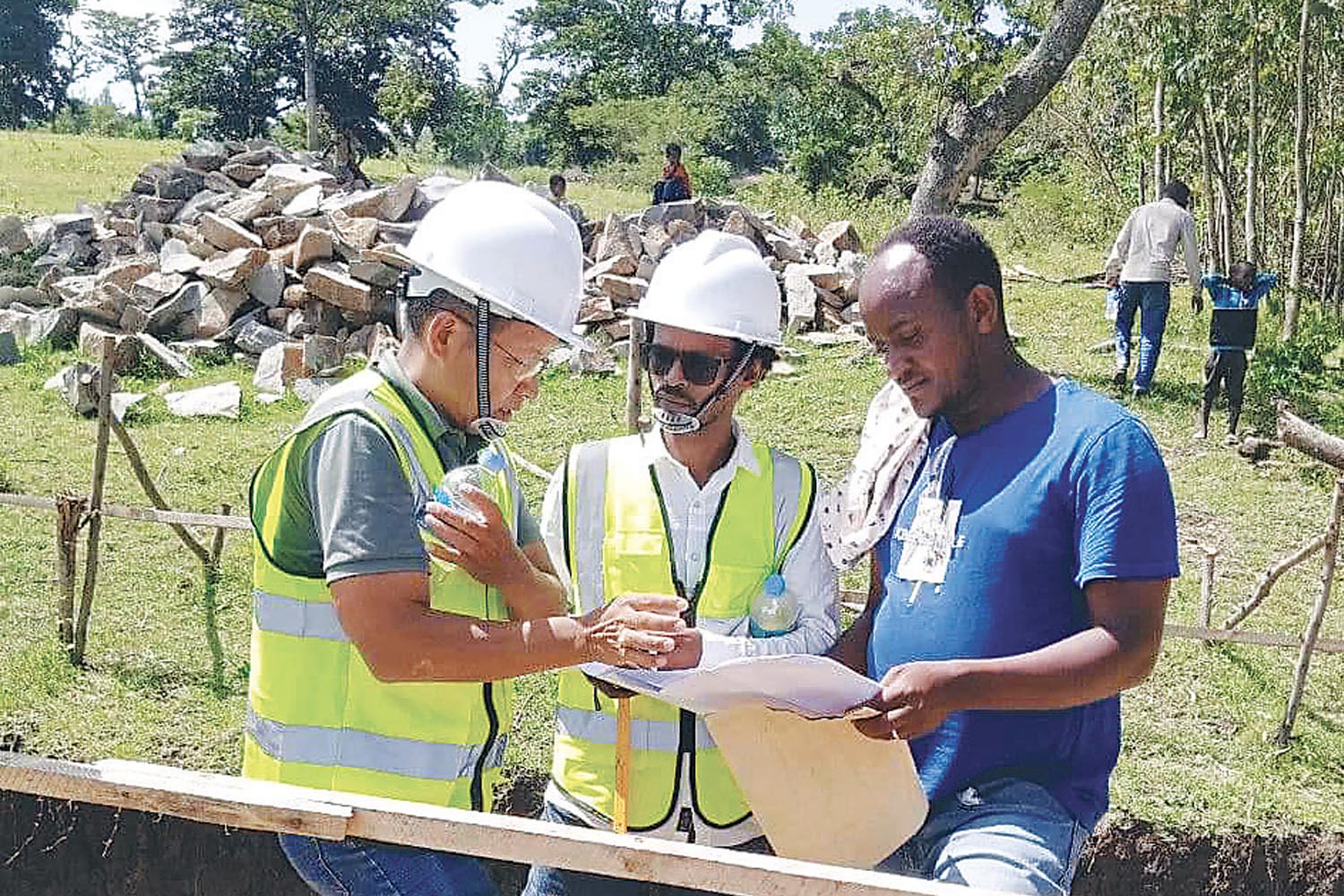
Padam Gurung (left) working in Ethiopia in this recent photo. Through TRAC4Change, Nepali engineers have helped governments in 11 countries, including Bhutan, Ethiopia, Tanzania, Indonesia, Guatemala and Afghanistan, develop their own trail bridge programmes. Photo: Courtesy of Ansu Tumbahangfe
Before adopting Nepal’s trail bridge model, rural communities in Ethiopia faced many of the same challenges Nepal had faced decades earlier. Villages were routinely cut off from schools, health centres and markets whenever rivers swelled during the rainy season. People either risked dangerous crossings or spent hours taking long detours to reach the nearest safe crossing.
Those challenges eventually led Ethiopian officials to an unlikely source of expertise: Nepal.
“There was no awareness or technical skill in designing and building trail bridges,” said Tsehay Tsegaye, Helvetas National Coordinator for Ethiopia.
Instead of adopting an expensive foreign model, Ethiopian officials found an answer in a country that had once faced similar dire constraints.
“Nepal’s model was simple, modular and affordable,” Tsegaye said. “The design could be modified depending on the site, and construction methods were straightforward.”
Ethiopia’s mountainous terrain, intersected by rivers and deep valleys, presented many of the same geographical challenges as Nepal. “Given Ethiopia’s financial constraints,” Tsegaye said, “the trail bridge implementation was an ideal solution to the country’s rural isolation.”
Today, 272 trail bridges have been built across Ethiopia with Nepali support. More importantly, Ethiopian engineers no longer rely on Nepali experts to design every project.
“The programme has enabled Ethiopian engineers to select sites, design and construct trail bridges independently,” Tsegaye said. Engineers in Ethiopia are now capable of building steel trusses and suspension bridges spanning up to 120 metres without outside support.
“This self-reliance is one of the programme’s greatest achievements,” she said.
The programme has now entered a new phase. Backed by financing from the World Bank, Ethiopia plans to construct another 600 trail bridges over the next three years using the system Nepal helped establish.
“For us, this is a success,” Tumbahangfe said. “Nepal took around 40 years to institutionalise the system. Ethiopia is doing it in 20.”
The strongest sign of Nepal’s success may be that its role is gradually shrinking. Where four Nepali bridge experts once worked in Ethiopia, only two remain today. Local engineers increasingly manage projects independently. “That is what we want,” Tumbahangfe said. “Soon our support will not be needed.”
Exporting the model has also required flexibility. In Indonesia, engineers discovered that local soil conditions differed significantly from those in Nepal, requiring bridge foundations to be redesigned. In Ethiopia, the community-based construction model that proved successful in Nepal was less effective. Rather than relying primarily on local labour, projects shifted towards contractor-led implementation. “Everything needs to be adapted to the local context,” Tumbahangfe said.
Earlier this year, Tanzanian officials travelled to Nepal to study the trail bridge programme firsthand. They journeyed from Kathmandu to Pokhara, crossing bridge after bridge along the way.
For many of them, it was the first time they had seen an entire national bridge network built around a standardised low-cost system. By the end of the visit, several officials pledged to champion trail bridge construction within their ministries.
For Tumbahangfe, reactions like these reveal a long-held misunderstanding about Nepal. Many still think of Nepal primarily as a recipient of aid rather than a source of development expertise.
That perception has begun to change in Ethiopia. “Nepal is often seen as a recipient of aid,” Tsegaye said. “But in this case, it became a provider of expertise.” Ethiopian officials and engineers now view Nepal as a peer and a source of practical solutions, she said, strengthening mutual respect between the two countries.
Part of the challenge is visibility. Roads, airports, and large-scale infrastructure projects attract headlines and donor attention. Trail bridges are smaller. A typical 60-metre bridge costs between $80,000 and $100,000, modest by infrastructure standards.
Yet their impact can be enormous. TRAC4Change estimates that roughly one billion people worldwide still lack reliable access because rivers, ravines, and difficult terrain separate them from roads and services. For many of those communities, a simple bridge could change everything.
The programme is now exploring expansion into Bangladesh and seeking opportunities in Vietnam and Laos while continuing work in Tanzania, Ethiopia, and Afghanistan.
For Gurung, however, the significance of the programme still comes down to one childhood memory, that of a river. He remembers standing on one bank and watching opportunities disappear on the other. Today, he helps ensure others do not face the same barriers.
A country once known primarily as a recipient of development assistance is now exporting solutions of its own. And thousands of kilometres from Sindhupalchok, children are crossing rivers safely because of ideas first tested in Nepal’s mountains.




 20.73°C Kathmandu