Presidential Innovista 2.0 showcases more than 55 student tech projects
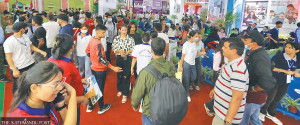
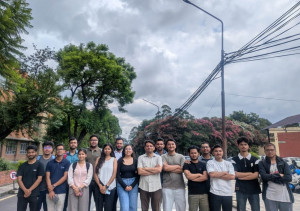
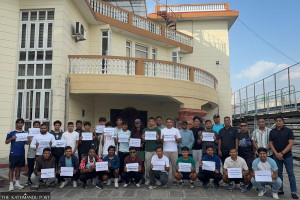
More than 170 students presented innovations in AI, robotics, cybersecurity and software development at the two-day exhibition, which drew about 4,000 visitors. Handout photo
More than 170 students showcased over 55 technology projects at Presidential Graduate School's two-day innovation exhibition, highlighting applications of artificial intelligence, robotics, cybersecurity, software development and digital innovation.
The event, titled “Presidential Innovista 2.0, 2026”, was organised by Presidential Graduate School, which is affiliated with Westcliff University in the United States. Held on June 25 and 26, the technology and business carnival attracted around 4,000 visitors, according to the organisers.
The exhibition featured projects spanning computer vision and artificial intelligence, Internet of Things (IoT) and robotics, cybersecurity, software development and technology-driven business solutions.
Laxman KC, founder and chairman of Presidential Graduate School, said the event was designed to bridge classroom learning with real-world applications.
“Presidential Innovista 2.0 is more than an exhibition. It is a platform that connects students' ideas, skills and potential with the market,” KC said. “Our goal is to demonstrate that students can apply what they learn in the classroom to solve real-world problems.”
He said the institution plans to expand the event in the coming years with the aim of contributing to a stronger innovation ecosystem in Nepal.
The exhibition was attended by business leaders, entrepreneurs, technology professionals and other visitors. Among them were Saurabh Jyoti, chairman of Padma Jyoti Group; Anand Bagaria, managing director of Nimbus Nepal; footballer Upendra Man Singh; Ideapreneur Nepal founder Pradip Maharjan; and entrepreneur and artist Sanjog Koirala.
Among the featured projects were an FPV drone designed for aerial flower showers, football-playing robots, a dancing robot that moves in sync with music, and an AI-powered emotion detection system capable of analysing facial expressions to recommend music.
Students also demonstrated cybersecurity projects focused on combating online fraud, preventing data breaches and improving bank account security.
Other exhibits included a smart irrigation system, a smart home solution equipped with automatic gas leak detection and shut-off mechanisms, tourism promotion software, and a remotely controlled vehicle fitted with a 360-degree camera.
According to the organisers, the projects illustrated how emerging technologies can be applied to practical challenges in agriculture, public safety, tourism, business and everyday life.
KC said the projects were developed from scratch by students and were intended not only as academic demonstrations but also as commercially viable innovations.
“Our objective is to show that innovation of this scale is possible in Nepal,” he said. “The next step is to connect these projects with industry, investors and the market.”
He added that promising ideas would receive support through the school's Business Incubation Centre, where students studying information technology and business would work together to prepare projects for commercialisation, investment and startup development.
Kalpana Gurung, director and principal of Presidential Graduate School, said the institution plans to organise the event annually.
“We will continue holding this event every year,” Gurung said. “By bringing together industry leaders and investors, we want to create pathways for students to access employment opportunities and build startups.”




 20.98°C Kathmandu