25 years on, Shuklaphanta displaced still await resettlement
Hundreds of families uprooted by park’s expansion decades ago remain in limbo, living under plastic shelters as another monsoon arrives. Post File Photo
Every time the monsoon arrives, Krishna Singh Bista braces for another sleepless night.
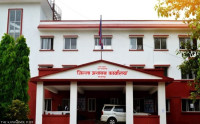
Rainwater seeps through the plastic roof of the makeshift shelter where the 56-year-old has lived for the past six months on government land outside the Division Forest Office in Mahendranagar. It soaks his bedding, clothes, and the few belongings he owns.
“There are days when we go to bed hungry because the firewood is too wet to light,” Bista said. “On one side, there’s the fear of snakes. On the other hand, rainwater pours through the roof. Everything gets soaked. You can’t even sleep.”
Bista is among hundreds of families displaced more than two decades ago when the former Shuklaphanta Wildlife Reserve, now Shuklaphanta National Park, expanded its boundaries.
Twenty-five years later, they are still waiting for the government to fulfil repeated promises to resettle them.
While his family now lives as sharecroppers in Daiji, Bedkot Municipality, Bista has stayed behind in Mahendranagar, hoping his presence at the protest site might finally spur the government into action.
“My father died waiting to be resettled. Now I have grown old waiting too,” he said. “Soon it will be my sons’ turn. Three generations of our family have lived in displacement, but every government has ignored us.”
Across the roadside encampment, rows of temporary shelters made from bamboo poles and plastic sheets line a patch of public land.
Inside, there are little more than wooden beds and thin mattresses.
Dura Devi Mahara, another resident displaced from Tarapur village, has also spent the past six months living beneath a tarp roof.
“When it rains, water comes in from every direction,” she said. “If I try to protect the pillow, my feet get wet. If I cover my feet, water drips onto my head. Sometimes snakes crawl into the shelter too. How are we supposed to live like this?”
Like many others, Mahara survives on daily wage labour. But the rains have brought construction work to a halt.
“Now we don’t even have food,” she said. “There’s no firewood, no rice, no way to cook in all this mud. Everything we own is soaked.“
Dilram Dagaura, displaced from Bhatpuri, says little has changed despite decades of campaigning.
“For 25 years we’ve demanded resettlement,” he said. “Nobody has listened, and I don’t think anyone is listening now.”
Before the park expanded, Dagaura owned five bigha (3.39 hectares) of farmland, enough to feed his family of nine.
Today, his family survives through sharecropping in Jhalari while he remains at the protest camp.
“We’re living with the constant risk of snake bite and living through this rain because we still hope someone will finally arrange our resettlement,” he said. “We’ve been here for months. Even food is running out.”
More than 300 displaced people have erected makeshift shelters on land belonging to the government’s herbal research office opposite the Division Forest Office.
They have been living there since mid-January after staging protests outside the District Administration Office demanding action.
“It was manageable during winter,” said Hikmat Chaudhary, who was displaced from Hirapur in 2001. “But now, during the monsoon, we have nowhere to cook, nowhere dry to sleep. Who is supposed to see our suffering?”
When heavy rain floods the shelters, many families move into an abandoned government building and a nearby Dalit hostel for temporary refuge.
“If the rain becomes too heavy, all of us squeeze into those old buildings,” Bista said. “When water fills the shelters, there’s simply nowhere else to go.”
When heavy rain floods the shelters, many families move into an abandoned government building and a nearby Dalit hostel for temporary refuge.
“If the rain becomes too heavy, all of us squeeze into those old buildings,” Bista said. “When water fills the shelters, there’s simply nowhere else to go.”
According to the protesters, almost every major political leader, including sitting members of federal parliament, has visited the camp over the past six months.
“They all promise that resettlement is coming,” Bista said. “We hoped this government would finally do something, but even that hope is fading. Nothing has moved forward.”
The displaced families continue to organise demonstrations to keep pressure on the authorities.
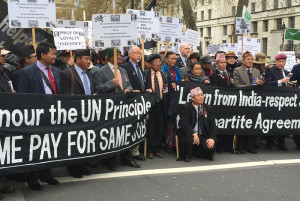
On Monday, they marched through Mahendranagar before converging outside the District Administration Office. Similar sit-ins and protests have been held repeatedly over the years.
The dispute dates back nearly five decades.
The government declared the former Royal Hunting Reserve the Shuklaphanta Wildlife Reserve in 1976 and began expanding its eastern boundary. By 2001, settlements inside the expanded conservation area had been cleared.
The reserve’s area grew from 150 square kilometres to 305 square kilometres, and in 2017 it was upgraded to Shuklaphanta National Park.
Families displaced during the earlier phases of expansion were resettled elsewhere.
Those removed in 2001 are still waiting.
Since 1980, successive governments have formed 32 commissions and task forces to resolve the issue.
Most were given mandates lasting between three months and a year but none has been able to establish even the exact number of families still awaiting resettlement.
Some commissions estimated 2,473 displaced families, while others reported significantly fewer.
The most recent commission, headed by former appellate court judge Jayananda Paneru, submitted its report on January 10, 2025. It identified 2,027 families eligible for resettlement.
An earlier commission led by former appellate court judge Thakur Prasad Sharmahad concluded in 2014 that only 1,480 families remained to be resettled.
Two commissions formed since then have relied on the numbers established by Sharma. The Surendra Bam-led commission recommended giving 10 kattha of land (one kattha equals 0.03386 hectare) or Rs 6 million per family to the displaced families verified by Sharma’s commission.
Paneru’s commission proposed a different approach.
It recommended providing Rs1 millionto families still living inside national park or adjoining forest areas before relocating them. Families already living outside forest areas would receive Rs700,000, while those who had been issued land ownership certificates but had never been able to use their land would receive Rs500,000.
Successive commissions and task forces have overseen the resettlement of roughly 5,200families, distributing more than 4,042 bighas of land across several locations in Kanchanpur district, including Bagphanta, Piparaiya, Dhakka, Laxmipur, Simalphanta and Sundarpur.
For the families still living beneath leaking tarpaulins in Mahendranagar, however, those figures offer little comfort.
They say they have spent a quarter of a century listening to promises.
Another monsoon has come, but a permanent home has not.




 15.76°C Kathmandu