Tea exports to India to ease as it softens quality inspection rules
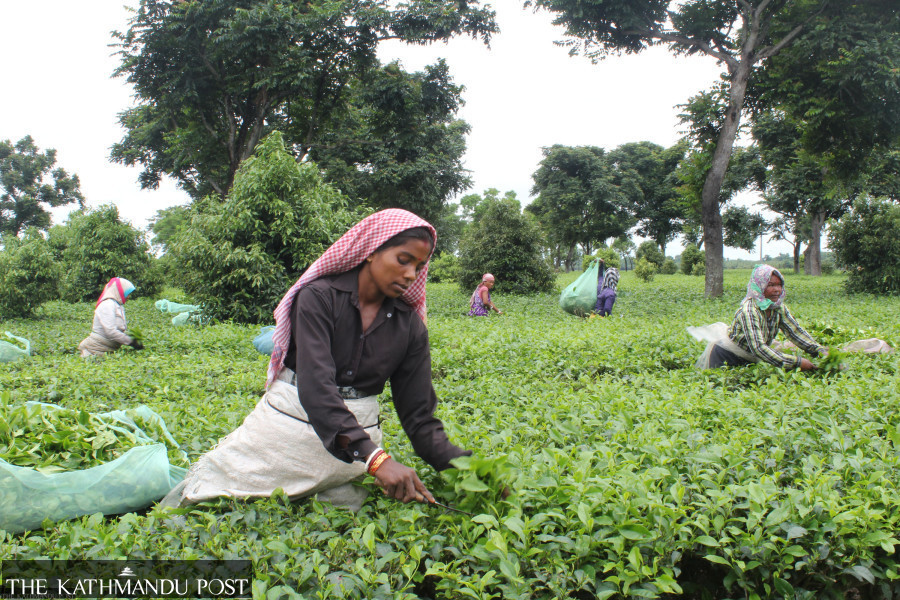
Producers say repeated trade disruptions leave them unconvinced the latest decision will ensure smooth exports. Nepal produces more than 27,000 tonnes of tea—around 8,000 tonnes of orthodox tea and 19,000 tonnes of crush-tear-curl (CTC) tea—annually. Post File Photo
India has eased barriers to tea exports from Nepal with immediate effect.
According to an official communication dated June 23 from the Food Safety and Standards Authority of India (FSSAI), obtained by the Post, the authority has approved a revised inspection regime for imported tea (HSN 0902). The decision was made following a meeting chaired by India's commerce secretary on June 16.
As per the circular, the FSSAI has decided to adopt a risk-based testing system for tea imported into India for domestic consumption. With the new decision, India has introduced risk-based testing of imported tea under HSN 0902, with 20 percent of consignments selected randomly for inspection. It applies immediately at all Indian entry points, including those without permanent FSSAI personnel.
“Only around one in five consignments will normally be intercepted for testing. The remaining consignments may receive faster food-safety clearance, subject to the usual customs and documentation requirements,” said a senior government official interpreting the latest Indian circular. This could reduce border delays, storage charges and uncertainty for Nepali exporters.
Starting in mid-June, India required every consignment of tea imported from Nepal to undergo mandatory quality testing. The decision made 53 factories in Ilam and 30 in Jhapa to cease production fully or partially. The Nepal government had been talking about seeking a diplomatic solution with India to resolve the export bottleneck.
The latest decision by the FSSAI comes as a major relief for Nepali tea exporters, following diplomatic efforts by the government and the formation of a task force to address the crisis.
According to officials, the Indian decision will allow faster customs clearance for most tea consignments, reduce testing costs and delays by limiting inspections to a fraction of shipments, and ensure continued access to the Indian market for exporters complying with FSSAI standards. However, the random selection of about one in five consignments for quality testing could still lead to delays.
“This circular marks a shift from blanket testing to a targeted, risk-based inspection regime. It removes a major hurdle for Nepali exporters,” a senior foreign ministry official said. “Under a rule introduced in February, every tea consignment would have been subject to quality testing. Testing only about one in five shipments is expected to significantly ease the challenges before Nepali tea exporters.”
However, some Nepali exporters doubt the durability of the latest relaxation. Many remain unconvinced that cross-border tea trade will continue smoothly in the long run.
Tea producers say frequent changing of rules by India on imports caused the crisis for Nepali entrepreneurs. While welcoming the latest relaxation, they remain unconvinced that it offers a lasting solution. They have urged the government to maintain diplomatic engagement with New Delhi to ensure uninterrupted access to Nepal's largest export market.
“The obstruction created by India has been repetitive, which is why we are not fully assured or confident of what happens next,” said Aditya Parajuli, president of the Nepal Tea Producers Association.
Nepal produces more than 27,000 tonnes of tea—around 8,000 tonnes of orthodox tea and 19,000 tonnes of crush-tear-curl (CTC) tea—annually.
Parajuli said the issue now is for the governments of Nepal and India to settle. According to the association, tea exports to India will resume from Monday.
Around 1,500 tonnes of Nepali tea remains stranded in warehouses in Nepal, while another 300 tonnes is stuck in India. Parajuli said laboratory test reports for the consignments held in Indian warehouses are expected soon. Once the reports are received, Indian buyers are expected to take delivery of the tea.
Anil Giri is a Chief Sub Editor covering diplomacy, international relations and national politics for The Kathmandu Post. Giri has been working as a journalist for more than two decades, contributing to numerous national and international media outlets.
Krishana Prasain is a business reporter for The Kathmandu Post covering markets. Before joining The Kathmandu Post in 2018, she spent 3 years in New Business Age magazine covering business.




 12.97°C Kathmandu