Nepali families paid millions to send their sons to US. They ended up in jail
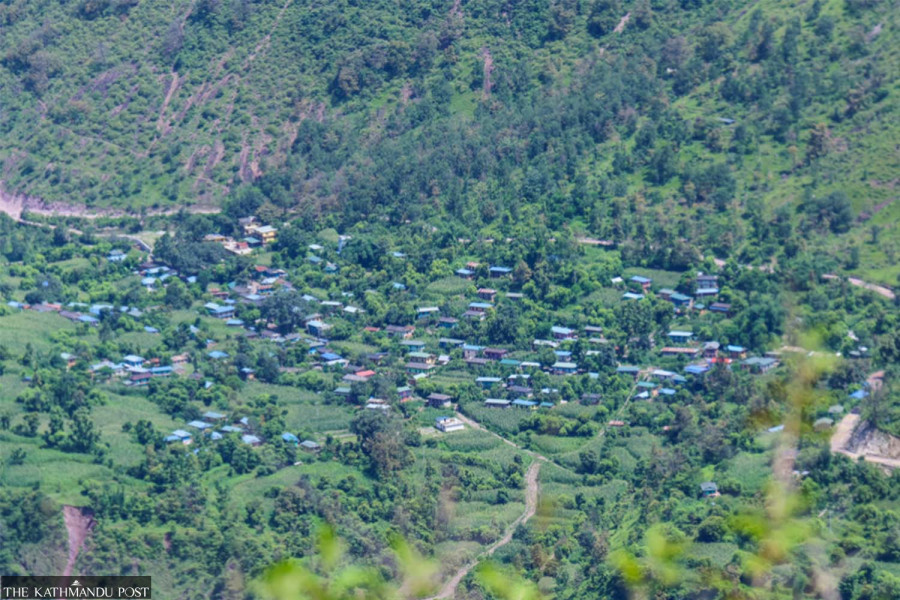
In Rukum East, families are still paying the price for perilous journeys to the United States, with young men stranded in detention and parents buried under crushing debt.A view of Pokhara village in ward 3 of Sisne Rural Municipality, Rukum East, where many families have stories of migration to the United States. Mahesh KC/TKP
Rain falls steadily outside the small mud house in Rukum East, cooling the air and casting a subdued mood over the village. Water drips from the roof. From the kitchen, a thin trail of smoke rises into the rainy sky.
Inside, a middle-aged couple sits close to the fire.
“Namaste. How are you?”
It is an ordinary exchange, the kind that begins countless conversations in rural Nepal. But before long, the talk turns to their son, the journey that took him halfway around the world and the debt that journey has left behind.
The father nudges a log deeper into the fire. Sparks flicker. He speaks slowly, sometimes looking into the flames, sometimes at his wife. At times, neither says anything.
There is a lot in that silence.
Outside, the rain keeps falling. Inside, the fire throws a faint light across the room as the couple recounts what happened to their son. Smoke stings their eyes, but they remain warm and welcoming.
“Where is your son?”
“America.”
“America?”
“Yes. He’s in jail there.”
“In jail? What happened?”
“Bad luck,” the father says. “We spent nearly Rs10 million, and our son ended up in jail.”
Sabin (not his real name), from ward 3 of Sisne Rural Municipality in Rukum East, has spent the past 19 months in a US jail.
This is how the conversation with his parents begins.
The couple does not want their names, or their son’s, published.
“If everything we tell you comes out in the news, they say it could cause more trouble for our son,” his father says.
As the couple talks, a story emerges of a young man who left Nepal in search of work, a journey that took him through several countries, and a family that borrowed millions of rupees to make it happen. Their son reached the United States. But instead of the new life they had imagined, he ended up behind bars.
xxxxx
Sabin had just turned 18 when he left Nepal for the United States.
An agent told his father that a young man that age could not travel alone and that he would have to accompany his son as far as Dubai. The two flew from Kathmandu to Dubai on visit visas. There, the father handed his son over to the agent and returned home.
Sabin remained in Dubai for 14 months, his father says. The family kept pressing the agent to move things forward, and eventually the journey resumed.
“After that, he was taken through Brazil and several other countries. It took another four months,” his father says. “Then, on January 6, 2025, we got the news that he had reached America.”
Soon after arriving, Sabin called his father.
“Dad, I’ve reached America. The police have arrested me here. They might put me in jail. Don’t worry. I’ll call you myself soon.”
Nearly three months passed before he called again.
“I’m in jail.”
Sabin is among a growing number of young Nepalis who have risked long and dangerous journeys to the United States after being promised work and a better life.
Many are taken through irregular routes spanning several countries, often after their families pay agents enormous sums of money. The journeys can take months and expose migrants to considerable risks.
Sabin made it to the United States. He was arrested soon after arriving and placed in jail.
At first, his parents took some comfort from knowing that he had reached his destination. They had spent months worrying about the journey. Now, at least, their son was in America.
But that relief did not last.
His detention and the uncertainty surrounding his legal case have left his family struggling with two burdens at once: worrying about their son and repaying the enormous debt they incurred to send him there.
The promise sold by the agents and the reality that followed have pushed the family into a crisis.
Sabin’s story is one example of how the dream of reaching the United States can turn into years of uncertainty, detention and debt.
xxxxx
Sabin had recently passed Grade 12 when he decided to leave Nepal. His Dubai visa arrived before he had even received his school certificate.
He had hoped to earn well in the United States and help his family overcome its financial difficulties.
Instead, the son who left home looking for work is now in a US jail, while his parents struggle to repay the money they borrowed to get him there.
His mother sits by the fire, cooking as she speaks.
“It feels as though we paid money to send our son to jail,” she says. “And he’s in a place where we can’t see him or meet him. He was studying. We were poor, but he wasn’t under any pressure. There was no need for him to get caught up in this America business.”
She pauses.
“Now we worry about our son on one side and deal with the people we owe money to on the other.”
The agent alone charged the family Rs8.5 million to get Sabin to the United States, his father says.
The family spent another Rs500,000 for the father’s trip to Dubai with his son, in addition to other travel and related costs. Their total debt has now reached about Rs13.5 million.
For the first few months after Sabin was jailed, the family heard from him by phone every few weeks. For the past six months, they say, they have been able to speak with him by video call.
“He calls every Monday,” his mother says. “He tells us he’s fine and that he’ll be out soon. But we have no idea when that will actually happen.”
The family was told six months ago that Sabin would have a final court hearing to determine whether he could remain in the United States or be sent back to Nepal.
“It’s been six months since they told us about the final hearing,” his mother says. “We still don’t know when it will happen, or what the court will decide.”
Sabin’s father says his son is trying to build a case that he could not safely remain in Nepal because of the effects of the Maoist conflict and should therefore be allowed to stay and work in the United States.
“Looks like you need a broker and money to get anything done, wherever you are,” he says. “We’ve even found someone from our own village over there who is helping us deal with the case.”
Through that intermediary, the family has arranged for a lawyer and sent money for Sabin’s needs in jail.
“We sent Rs1 million four months after he reached America as an initial payment to the lawyer. Since then, we’ve been sending him about $40 to $45 a month for his day-to-day needs.”
The family has also been gathering documents in Nepal and sending them to the United States in the hope they will help with Sabin’s case.
His father has travelled to Kathmandu twice to arrange them.
“We had to provide his birth certificate, citizenship certificate and other documents mentioned in the case, as well as hospital records showing that he had received treatment,” he says.
“Getting his birth certificate and citizenship certificate wasn’t a problem. But we found out that there are people here who can arrange the other documents for a fee. So I went to Kathmandu, had them prepared through those people and sent them to America. Now all we can do is wait and see what the court decides.”
xxxx
The last time Sabin’s parents spoke to him was last Monday, they say.
Asked what their son has told them about life in jail, his mother chooses her words carefully.
“We’ve heard from others that life in an American jail is very hard. But he always tells us he’s fine. Maybe he says that because he doesn’t want us to worry.”
“We’re doing everything we can,” she says. “He’s doing what he can from there. Now, the rest is in God’s hands.”
His father says even speaking to their son is difficult.
“We can’t call him. He has to call us, and we just answer. He says they don’t allow long conversations. There is one phone for the whole jail, and they have to take turns using it.”
Still, the weekly calls have become a small source of comfort.
“At least once a week, we get to see him and speak to him, even if it’s from far away. That gives us some relief.”
xxxxx
In this village in Rukum East, stories about America are everywhere. Nearly every household, the residents say, has a story of its own, some hopeful, others painful.
Another young man from Pokhara has been in a California jail alongside Sabin.
His family, too, did not want their names or their son’s full identity disclosed. But they agreed to recount what happened.
Aashish (not his real name), now 30, used to run a grocery shop in Dang before leaving for the United States.
The shop provided enough to cover his everyday expenses and support his family. He was getting by.
Then he, too, was drawn into the promise of reaching America.
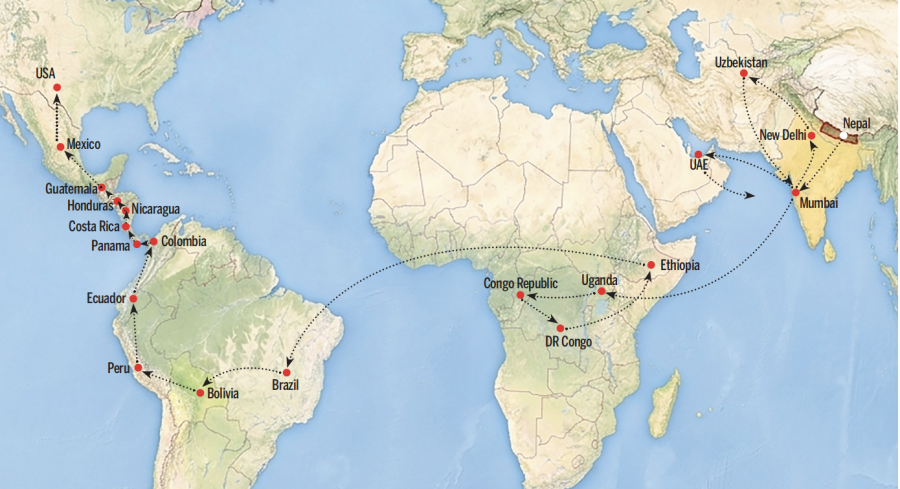
A map showing a typical route used by human traffickers to take Nepalis illegally to the United States. The route varies depending on the journey.
His life has since been turned upside down.
His family says he has spent 19 months in a US jail.
Aashish left home shortly after Tihar in 2021 after an agent promised to take him to America.
His mother says the journey took him through several countries before he was eventually sent back to Nepal.
“He left after Tihar in 2021. The agent took him from one country to another, and after all that, he finally came back home in December 2024,” she says. “The first agent took Rs1.5 million from us but never got him to America. Then another agent took over and eventually got him there.”
The second agent initially promised to get Aashish to America for Rs5.5 million. Later, he demanded another Rs1.5 million.
The agents eventually took Rs8.5 million in total, his mother says.
The family has since spent more than Rs10 million on other travel costs, a lawyer in the United States, his expenses there and documents related to his case.
So far, she says, they have little to show for the money.
“We are in debt here, and our son is in jail over there.”
Sabin and Aashish reached the United States in January 2025 and eventually ended up in the same California jail.
Aashish was initially held elsewhere for four months before being transferred to the jail where Sabin was being held.
The two young men, who had travelled to America through different stages of the same perilous migration system, eventually found themselves behind bars together.
Their families have been left facing remarkably similar struggles.
Aashish also speaks with his family once a week.
But there has been little progress in his case.
“We had imagined so many things. Look what happened instead,” his mother says with a sigh. “Even if our son comes home now, how will we repay all this debt? If he returns, we’ll be left with nothing.”
Both families have mortgaged their property to secure bank loans. When that was not enough, they borrowed from relatives, neighbours and other lenders at high interest rates.
Without a regular source of income, they struggle to keep up with their bank instalments. Meanwhile, interest on other loans continues to pile up.
“People who lent us money come asking for it,” Sabin’s father says quietly. “But we don’t have the money to give them. Now we don’t even know what to tell them.”
He looks towards the fire.
“What kind of crisis has fallen on us? Here, the lenders are after us. Over there, the American police have our son.”
xxxx
For more than a decade, human traffickers and migration agents have been making their way into villages and neighbourhoods across Rukum, promising young people a route to the United States through what is commonly known as the “donkey route”, an irregular journey through multiple countries.
At first, agents charged around Rs800,000 to Rs1 million per person. Now, families say, the price of reaching the United States through such routes can approach Rs10 million.
The flow of young people attempting the journey has slowed since the United States tightened its immigration policies. But the consequences of the earlier rush are still being felt in villages like this one.
For many who poured huge sums of money into the journey, the outcome has been anything but the life they were promised.
Some disappeared along the way. Some died. Some reached the United States only to spend years in detention. Others eventually returned home empty-handed after years in jail.
The government and agencies responsible for tackling human trafficking and irregular migration are aware of the problem. Yet for families like these, little appears to have changed.
Why does this continue?
Why are those who arrange the illegal movement of Nepalis to third countries not being brought to justice?
The police have a simple answer.
“No victim has filed a complaint. On what basis, and against whom, are we supposed to take action?”




 14.79°C Kathmandu