Three Rukum West men disappeared from Libya on a US journey two years ago. Families still await their return
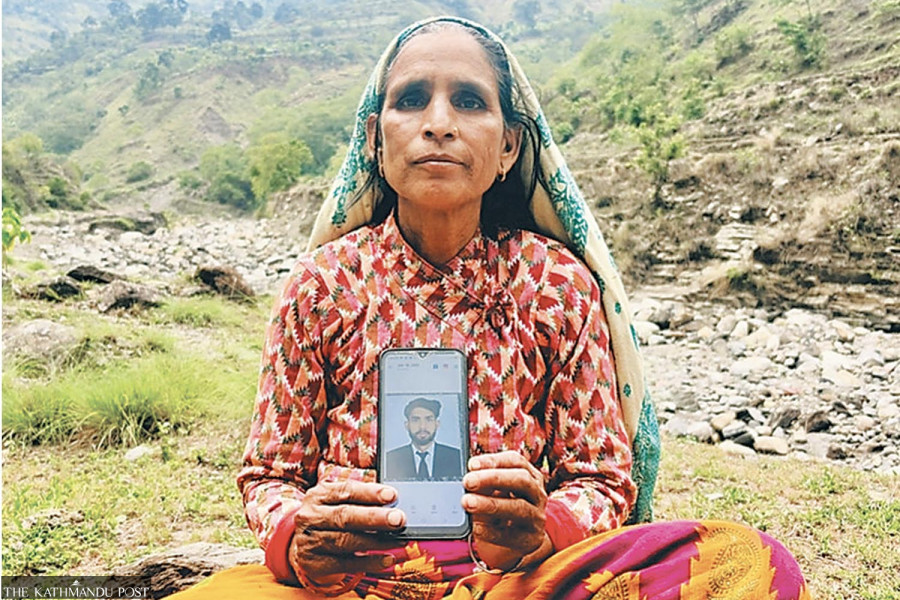
Families trapped between hope, grief and mounting debt as young members lost on the ‘donkey route’.Bhadra Kumari Khatri holds an image of her son Dipak KC on her mobile phone in Aathbiskot Municipality-7, Rukum West. Mahesh KC/TKP
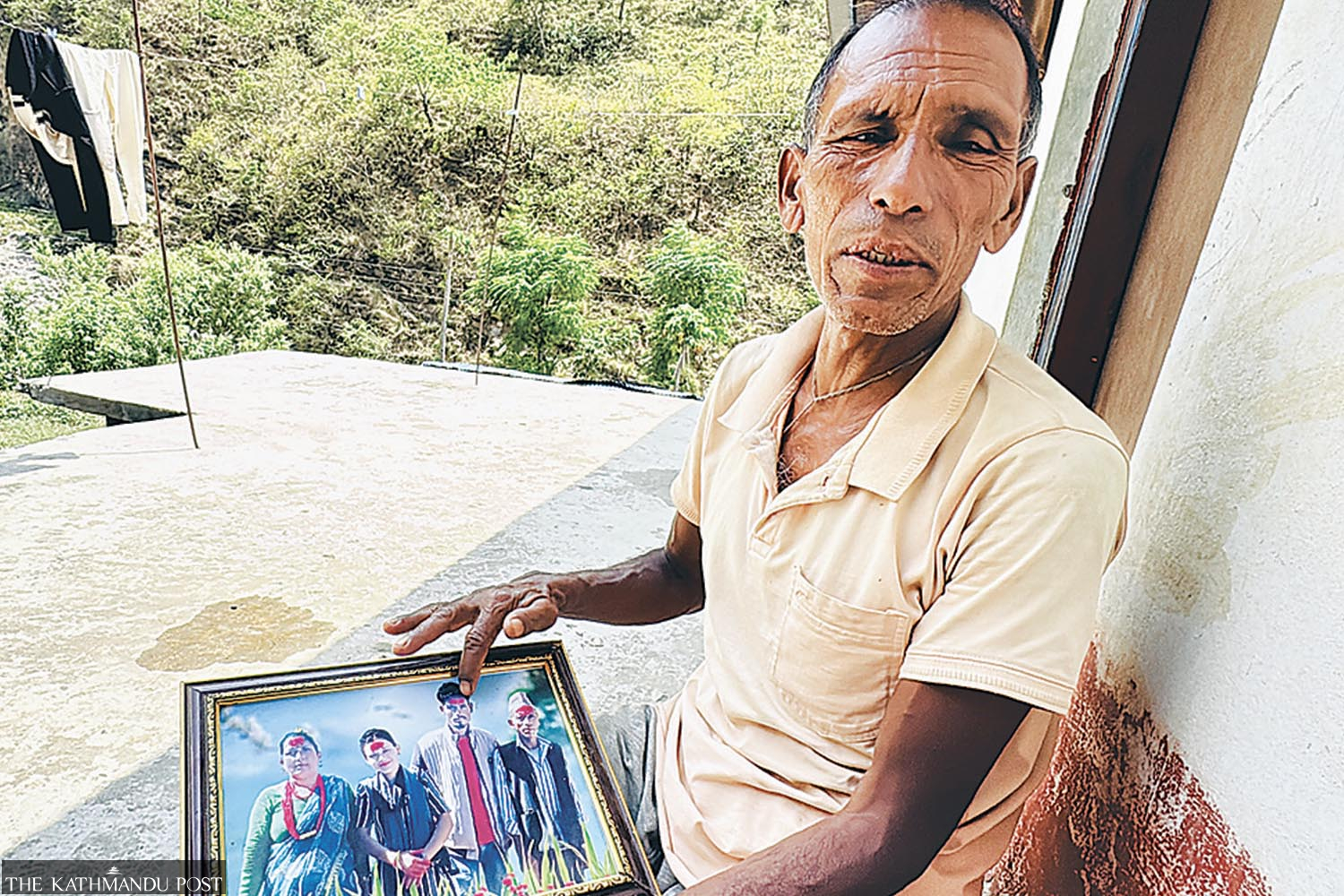
On the wall of a small bedroom in Khaṛkhara village of Aathbiskot Municipality-7 in Nepal’s Rukum West district hangs a photograph from Dashain, the country’s biggest Hindu festival.
It shows an entire family smiling. Everyone in the frame looks happy, in a moment from a time before their lives changed forever.
Parimal Khatri carefully took the photograph down from the wall. He stared at it for a while. Then, tears welling up in his eyes, he touched one of the faces in the picture.
“This is my son. He has been missing for two years,” he murmured. “We were together at the Dashain of October 2024. After that, he left home, saying he was going to America. Then he disappeared. We don’t know where he went.”
He could not finish what he was saying; his voice failed him. The room fell silent.
After struggling to hold back tears, Parimal began to speak about the pain he had suppressed for two years.
“I have two sons. Dipak is the elder one. He was 29,” he said. “The younger one is still at home.”
Dipak KC had been trying to go to America for four years. For the first two years, he kept travelling to places and coming back. “When he came home in April-May 2024, he stayed for around 10 days. After he left, we lost contact with him on June 22, 2024.”
Dipak is not the only young man from Aathbiskot who vanished while attempting to reach the United States through the illegal “donkey route”, a term referring specifically to the highly dangerous, illegal migration routes used to smuggle people into the United States.
Two other young men from the municipality, 19-year-old Gopal KC from Aul in Aathbiskot-7 and 21-year-old Pahal KC from Radi in Aathbiskot-9, have also been missing for two years.
Their families now share the same nightmare: the unbearable pain of not knowing whether their sons are alive, and the crushing debt left behind after paying millions of rupees to agents who promised to take them to the United States.
Family members say all three men last contacted them from Libya two years ago. Since then, there has been no news about them.
According to Parimal, an agent lured Dipak to Kathmandu in April-May 2022, promising to send him to America.
After a few days in Kathmandu, Dipak was taken to Dubai. But he was eventually sent back to Nepal.
That was the beginning of what his family describes as a long and traumatic journey under the control of human traffickers.
He was taken from one country to another, spending time in Indian cities and cramped rooms in the UAE. The promise remained the same: America was within reach.
For years, Dipak’s journey was caught in a cycle of uncertainty, fear and repeated assurances from traffickers.
“He used to tell us they had taken him somewhere new every time. One day it was one place, another day somewhere else. We have forgotten many details now,” Parimal said. “Whatever happened, he returned home three times during those first two years.”
Dipak’s mother, Gami Khatri, still remembers their final video call two years ago.
“It was around 2pm on June 22, 2024,” she said. “He told me, ‘Mother, I am in a place called Libya. They say they will take us to Greece from here. I will talk to you after reaching there. Don’t worry about me.’”
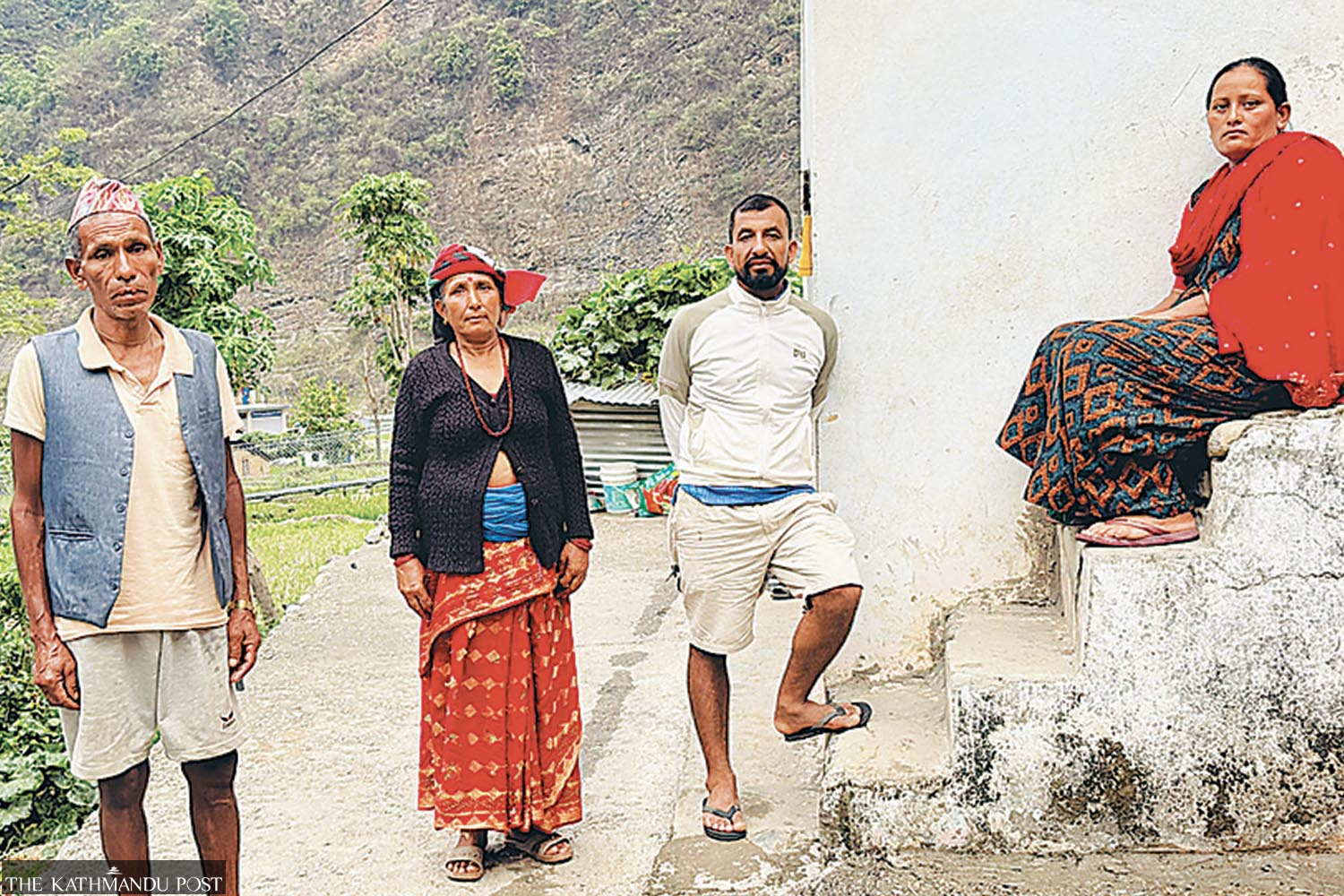
Parents and relatives of Dipak KC, one of the three Rukum West youths lost on their journey to the United States in their village. Mahesh KC/TKP
She paused.
“Where could that poor boy have gone? How could he not return for so long?”
Another moment from that final call remains vivid in Parimal’s memory.
“He told us, ‘The police are coming around us. If I keep talking, they will catch us. I will call after we cross this checkpoint,’” Parimal recalled.
“We told him to end the call. A Black man was standing beside him. He was smiling and moving his body. My son made some gestures, and his face looked expressionless. Then he ended the call. Two years have passed since. We have no idea where he went or what happened to him.”
Dipak’s family includes his 55-year-old mother, his wife, two sons, father, younger brother and sister-in-law. His sisters are married.
In their attempt to send him to America, the family has spent more than Rs12 million.
According to Dipak’s sister Bimala Oli, the family paid Rs8.2 million to agents at different stages of the journey. They spent another Rs3.1 million on travel between countries, Rs600,000 searching for him, and still owe Rs300,000 for his stay in Kathmandu.
The total cost has reached Rs12.2 million.
Dipak had completed grade 12 and worked in Malaysia for three years before returning home. He initially planned to build a life in Nepal.
But the pressure to migrate was strong.
People around him, including friends and neighbours, were reaching the US through the same route, and his sister Bimala eventually encouraged him.
“Go, dear. We are with you. We will support you,” she had told him.
Today, those words haunt her.
“He was earning Rs50,000 to Rs60,000 a month in Malaysia. The agent told us he could earn Rs300,000 to Rs400,000 a month in America,” Bimala said, breaking down. “Everyone was going. We thought it would be better if he got there. How could we have known this would happen? Now we regret everything.”
The family, which survived on ordinary farming, has been financially devastated.
“We have debt worth millions. Creditors are after us. We sold our ancestral land and house in Aul village and moved into this small house,” Parimal said, his voice breaking. “We are ruined. Even this house and land are mortgaged to the bank.”
Earlier this year, Parimal moved to Kathmandu with Dipak’s wife because they were struggling to pay for the education of Dipak’s two sons.
Dipak’s wife now works as a daily wage labourer.
Parimal said a private school agreed to educate the children after being told that their father was missing.
The exhausted parents fell silent again, overwhelmed.
Bimala, however, spoke with anger.
She blamed human traffickers for her brother’s disappearance and demanded action against those responsible.
She filed a complaint with the Anti-Human Trafficking Bureau in Kathmandu on December 5, 2025, but said the authorities still had no clue about Dipak’s whereabouts.
“Seven months have passed since we filed the complaint, but nothing has happened,” she said. “The trafficker made our family member disappear and took millions of rupees from us. But the state has ignored our suffering.”
The agent who promised to send Dipak to America through the “donkey route” is a local resident of Aathbiskot, but the family has not disclosed his name. They say they have been trying to pressure him through different channels.
After waiting two years for any news about his son, Parimal has only one demand.
“We want either information that our son is alive or his body back.”
After Dipak was taken from Nepal to Dubai, he met fellow Aathbiskot residents Gopal KC and Pahal KC.
The agent then placed all three young men in the same group and continued their journey towards America.
Today, the three families are searching for their sons together, united by the same question: where did they go?
***
On the edge of a paddy field in Aul village of Aathbiskot Municipality-7, 51-year-old Bhadra Kumari Khatri sits leaning on her sickle, staring into the distance.
She is stuck to a memory from two years ago, the evening she saw her youngest son, Gopal, online while returning home after rice plantation.
That call became her last conversation with her son.
“It was the evening of June 23, 2024. I was returning home after working in the fields when I saw him online,” Bhadra Kumari said. “I asked him where he was. He said, ‘We are in a place called Libya … I will call you after a day or two.’ Since then, I have not heard his voice.”
Digging with the tip of her sickle, she broke down.
“Where did he go? Where is he? They say they are searching, but they cannot find him. These traffickers should be caught and jailed. We have not even filed a case against the agent. He keeps saying he will find him and bring him back, but he has done nothing.”
Bhadra Kumari’s life has been marked by years of struggle and loss.
Sixteen years ago, her husband died after falling from a cliff, leaving her to raise the family alone. Working as a labourer and taking up farm work whenever she found it, she raised six sons and a daughter.
She never gave up.
But after losing her youngest son, the woman who endured every hardship says she feels “broken from within”.
Three years ago, when Gopal began preparing to leave for the US, his Secondary Education Examination results had just come out. He had passed with a B grade.
Instead of continuing his education, he quickly obtained his citizenship document and focused on leaving for America, his mother recalls.
The biggest motivation for Gopal was his elder brother, who had been living in the United States for four years.
“My fifth son called him there, saying life would be better once he reached America. The youngest also developed a strong desire to go,” Bhadra Kumari said. “The agent told us that if he reached America while still young, he could even get citizenship there.”
Other young people from the village had also been earning well in the US. “Seeing them, he wanted to go too.”
According to Gopal’s elder brother Narendra, he was kept in Dubai for nine months. When his visa expired, traffickers arranged an exit permit and sent him to Singapore before he returned to Nepal.
He was then taken to Qatar, where he stayed for three months, before being sent back to Dubai.
Eventually, after travelling through several countries, he was taken to Libya in June 2024.
That was where he met fellow Aathbiskot residents Dipak Khatri and Pahal KC.
“Gopal and Pahal were taken to Dubai together the last time. There they met Dipak, and the three of them disappeared together,” Narendra said.
“On June 24, 2024, Gopal told us they were at the place where they would board a boat and that they would move forward that day. Two years down the line, there’s no information.”
During his search, Narendra traced two other young men from Rukum who had travelled with the same group.
“I found out about two other people from Rukum who had left around the same time. One was from Magma and another from Chaurjahari,” he said. “I spoke with one of them. He said, ‘The agent had taken five people at that time. He told us he would come back for the two of us later, but he never returned.’ They also did not know anything more.”
Three months after Gopal went missing, Narendra travelled to Dubai. He met the agent and asked for information about his brother.
But after initially showing some interest, the agent stopped responding.
Narendra then sought help from a Nepali man called Dipak, who was living in Libya.
That attempt also failed.
During his search, Narendra uncovered another troubling detail.
Several months after Gopal disappeared, his Messenger account looked active again.
“I found out that a Bangladeshi man was still using Gopal’s phone,” Narendra said. “When I saw the account online, I immediately made a video call. He answered.”
“I asked him, ‘This phone belongs to my brother. How did it come into your hands?’ He said that 35 people had boarded a boat to cross the sea.”
Narendra said the Bangladeshi man told him that traffickers had taken the phones of all 35 people before they boarded the boat.
“Later, when they returned one phone, he received this one,” Narendra said. “I asked why he was using someone else’s account. He said, ‘Some of my friends were among those 35 people. I check this account from time to time in case anyone contacts us.’”
Narendra later learned that the Bangladeshi man was in Greece.
Parimal Khatri points to his son Dipak KC’s image in a family photograph. Mahesh KC/TKP
“I spoke with him again and asked for the last location where he had separated from my brother and the others,” Narendra said. “He told me the boat had departed from a place called Tobruk near Benghazi in Libya.”
“When I shared this information with a Nepali man named Dipak in Libya, he told me he was in eastern Libya, while Tobruk was in the west, making it difficult for him to search.”
Then came another devastating blow.
The Bangladeshi man told Narendra that he had heard all of his friends from the 35-member group had died.
“The news shook me,” Narendra said. But he has not given up hope that his brother may still be alive. No one has officially confirmed their deaths.
Narendra’s family paid Rs4.4 million to agents who promised to send Gopal to America.
They spent nearly another Rs1 million searching for him and covering related costs.
Narendra, who is currently in the United States, says he is already struggling to repay the debt he took on to reach America himself.
“On top of the old debt, we added another burden for my younger brother. We are exhausted,” he said.
The family, which previously survived through farming and daily labour, has more than Rs5 million in debt as it awaits Gopal’s return.
Gopal had reached Dubai through a local agent from Aathbiskot.
“The first agent who took our money has promised to return it within mid-June to mid-July,” he said. “We are also pressuring him to help find my brother.”
If they revealed everything about the agent now, he might disappear, Narendra said.
A few months ago, the family provided verbal information to the Anti-Human Trafficking Bureau in Kathmandu, but they have not yet filed a formal complaint.
“If we do not receive clear information about the condition of the people and the money involved, we will proceed with legal action with all available evidence,” Narendra said.
***
The third young man to disappear on the same shadowy "donkey route" to America was 21-year-old Pahal.
His father, Nare Khatri, says he last spoke to his son at around 9am on June 24, 2024. The family has not heard Pahal's voice since.
Three and a half years earlier, Pahal had left home chasing the promise of a better life in the United States. Today, he is missing.
Like Gopal, Pahal quit studying after passing the Secondary Education Examination. Carrying a newly issued citizenship card, he embarked on the perilous journey to America.
He was driven partly by family circumstances and partly by the influence of friends who had already left. Today, his family does not know which country he is in, if alive.
“That day he called and said they were being taken onward from a place called Libya,” Nare recalled. “He said, ‘We haven't been able to contact the agent for five or seven days. They say we'll travel through Greece and Spain before reaching Brazil. We may leave today or tomorrow, but we don't know exactly how we'll be taken.’”
Pahal had also tried to reassure the family.
“He told us, ‘Don't worry if you don't hear from us for a day or two.’ We kept trying to contact him for the next several days, but couldn't reach him. Since they were supposed to be travelling, we assumed they were on the move.”
“Two years have passed since then. We don't know where they are or what condition they're in.”
The family paid traffickers Rs5.1 million two years ago on the promise that Pahal would be taken to America. Including other expenses, the family's total spending has reached around Rs5.5 million.
“We have receipts for every payment made to the agents,” Nare said. “The first agent who took the money has promised to return it before mid-July. That gives us some hope.”
He said the agent who arranged for Pahal's journey as far as Dubai remains in contact with the family.
“But the agent, also from Aathbiskot, who took him onward to Libya before he disappeared, is no longer reachable.”
The family borrowed the entire amount at an interest rate of five percent. Today, they are drowning in debt.
Even so, Nare has not given up hope that his son will return some day.
He continues to pressure the agents for answers and says the family is preparing to pursue legal action if the matter is not resolved.
Chasing the American dream
Stories like these have become increasingly common across Rukum West, where migration to the United States is a huge aspiration among youth.
But for many families, the journey has brought far greater loss than opportunity.
Some have lost their life’s savings. Others have lost their children.
Many families quietly carry both burdens, reluctant to speak publicly for fear of social stigma and damaged reputations.
Human traffickers exploit those dreams, promising young Nepalis they will reach America and build a prosperous life. They approach families with success stories, demand millions of rupees based largely on verbal agreements, and send migrants on journeys that might take years.
Some eventually reach the United States illegally.
Others vanish mid-way.
Asked why their sons were willing to risk everything, the families of all three missing young men gave essentially the same answer.
“They wanted to earn more money,” they said. “At the very least, they hoped their sons wouldn't have to spend their lives struggling on these hillsides as we did.”
Another obvious question follows: How do ordinary farming families raise such enormous sums of money?
Again, the answers were strikingly similar.
People believe those who reach America earn enough to repay their debts within two to four years, according to the families. That belief makes lenders willing to provide loans. Families mortgage their land and homes to banks and borrow more from relatives and private moneylenders at high interest rates.
Although the disappearances of the three young men have been known to their families and relatives for two years, police say they have no official record of the cases.
Deputy Superintendent Bed Bahadur Poudel, chief of the Rukum West District Police, said no formal complaints have been filed with his office.
“We cannot begin an investigation unless someone files a complaint,” Poudel said. “I have heard there are many cases like these, but no one has submitted a formal report seeking legal action or an investigation.”




 20.51°C Kathmandu