For displaced children, returning to school remains an uphill battle
Weeks after families from informal riverbank settlements were displaced, some children remain unenrolled, while others attend school under uncertain arrangements amid poor coordination. Measurements are taken for displaced children's uniform at Janabikas Secondary School, Balkhu in this recent photo. Post File Photo
At the Nepal Red Cross Society facility in Banepa, Kavrepalanchok, Kumari Lama’s eighth-grade daughter’s education has been thrown into disarray. She had been studying at a local school in Thapathali, Kathmandu, before her family was displaced during the government’s April 25 drive to clear encroachments from public land and riverbanks across the Kathmandu Valley.
After the eviction, the Lama family was moved to the holding centre. With no permanent settlement in sight, Kumari initially focused on securing shelter, hoping the government would arrange schooling for children from displaced families.
However, with the terminal examination just a month away, she grew increasingly worried. She eventually left the holding centre, rented a room at Pepsicola, Kathmandu, and enrolled her daughter in a nearby school on Friday.
“There was only one seat left. I managed to get her admitted, but she has already missed many classes. Now she does not even want to go,” she said.
At the same holding centre, 11-year-old Sijan’s schooling has also been disrupted. He had been studying in Grade 6 at Janavikash Higher Secondary School in Balkhu before his family was relocated from a riverbank settlement. In recent weeks, however, he has stopped attending school.
His grandmother said the problem extends beyond getting children to school.
“There is no proper environment here. There are no suitable conditions for studying, so the children don’t want to go to school,” she said.
The two children are among dozens whose education has been disrupted after informal settlements across the Kathmandu Valley were demolished and families were moved to temporary holding centres. Nearly two months later, many children remain without formal school enrolment, while others are attending classes without registration, uniforms or stable learning arrangements.
Inside the Banepa holding centre, schooling has effectively broken down.
Residents Rima Pokharel and Rojina Pariyar began teaching children informally about a month ago after no official arrangement was made for their education.
“We started teaching because the children had nothing to do,” Pokharel said. “But it has become very difficult. We don’t have textbooks. Without books, we don’t know what to teach.”
She said she sometimes relies on YouTube lessons and online materials to improvise classes.
“I try to follow a common syllabus for everyone,” she said, adding that there are 16 school-age children at the centre.
“If we teach Grade 7 students lessons meant for Grade 1, they lose interest. But if we teach Grade 1 lessons to older students, they get bored. We are struggling,” she said.
Some families have already sent their children to live with relatives, saying schooling at the holding centre is not feasible. Eight children remain out of school.
Pokharel said she repeatedly approached Red Cross officials but received only verbal assurances that no formal instruction had been issued regarding the continuation of children's education.
She eventually stopped the informal classes.
“But the children still ask me when I will teach again. They want to study, but we have no resources. I wish something could be done for their future,” she said.
The situation also shows a broader lack of coordination among the three tiers of government in ensuring education for displaced children. Education is a constitutional right, with responsibility shared across all levels of government, while local governments are primarily responsible for providing basic and secondary education.
Officials, however, acknowledge that they do not have a clear picture of where many of the displaced children are currently studying.
Mahendra Parajuli, deputy director general and spokesperson for the Center for Education and Human Resource Development (CEHRD), said he was unaware of the issue.
“It is the responsibility of all three tiers of government to ensure free and compulsory education,” he said. “Local governments, in particular, are responsible for basic and secondary education and must be more accountable and better informed to ensure that children within their jurisdictions are attending school. We coordinate accordingly.”
Banepa Municipality says it has not received any instructions from the federal government.
“The federal government has not coordinated with us,” Mayor Shanti Ratna Shakya said. “If we place these students in nearby schools, it may affect results, and the schools may not have enough resources.”
Across the Valley, arrangements vary widely, with no unified data on the schooling status of displaced children.
Kathmandu Metropolitan City has coordinated with the Private & Boarding School's Organisation Nepal (PABSON) and the National Private & Boarding Schools' Association Nepal (NPABSON) to place 16 children from the Radha Soami Satsang Beas holding centre in Kirtipur in private schools, while others are attending nearby government schools without formal enrolment.
At the National Water Supply and Sanitation Training Centre in Nagarkot, the situation is somewhat better. Resident Indra Bahadur Thapa said displaced children are attending the nearby Kalika Secondary School.
“There are 17 children here. Eleven are in government schools,” he said. “Some have gone to live with relatives and returned to their previous schools. Some have moved to rented rooms and resumed their studies. The rest are attending the local school.”
“They have been given exercise books and pens, but no uniforms. Even their enrollment has not been completed,” he added.
At the Nepal Electricity Authority training centre building in Kharipati, Bhaktapur, resident Pawan Gurung said children are attending a nearby community school without formal admission.
“There are about 22 to 23 children attending government schools, but none of them have been formally enrolled. Because they are not enrolled, parents are worried,” he said.
In Kirtipur, some children have been formally placed in schools through coordination by Kathmandu Metropolitan City.
One of them is 11-year-old Shyam Paswan, who now studies in Grade 6 at Adarsha Secondary School in Bhimsensthan. He and three other children were admitted with the promise of a hostel.
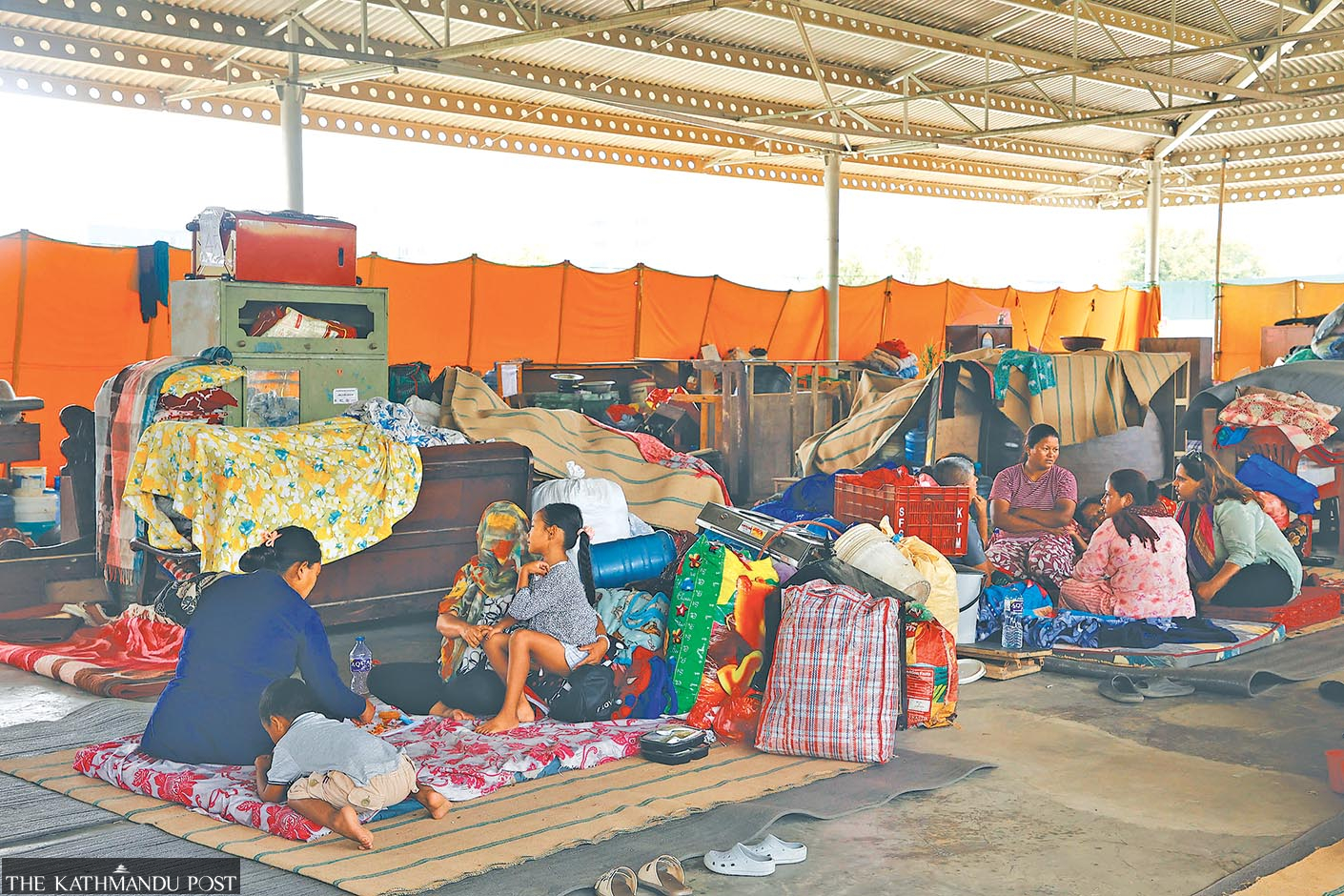
Displaced families at the Radha Soami Satsang Beas holding centre in Kirtipur, Kathmandu. Post File Photo
More than a month later, however, no hostel arrangement has been made.
“We walk one hour to school every day. And we walk back,” Shyam said.
Their families say repeated requests to the school have gone unanswered.
“We don’t have money to send them by vehicle. Even after raising the issue repeatedly, nothing has been done,” said his sister, Anjali.
The students also do not have uniforms.
When a Kantipur reporter visited Kirtipur on Wednesday, Shyam and his friends had already returned from school early.
“There was a function today. We did not have uniforms. The class captain told us to go home. The guard also asked us to leave,” Shyam said.
Asked about the issue, the head of Kathmandu Metropolitan City's education division said, “We do not have time to follow up on them every day.”
At Janavikash Higher Secondary School in Balkhu, where children from the Kirtipur holding centre attend classes, many have yet to be formally enrolled.
Principal Anil Kumar Jha said uncertainty over where the families would eventually settle had delayed the enrollment process.
“But the metropolitan city has now facilitated the process, and enrolment will be completed starting Sunday,” he said.
Initially, 58 children were identified from the Kirtipur holding centre, but only 41 attended school on the first day.
“Books were distributed four to five days after classes began. Children attended regularly for 20 to 25 days, then attendance started dropping,” he said.
Kathmandu Metropolitan City has also placed 16 children in private schools with hostel arrangements through PABSON and NPABSON.
According to PABSON Kathmandu president Nabaraj Bhatta, the students have been placed at Nexus International Academy in Pepsicola, Gateway Academy, Venus School in Jorpati, HEMS School in Kalopul, Innovative English School in Buddhanagar, Valley Public School in Kapan, Angel Heart Secondary School in Manmaiju, and KBC School in Nagarjun.
Bhatta said two children, one each from Venus School and Nexus International Academy, were later reported to have returned to the holding centre, and follow-up efforts are ongoing to bring them back.
Data on children displaced from informal settlements remains incomplete.
At Janavikash Higher Secondary School in Balkhu, attendance has dropped to just 12 or 13 regular students.
“Children sometimes do not want to come to school and want to go home,” Principal Jha said. “Some call their mothers, saying they are unwell and want to return.”
He said the school has tried to support students by providing uniforms, tracksuits, books and meals.
Another reason for declining attendance, he said, is that some children have returned to their previous schools.
Parents have also raised concerns about school attendance.
Kathmandu Metropolitan City’s Education division head Sushil Subedi said 66 families were initially recorded at the Kirtipur holding centre, with children later found living in different locations, including rented rooms, relatives' homes and other schools.
During the initial data collection, 57 children were identified. Some were studying at Viswa Niketan Secondary School in Thapathali, while others attended Guheshwari Boarding High School and private schools in Babarmahal.
“Of the remaining 44 children, we placed 16 in hostels and arranged Janavikash Higher Secondary School for the rest,” he said.
He added that the latest data is outdated and needs to be updated.
The Centre for Education and Human Resource Development (CEHRD) also says it does not have current figures.
“There was an initial data collection after the eviction, but the situation may have changed,” Parajuli said. “We will update it soon.”
Sharing the centre's coordination plan for school enrolment, he said that until the permanent residence of children currently staying at the holding centres is determined, they will be admitted to nearby schools.
“If they relocate to another place in the future, we will arrange to transfer their current enrollment directly through the government system,” he said.




 19.64°C Kathmandu