Proposed law seeks to keep strategic mineral mining under state control
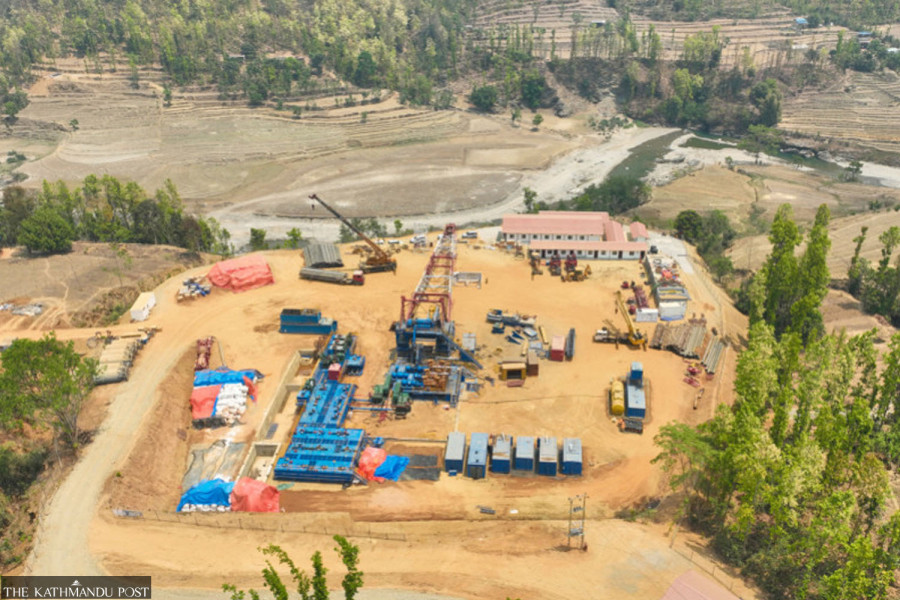
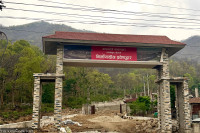
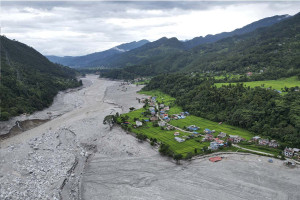
The draft legislation places radioactive mineral mining under stricter regulation and tightens rules on exploration, licensing and royalties. The exploration drilling site at Jaljale in Bhairavi Rural Municipality, Dailekh. Post file photo
The government has proposed a new mining law that would grant the state exclusive authority over the extraction of minerals deemed strategic or of national importance.
The draft bill, prepared by the Ministry of Industry, Commerce and Supplies to amend and consolidate laws related to mines and minerals, states that if such minerals are mined through a company, it must be a company wholly owned by the Nepal government.
According to Ganesh Nath Tripathi, spokesperson for the Department of Mines and Geology, this is the first time Nepal is introducing a separate category for minerals of strategic and national importance.
Section 8 of the draft bill authorises the government to designate any mineral as being of strategic or national importance through a notice in the Nepal Gazette, based on its use, availability and relevance to national interests. Once such a designation is made, the government may impose restrictions on the storage, conservation, use, transportation and export of the mineral, and may prohibit certain activities in areas where it is found.
The proposed law grants the government exclusive authority to determine procedures for and oversee the extraction of strategic and nationally important minerals. If mining is carried out through a company, it must be a company wholly owned by the state.
Tripathi said minerals that could have long-term implications for the country or make a significant contribution to the economy would likely be classified as strategic or nationally important.
Nepal currently categorises minerals as metallic and non-metallic. The proposed legislation introduces a new classification in response to global developments, particularly growing competition for critical minerals and radioactive resources. It remains unclear how much of these potentially valuable resources Nepal possesses, such as gold, platinum, precious and semi-precious stones, rare earth elements, uranium and thorium.
"A list of strategic and nationally important minerals will be prepared after regulations under the law are finalised," Tripathi said.
The bill also gives the government sole authority over radioactive minerals. Under Section 32, radioactive mining can be undertaken only by the government or a fully state-owned company, and only after obtaining approval from the relevant regulatory authority, before securing a mining licence.
The legislation sets strict conditions for such operations, including radiation safety measures, environmental safeguards, pollution control, public health protections, waste management plans, insurance and compensation arrangements, and the safe transportation of radioactive materials. Companies awarded licences would be required to comply with all standards set by the Department of Mines and Geology.
The bill proposes tighter oversight of geological surveys, mineral exploration and seismic studies. Any domestic or foreign organisation wishing to conduct such activities or install research equipment in Nepal would need prior approval from the department. The department would have the authority to impose conditions, halt unauthorised activities and seize equipment used in violation of the law.
Another provision gives the Cabinet powers to suspend mining operations or revoke licences if deemed necessary for national security or national interest. Companies whose licences are revoked would be entitled to compensation for direct losses, as determined by a committee appointed by the government.
The proposed law also requires mining companies to pay royalties before transporting extracted minerals. Ten percent of the royalty collected would be transferred to the local government concerned as a local mineral utilisation fee.
The federal government, through the department, could intervene if provincial governments request assistance, disputes arise, specialised technology is needed, or a province asks the department to undertake exploration. The federal government would also retain the power to assign the department to explore any mineral resource through a notification in the Nepal Gazette, the government’s official publication for legal notices.
Anil Giri is a Chief Sub Editor covering diplomacy, international relations and national politics for The Kathmandu Post. Giri has been working as a journalist for more than two decades, contributing to numerous national and international media outlets.




 27.12°C Kathmandu