A look at Nepal’s Speakers: power, pressure and the struggle for neutrality
A long political history shows how Speakers have tried to balance consensus-building with allegations of executive influence, obstruction and partisan pressure inside parliament.
In the United Kingdom’s House of Commons, a long-standing tradition requires newly elected Speakers to be escorted by fellow MPs to the Speaker’s chair, in a symbolic act often described as a ceremonial ‘drag’ to the seat of office.
At first glance, the practice appears unusual. However, it is rooted in the historical role and risks associated with the office.
According to Parliament.uk, this custom has its roots in the Speaker's function to communicate the Commons’ opinions to the monarch. Historically, if the monarch didn’t agree with the message being communicated, then the early death of the Speaker could follow. So, previous Speakers required some gentle persuasion to accept the post.
The modern-day tradition of escorting the Speaker to the chair is therefore a symbolic reminder of that historical danger.
In Britain, the Speaker of the House of Commons is expected to remain strictly impartial, neither aligning with the government nor the opposition once elected. The speaker is widely regarded as the guardian of the House, responsible for upholding parliamentary rules and ensuring neutrality while managing the tensions between a powerful executive and an active opposition.
However, since the restoration of democracy in 1990, speakers in Nepal have repeatedly come under criticism for failing to maintain neutrality.
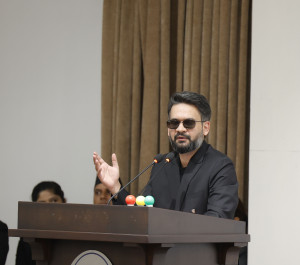
Recently, opposition lawmakers in the House of Representatives have raised concerns over Speaker DP Aryal, elected from the Rastriya Swatantra Party, which secured nearly a two-thirds majority in the March elections. Aryal has been accused by opposition parties of leaning towards the government. Earlier speakers faced similar allegations.
The Nepali Congress, CPN-UML, the Nepali Communist Party, Shram Sanskriti Party and Rastriya Prajatantra Party jointly obstructed proceedings, demanding that Prime Minister Balendra Shah respond to their questions.
The obstruction followed Shah’s remarks in the House on May 31, when he stated that it is not only that India has encroached on Nepali territories, but Nepal has also encroached on Indian territories. Opposition parties demanded clarification and blocked proceedings repeatedly.
Earlier, opposition parties had also demanded that the prime minister respond to questions related to the government’s policies and programmes. After Shah made further controversial remarks during a parliamentary response session, tensions escalated further.
The Speaker’s handling of the situation also came under scrutiny, with opposition MPs accusing him of showing bias towards the ruling side.
In Nepal’s parliamentary practice, Speakers are typically drawn from the ruling party or coalition, but after assuming the Speaker’s chair, they are expected to put aside partisan interests and serve as neutral custodians of the House.
Following the 1990 People’s Movement, Daman Nath Dhungana, Nepal’s first Speaker, played a foundational role in shaping parliamentary practice.
The Nepali Congress secured a majority and formed a single-party government in 1991. Dhungana, who came from a legal background, was elected Speaker with support from both the ruling party and the opposition.
His tenure helped establish the principle that the government belongs to the ruling party, while parliament represents all, particularly the opposition.
Parliamentary affairs journalist and writer Hari Bahadur Thapa said Dhungana played a crucial role in institutionalising parliamentary democracy in Nepal.
“He ensured that opposition voices were heard in parliament,” Thapa said.
However, Dhungana’s approach also created tension with the ruling Nepali Congress, as he frequently allowed strong opposition criticism inside the House.
“He gave enough space to the opposition, which established parliament as a place for both government and opposition voices,” Thapa said. “But this created discomfort within the ruling party.”
His relationship with then prime minister Girija Prasad Koirala became strained as he resisted executive pressure within parliamentary proceedings.
At the time, the UML, then emerging as a strong opposition force, frequently disrupted parliament. In February 1991, it obstructed proceedings for seven hours, demanding suspension of the Tanakpur agreement.
Dhungana managed repeated disruptions without restricting opposition speech.
“He allowed opposition MPs to speak freely and avoided suppressing dissent,” Thapa recalled. “Congress leaders accused him of favouring the opposition, and he was even pressured into considering resignation.”
Then opposition MP Birodh Khatiwada was among those who frequently challenged the government in parliament. Dhungana allowed him and others to continue speaking despite sharp criticism.
“Although Dhungana was elected Speaker with the backing of the Congress, he neither carried the party’s political arrogance nor overlooked the opposition’s more extreme tactics,” Thapa said. “He maintained a balanced approach. At the time, the UML had a strongly revolutionary posture, and almost every exchange between the government and the opposition in parliament turned into an argument. He managed those conflicts effectively.”
Thapa said Dhungana gave the opposition ample opportunity to speak in the House, allowing the voices of the people to be heard.
“Then Prime Minister Girija Prasad Koirala often sought to exert pressure inside parliament, but the Speaker managed the situation skilfully,” he said.
Even when disagreements between the ruling party and the opposition were intense, Dhungana sought to manage them through dialogue and coordination.
According to Thapa, he never adjourned parliament simply by issuing a notice, instead making every effort to keep the House functioning.
His tenure lasted from June 23, 1991, to October 1 1994. He died on November 17, 2024.
Ramchandra Paudel served as Speaker from December 18 1994, to March 23, 1999. His tenure saw frequent parliamentary deadlocks, protests, and disruptions.
According to observers, the parliament during this period appeared increasingly tilted towards the executive. Thapa said Paudel operated under the belief that majority decisions should not be blocked by the minority.
The opposition, UML, strongly resisted this approach and even registered a motion accusing him of misconduct, which ultimately failed.
In October 1998, during the passage of the Local Self-Governance Act, parliament witnessed severe chaos, including the breaking of chairs and microphones.
“Parliament visibly reflected executive dominance during this period,” Thapa said.
Congress leader Taranaath Ranabhat became Speaker on March 23, 1999, after resigning as Minister for Law.
He attempted to maintain balance through cross-party consultation. However, during the Lauda Air leasing controversy, the CPN-UML obstructed parliament for 57 days in the winter session of 2000, demanding the resignation of prime minister Girija Prasad Koirala
The Speaker struggled to resolve the prolonged deadlock.
“He tried to hear both sides but failed to end the obstruction in the Lauda case,” Thapa said.
During King Gyanendra’s direct rule in 2005, Parliament was dissolved, and later reinstated following the 2006 People’s Movement and peace process.
Subas Chandra Nembang, a senior constitutional lawyer, became Speaker of the Interim Legislature in 2006.
He is widely regarded as one of Nepal’s most widely admired speakers.
Nembang played a key role in managing the transition of the Maoists from armed conflict into mainstream politics and integrating multiple parties into parliamentary practice.
Former Parliament General Secretary Manohar Prasad Bhattarai said Nembang had exceptional ability in coordination.
“He worked with Maoists, Congress, UML and Madhesh-based parties with equal balance,” Bhattarai said.
Then Maoist leader Onsari Gharti, who later became Speaker herself, said Nembang prioritised dialogue.
“He understood the dignity of the Speaker’s office. Whenever tensions flared between the government and the opposition, he had the ability to bring the entire House back on track. He never believed the Speaker’s chair was a position from which to impose authority. Instead, he preferred to facilitate dialogue and build consensus,” she said. “Whenever disagreements arose, he took the initiative to engage party leaders.”
According to journalist Thapa, Nembang drew on his extensive parliamentary experience to foster a culture of dialogue and consensus in the House. He was Nepal’s longest-serving Speaker.
However, critics argue that during constitution drafting, he was sometimes overly flexible, particularly when Madhesh-based parties protested and boycotted sessions.
Some Madhesh leaders say their objections were not adequately addressed during the final stages of the constitution.
Laxman Lal Karna, a former Constituent Assembly member from the Sadbhavana Party, said Nembang appeared to be influenced by the Congress, the UML and the Maoists in the final stages of constitution drafting when Madhesh-based parties disagreed with key provisions of the proposed constitution.
“Nembang earlier came across as humble and impartial. But during the final stage of promulgation, he appeared to come under the influence of the major parties,” Karna recalled. “He chose to press ahead with the Constituent Assembly proceedings and pushed the process to a decision when the Madhesh-based parties disagreed.”
He served four terms as Speaker: from May 13, 2006, to January 15, 2007; from January 17, 2007, to May 27, 2008; from July 27, 2008, to May 27, 2012; and from February 18, 2014, to October 14, 2015.
Gharti said she prioritised consensus but accepted majority decisions when consensus was not possible. She emphasised that opposition voices must be given adequate time and space.
“My view was that the opposition should always be given adequate space to express its views. But ultimately, whatever decision the House reaches must be respected,” she said. “Before that stage, if even a single member held a dissenting opinion, I believed it was important to recognise its significance and give that member enough time to be heard.”
She also acknowledged that speakers often face pressure from party leadership, which can create institutional challenges.
Krishna Bahadur Mahara, elected Speaker in 2018, resigned in 2019 after allegations involving a female staff member.
Mahara, once regarded as one of the Maoists’ more pragmatic leaders, saw his political career decline after his resignation. He was criticised by the Nepali Congress for failing to advance the ratification of the Millennium Challenge Corporation (MCC) Nepal Compact.
Mahara served as Speaker from March 11, 2018, to October 1, 2019.
After Mahara’s resignation, Agni Prasad Sapkota became Speaker.
His tenure saw prolonged obstruction by the CPN-UML after the Speaker refused to process the expulsion notice of 14 UML lawmakers of the Madhav Kumar Nepal faction. This resulted in nearly nine months of parliamentary disruption.
Sapkota served in office from January 26, 2020, to October 8, 2022.
Devraj Ghimire became Speaker in 2022 after the UML-Maoist alliance.
Observers say his tenure reflects strong influence from the ruling coalition.
“Ghimire appeared to be strongly influenced by then prime minister KP Sharma Oli after the Congress–UML alliance was formed,” Thapa said. “He was seen as unable to properly rule over the government, and as prioritising the ruling side’s agenda over cross-party consensus.”
Opposition parties criticised him for failing to maintain the neutrality of the Speaker’s office. After the Congress–UML coalition government was formed, they accused him of suppressing the voices of opposition lawmakers.
In September 2024, CPN-UML lawmaker Yogesh Bhattarai described the Maoist armed conflict as ‘violent,’ prompting protests from Maoist MPs. They demanded that the word ‘violent’ be removed from the parliamentary record, arguing it was against the constitution, but alleged that the Speaker ignored their request.
Ghimire served as Speaker from January 20, 2023, to January 19, 2026. He is widely regarded as a controversial Speaker. Opposition parties repeatedly questioned his neutrality.
After the March elections, Aryal of the Rastriya Swatantra Party became Speaker.
The Rastriya Swatantra Party (RSP) could, if it wished, easily push through decisions on a range of issues, with the Speaker seen as capable of steering proposals through the decision-making process. However, despite opposition demands that Prime Minister Balendra Shah appear in parliament for clarification, Speaker Aryal is accused of failing to facilitate the process effectively. He was also accused by the opposition of suppressing dissent during the endorsement of the House rules.
Opposition parties had objected to provisions in the rules, arguing that clauses related to corruption and money laundering should not contradict the constitution and existing laws. The rules were eventually passed amid heavy deployment of marshals under the Speaker’s direction.
Nepali Congress Chief Whip Nishcal Rai said Speaker Aryal had at times failed to uphold the dignity of parliament. “We still believe Speaker Aryal will maintain the dignity of parliament in the coming days.”
Parliamentary journalist Thapa said Speaker Aryal appears to prefer swift decisions over broader cross-party consultation. “The Speaker’s role is essentially that of a referee. It is about ensuring that the executive’s shadow does not fall on parliament, allowing parliamentary committees to function independently, and holding the government accountable to the legislature,” Thapa said. “If the Speaker believes majority backing alone justifies unlimited authority, it can create serious problems.”
Former Parliament General Secretary Bhattarai said speakers must remain free from executive influence. “I had the opportunity to work with Subas Nembang for a full term as general secretary. I only felt the influence of power in others, not in him,” he said.
Former Speaker Gharti said that while speakers are usually drawn from political parties, they must remain conscious of their neutral role once elected. “The focus should be on what benefits the state and the public. Work in that direction and things generally go well,” she said. “I have seen some speakers remain guided by party interests, which creates difficulties for the office. Decisions should ideally be based on consensus, or at least broad agreement among parties.”




 27.12°C Kathmandu