A debate over inclusive leadership has taken centre stage at the Rastriya Swatantra Party (RSP) ahead of the closed session of its first general convention, with delegates calling for stronger guarantees of representation for women, Madheshi, Indigenous and Dalit communities in party leadership structures.
Delegates said representation should extend beyond the constitutional minimum of 33 percent for women and instead move towards proportional and meaningful inclusion in office-bearer positions and the central committee.
Pabitra Thapa, a delegate from Kaski, said the party should not limit itself to constitutional thresholds.
“In my personal view, female leadership must be brought into the mainstream. While we must meet the constitutional 33 percent requirement, we should be aiming higher, towards 50 percent,” Thapa said. She added that women were often confined to deputy or associate positions, reflecting a broader structural issue.
“This is a structural problem within society, not just one party. Society is still hesitant to accept women in top leadership roles. We speak about it publicly, but implementation remains difficult,” she said.
Demands for proportional representation are expected to dominate closed-door discussions. Delegates from Madhesh Province are preparing a coordinated push to secure leadership roles for Madheshi representatives among office-bearers.
Ramjit Ram, spokesperson for the RSP Madhesh Province Committee, said the issue of population-based representation would be formally raised.
“We will raise the issue of ensuring representation proportional to population. Even though our colleagues will compete in the open category as well, the leadership has been receptive so far,” he said.
The push for broader inclusion has also been echoed by senior party figures. Outgoing central committee member Dr Toshima Karki had earlier questioned the central leadership during the final meeting of the dissolved central committee, asking why women were repeatedly assigned deputy or joint roles.
She had proposed an additional General Secretary post reserved for women. Other leaders in the same meeting also called for proportional representation of Indigenous groups, Madheshis and other marginalised communities in line with constitutional guarantees.
Krishna Man Shakya, a delegate from Dhading, said inclusivity must be clearly defined in party structures.
“Inclusivity is a major national issue. The RSP gives it theoretical importance, but this is our first national convention, and implementation needs refinement,” Shakya said. “Procedures are still unclear, and without defined criteria, genuine representation is difficult to achieve.”
Similarly, Kusum Maharjan said the party must translate its past positions into internal practice, noting that it had previously advocated for the representation of marginalised groups in government.
RSP chair Rabi Lamichhane said the party would adhere to constitutional principles of inclusion. While earlier statute amendment discussions had considered linking leadership posts to identity-based clusters such as Madheshi, Dalit and Indigenous categories, those provisions were not formally fixed.
The issue has also drawn attention from leaders of other parties who attended the convention’s opening session.
Nepali Congress president Gagan Thapa said democracy and inclusion must be reflected in practice rather than principle alone.
“Democracy, rule of law, inclusivity and social justice are not decorative elements of the constitution; they are embedded in Nepali society,” he said. “I hope this convention clarifies the RSP’s position on these values and commits to them in practice.”
CPN-UML leader Pradeep Gyawali said the RSP’s key test was its commitment to constitutionalism rather than ideological positioning.
“Whether the RSP is at the centre, left or right matters less than whether it internalises constitutionalism, rule of law, fundamental rights, social justice and inclusivity,” he said.
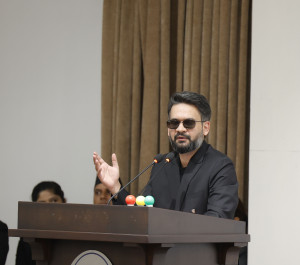
Speaking at the same programme, RSP chair Lamichhane said that the party remained committed to constitutional values.
“Democracy, separation of powers, the constitution, federal democratic republic, civil liberties, human rights and inclusivity are invaluable gains handed down by previous generations,” he said. “We will preserve these values and will not deviate from them.”
Minister of Law, Justice and Parliamentary Affairs and RSP leader Sobita Gautam said the convention would strengthen inclusive participation across all levels of leadership.
“We aim to make the party structure as inclusive as possible. The final composition is not yet decided, but we are committed to an open and inclusive process,” she said.
RSP joint general secretary Bhoop Dev Shah said internal discussions had already prioritised inclusion of women and marginalised groups.
“We have tried to reflect inclusivity in our team, and the leadership will follow in the coming days. The central committee will reflect the diversity of the country,” he said.
Responding to concerns that women are largely limited to deputy-level positions, Shah said all posts were open through competitive selection.
“Which positions have we restricted? All posts are legally open,” he said.
Another joint general secretary, Kabindra Burlakoti, said the party was working to expand representation systematically, noting that groups from Dalit and Tharuhat-Tharuwan movements had recently been integrated into the party.
Lawmaker and the member of the party’s statute amendment committee, Prakash Chandra Pariyar, said formal provisions would be introduced based on committee feedback.
“The revised statute will include nominated seats to ensure inclusivity,” he said.
The party has recently expanded its office-bearer structure to 19 positions. Critics, however, argue that only four posts remain explicitly reserved for women, the same number as in the previous 12-member structure.
Under the revised structure, the party’s 19 office-bearer positions are distributed as follows: one Chairperson and one Senior Leader; three Vice-Chairpersons, including one woman and one nominated member; two General Secretaries, one of them nominated; five Joint General Secretaries, including one woman and two nominated members; one Spokesperson; three Joint Spokespersons, including one woman; one Treasurer; and two Joint Treasurers, including one woman.




 21.12°C Kathmandu