Karnali villagers wait for a border fair they cannot afford to miss
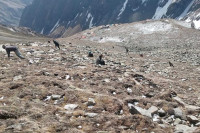
Many residents of Nepal’s remote northern frontier depend on seasonal Chinese markets for cheaper food and daily essentials. There’s no certainty over whether, or when, such fairs would be held this year. The road connecting to the border crossing on the Nepal–China border in Dolpa. Post Photo
July and August are critical months for Chhiring Lama of Mugu. Every year during these months, Lama sells yarsagumba and other medicinal herbs at the 15-day trade fair in Hyajimar, along the Nepal-China border. With the earnings, he buys Chinese clothing, food and other essential goods to sustain his family throughout the year. Lama has been doing so for nearly two decades.
Lama lives in Mugum Karmarong Rural Municipality, a grueling two-day walk away from Gamgadhi, the district headquarters. China is only a day away. Goods are cheaper and transport is easier.
Usually, the fair starts in late July or early August. But this year, with August already approaching its end, there’s no clue when the fair would begin. “It is difficult for us without the Chinese border fair,” Lama told Kantipur recently.
For years, many residents of Nepal’s remote northern frontier have relied on these Chinese border fairs for both food and income, selling medicinal herbs and livestock products to buy cheaper essentials. But with the seasonal markets in Mugu and Dolpa yet to open this year, communities cut off by difficult terrain are facing higher food costs and uncertainty over how they will sustain themselves.
These are areas that see limited crop production. Karma Chhiring Gurung, a resident of Dolpa’s Shey Phoksundo Rural Municipality-3, said the harsh climate and lack of irrigation mean his village can grow only one crop of naked barley a year—and even that harvest does not feed a family for more than three months. Medicinal-herb collection and livestock rearing thus remain the main sources of livelihood. Residents sell herbs like yarsagumba, panchaule and jatamasi, along with local products such as ghee, chhurpi, mountain goat meat and sheep wool, at the fairs.
Residents of Shey Phoksundo have to walk three days to reach the district headquarters Dunai. “With no road access, goods have to be transported by mule,” Gurung said. “So we have to pay a huge premium for Nepali rice.”
The village has a Food Management and Trading Company depot, but rice is delivered there only once a year, leaving residents dependent on food brought from China, Gurung added.
In Dunai, a 30 kg sack of rice costs between Rs2,500 and Rs3,000. The cost of transporting rice by mule is Rs90 per kg. “We are forced to buy rice in the village for as much as Rs6,000 a sack, almost twice the price,” Gurung said.
In contrast, Chinese rice costs between Rs800 and Rs1,000 a sack and can be brought to the village within a day.
Meanwhile, unlike in Mugu and Dolpa, a temporary Chinese market has already been held at Lilong on the Humla border this year. The fair took place from July 30 to August 10.
Last year, the border fair at Marim La on the Dolpa-China frontier was held from August 10 to 21. Chinese authorities have yet to provide any information about this year’s fair, said Junu Hamal Dhakal, chief district officer of Dolpa.
“The Chinese side makes the final decision on whether to hold the border fair,” she said. “We make the necessary security arrangements.”
Local representatives are also pushing for the fair, she added. “We have written to the Home Ministry to seek its opening.”
The district administration will issue temporary passes to residents once the fair is confirmed, Dhakal said. Last year, it issued passes to around 2,200 people.
Karma Chhoewel Gurung, chairman of Dolpo Buddha Rural Municipality, said cross-border trade between the two countries is limited to the 15-day fair. “If the border crossing were opened year-round,” he said, “life for people in the municipality would become much easier.”
Residents are also eager for the fair because their medicinal herbs and other local products fetch better prices there. Pemba Bhote of Dolpo Buddha-4, for instance, sold yarsagumba for Rs2.8 million per kg last year.
Bhote said medicinal herbs in Nepali or Indian markets sell for much less, while sellers face repeated inspections and paperwork.
Chhiring Kyapne Lama, chairman of Mugu’s Mugum Karmarong Rural Municipality, said communities along the frontier have maintained trading ties with Tibet since 1915. “But that relationship is still limited to temporary fairs,” he said. “If the border crossings were opened permanently and roads were built to China, the benefits would extend across Karnali.”
Construction of the Gamgadhi-Nagchenagla road, intended to connect to China, began in February 2006. But, according to Lama, only 18 kilometres of the planned 68-kilometre road has been completed so far.




 17.6°C Kathmandu