Government orders recovery of Kathmandu’s encroached land based on 1995 report
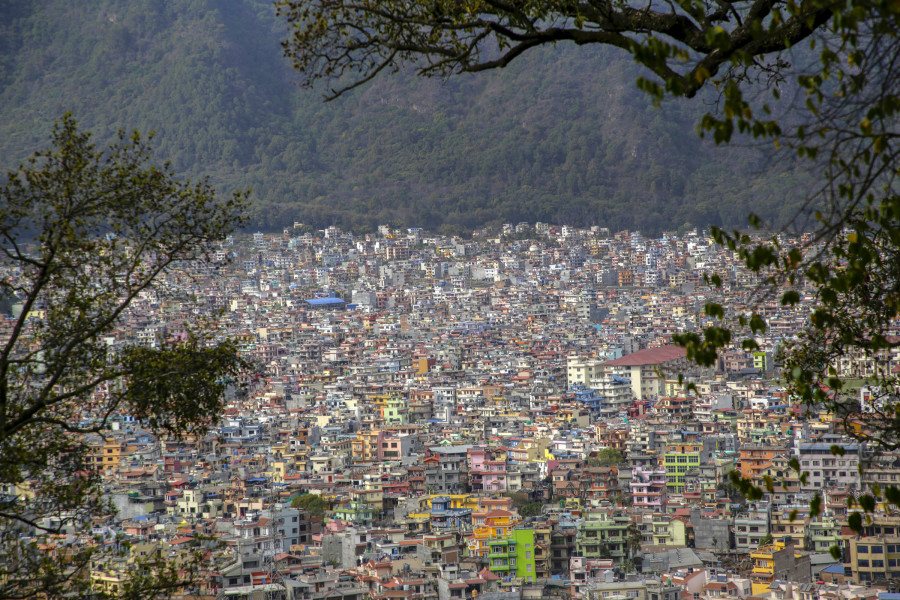
The government on Monday initiated the process of freezing all government and public land identified as encroached by a 1995 report. A view of unplanned urban sprawl in Kathmandu. Post file photo
In a historic move the government has officially decided to implement a high-level commission report on public land encroachment in Kathmandu 31 years after it was first submitted.
On Monday, the Ministry of Land Management, Co-operatives, Federal Affairs and General Administration initiated the process of freezing all government and public land identified as encroached in the Rawal Commission report, preventing any transfer of ownership.
According to ministry spokesperson Ganesh Prasad Bhatta, the ministry has formally written to the Department of Land Management and Archives and the Department of Survey to begin the implementation process of the report prepared in 1995 by the High-Level Commission on Investigation and Protection of Government and Public Land led by Ram Bahadur Rawal, a former secretary. The commission was formed in December 1992.
According to the ministry’s directive, land listed in the commission’s report as encroached cannot be bought, sold, transferred, registered in another person’s name, or otherwise subjected to any change in ownership until further notice.
The sweeping decision, passed by a Cabinet meeting on June 12, aims to reclaim more than 1,859 ropani (around 94.5 hectares) of land in Kathmandu that has been illegally converted into private estates. This unprecedented resurrection of three-decade-old archives has immediately ignited an intense national debate regarding its actual feasibility.
The decision has generated both hope and scepticism. Supporters see it as a long-overdue effort to recover public assets that were gradually transferred into private hands. Critics and legal experts, however, question how practical it will be to reclaim land that has changed ownership multiple times over the past 31 years.
The report had identified more than 1,859 ropani of public land in Kathmandu as being under encroachment and recommended immediate corrective measures. Yet successive governments failed to act on its findings despite repeated public demands and even a Supreme Court directive.
On Monday, questions about the report’s implementation continued to pour into the Land Management Ministry. An advocate telephoned ministry spokesperson Bhatta to ask when the report would actually be enforced and whether action would begin immediately. Bhatta replied that implementation would take time because a facilitation committee formed by the ministry had been given 15 days to prepare a roadmap.
The advocate then raised a more complicated issue—what would happen to land parcels that had been frozen by the commission but later released through court orders, and to plots that had passed through several buyers over the decades.
Bhatta said decisions would be taken after studying relevant court rulings and that land determined to be government property would ultimately be restored to state ownership.
The exchange reflects the challenges facing authorities as they attempt to implement a report prepared in a very different political and administrative era.
Land Management Minister Pratibha Rawal insists that the government is fully committed to enforcing the report. Speaking to journalists after discussions with the newly formed facilitation committee, Rawal said work had already begun and that visible progress would emerge within weeks.
“Implementation has started. There will be no ifs and no buts,” said Minister Rawal. “The ministry has already begun the process and results will gradually become visible.” She acknowledged that some land records still contain annotations referring to the Rawal Commission while others may require extensive verification.Despite the difficulties, Rawal argued that the government had made a political decision that would not be reversed.
The minister also said the government intended to implement recommendations from other land-related commissions whose reports have remained dormant for years.
“The ministry has already issued notices regarding guthi (trust) land. Other reports will also be implemented gradually. None of them will be shelved,” said Minister Rawal.
To assist implementation, the ministry has formed an eight-member facilitation committee under Krishna Prasad Sapkota, deputy director general of the Department of Survey.
Sapkota said the committee had held its first discussion with the ministry and was working to define its scope before submitting recommendations within two weeks.
Asked whether the report could realistically be implemented after three decades, he declined detailed comment, saying the committee would present its assessment once its work was completed.
The commission itself had proposed three possible models for reclaiming encroached land. Its preferred option was a valley-wide campaign to recover all illegally occupied public land simultaneously. The report argued that such an approach would be practical if authorities first compiled complete records and issued extensive public notices. It considered the existing practice of providing only seven-day or 35-day notices unrealistic and instead recommended broad public awareness campaigns encouraging occupants to vacate land voluntarily.
As a second option, the commission suggested launching a pilot campaign in a limited area. It proposed starting either in Bauddha, which recorded the highest level of encroachment, or in a smaller site such as Khichapokhari, where only six ana and three paisa (214.63 square metres) of land had been occupied. The third model envisioned developing a successful pilot project and gradually expanding it to other areas. The report also recommended prioritising river corridors along the Bishnumati, Bagmati, Dhobikhola and Manohara rivers, as well as locations where encroachment had caused serious harm to public interests.
The Cabinet decision was based on a Supreme Court order instructing the government to implement the report and protect public land. It also directed authorities to maintain systematic records of government and public land across the country and ensure their preservation.
The commission was formed by the government led by then prime minister Girija Prasad Koirala under the chairmanship of former secretary Ram Bahadur Rawal. After extensive investigation, it submitted its report in 1995. The document remained confidential for years until details were disclosed in 2019 through the Right to Information Act by the Centre for Investigative Journalism Nepal.
The report documented encroachment of ponds, temples, streams, wells, stone spouts and guthi land in areas including Chabahil, Bauddha, Battisputali, Thapathali and Baneshwar. It found that land belonging to Kamalpokhari and Nagpokhari had been registered in private names.
Janaki Ballabh Adhikari, a member of a later government committee investigating encroached public and guthi land, welcomed the decision but warned that implementation would be difficult after such a long delay.
“Too much time has passed. Some records may have been lost and many plots may have changed hands several times. Still, it is a positive step,” he said.
Granddaughter leads implementation of grandfather’s report
The Rawal Commission carries an unusual family connection spanning three generations. Ram Bahadur Rawal, who chaired the commission that investigated encroachment of government and public land, is the grandfather of the current Land Management Minister Pratibha Rawal.
“By coincidence, that commission was led by my grandfather,” said Minister Rawal. “Now, as his granddaughter, I have been entrusted with the responsibility of implementing its recommendations.”
How was the land encroached?
The Rawal Commission was established after widespread complaints that public land in Kathmandu was being systematically encroached upon.
Initially formed under then minister of state Siddharaj Ojha, the commission later came under the leadership of former secretary Rawal. It conducted extensive investigations between late 1993 and 1995. The commission examined cadastral surveys conducted in 1965 and compared them with later maps and field observations.
According to the report, Kathmandu Metropolitan City then contained more than 18,941 ropani (963.6 hectares) of government and public land. Of that total, approximately 1,859 ropani (94.57 hectares)—nearly 10 percent—had been encroached upon.
The commission identified two major forms of encroachment. In some cases, individuals had directly occupied public land and used it for private purposes. In others, public land had been merged into private plots and formally registered under private ownership.
The report found that 1,187 encroachers were directly using 308 land plots of public and government land. A further 6,906 individuals had incorporated 1,762 parcels of public land into their own holdings and obtained ownership certificates.
Where over 100 ropani land encroached
The report identified extensive encroachment across all 35 wards of the then Kathmandu Metropolitan City.
The worst affected area was Bauddha, where 222 ropani (11.29 ha) of land had been encroached upon. Chabahil followed with more than 192 ropani (9.77 ha) under illegal occupation. The Baneshwar-Dhobikhola-Shankhamul-Mahadevsthan corridor recorded more than 184 ropani (9.36 ha) of encroached land, while the Koteshwor-Manohara-Tinkune area accounted for nearly 160 ropani (8.14 ha).
Other heavily affected locations included Battisputali and Sinamangal, Bhimsengola and the Bagmati river corridor, Handigaun and Gaucharan, and areas surrounding Bishnumati, Balaju and Raniban.
The report also documented encroachment in sensitive cultural and religious zones, including Pashupati, Tilganga, Bhandarkhal and Swayambhu.
Even the Supreme Court’s order left unimplemented
The report remained secret for years after it was submitted to the government in 1995.
Repeated efforts to obtain it through official channels failed, prompting legal action and right-to-information campaigns.
After the government failed to make the commission’s report public, senior advocate Prakash Mani Sharma, a prominent campaigner on public interest issues, along with others, filed a writ petition at the Supreme Court in 2003, naming the Office of the Prime Minister and Council of Ministers as defendants.
The Supreme Court issued a final verdict in 2010, directing the government to make public the Rawal Commission report and implement it, investigate encroached public land across the country and take legal action where necessary.
The court described the issue as one of great public importance and instructed authorities to prioritise implementation. Yet the order remained largely ignored. Governments changed, committees were formed and reports were prepared, but the recommendations never progressed beyond bureaucratic discussions.
Facilitation committee formed for implementation
The newly established facilitation committee is expected to play a crucial role in translating the Cabinet decision into action. The committee includes representatives from the ministries of home, infrastructure development, land administration offices, survey offices, the department of land management, and the department of survey.
Its immediate task is to determine how the report’s findings can be reconciled with present-day land records.
“The Cabinet’s decision has finally opened the way for the implementation of a report that remained unenforced for years,” said Minister Rawal. “The government will now coordinate with all stakeholders to protect encroached government and public land.”
Deepa Dahal, press and research adviser to the prime minister, said that by the time the Rawal Commission completed its study, more than 1,859 ropani of the over 18,941 ropani of government and public land within Kathmandu Metropolitan City had already been encroached upon. “Efforts will now move forward to identify, recover and protect those encroached properties,” she asserted.




 14.69°C Kathmandu