Two decades on, road to China border remains unfinished in Mugu
Only 18 kilometres of the 68-kilometre Gamgadhi-Nakche Nangla road have been opened, leaving residents of Mugum Karmarong reliant on costly mule transport and days-long walks for basic supplies. Mugum Karmarong locals heading to Gamgadhi, district headquarters of Mugu, to purchase food and other daily essentials. Post File Photo
For 56-year-old Sanduk Tamang of ward 3 of Mugum Karmarong Rural Municipality in Mugu, reaching the district headquarters in Gamgadhi requires a gruelling two-day walk. By comparison, he can reach Nakche Nangla on the Chinese border in a single day.
Yet with the border crossing closed and no motorable road linking the area to the rest of the district, Tamang and thousands of others must undertake risky journeys along narrow mountain trails to buy food and daily necessities.
“We are forced to travel to the headquarters risking our lives on treacherous mountain paths. Without a road, there is no alternative but to use mules to transport goods,” Tamang said. “If the road from Gamgadhi to our villages were completed, we would no longer have to pay exorbitant transport costs for food.”
According to local residents, the harsh climate and lack of irrigation mean that only one crop of naked barley can be grown each year. The harvest lasts for less than three months, leaving households dependent on imported food for the remaining nine months.
Tashi Lama of Mugu village in ward 1 of Mugum Karmarong said residents have long hoped that a road connection to China would ease their hardships.
“We were told years ago that a road would connect us to China. If vehicles could finally reach our village, life would become much easier,” he said.
The Gamgadhi-Nakche Nangla road, envisioned as a strategic route linking Karnali Province with the Chinese border, has remained stalled for years due to inadequate funding.
According to Chhiring Kyapne Lama, chairman of Mugum Karmarong Rural Municipality, the road is the shortest route connecting Karnali to China.
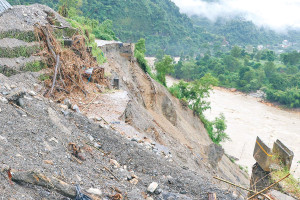
Although construction began in February 2007, only 18 kilometres of track have been opened from Gamgadhi to Chhail. The remaining 50 kilometres of the planned 68-kilometre road are yet to be built.
Chairman Lama said communities in Mugu have maintained trading links with Tibetans since 1915, but the absence of road infrastructure has prevented cross-border commerce from expanding.
“If the road is built, one could travel from Hyajimar to Lhasa by vehicle in just two to three hours,” he said. “A motorable road up to the border point would significantly boost trade between Nepal and China.”
Dhanargolbu Lama, a resident of Kimri, said people from villages including Kimri, Karti, Takha, Khari, Mugu, Dolphu, Chitai, Rius and Puwagaon must walk at least a day and a half before reaching the nearest road access point.
“When will the road finally reach our village and end our suffering?” he asked. “Only one crop of naked barley grows in the municipality, and it does not last three months. Every year, we face food shortages.”
The lack of road access has also driven up the cost of basic goods. A sack of 30 kilograms of rice costs around Rs6,000 in the villages after being transported by mules, horses or yaks. The same sack sells for between Rs2,200 and Rs2,500 in Gamgadhi. Transport alone costs around Rs100 per kilogram.
Residents said a government food depot in the area has not received rice supplies since July last year.
The transport bottleneck has also affected local producers. Potatoes, apples and barley often go to waste because farmers cannot get them to markets, while the high cost of transporting construction materials has hindered local development projects.
Shrawan Kumar Mahatara, acting chief of the Road Division Office in Jumla, said only Rs120 million has been spent on the project so far, despite an estimated total cost of Rs800 million.
“This road receives very little funding, and when money is allocated, it is negligible,” Mahatara said. “Contractors also bid very low to secure tenders, making it difficult to ensure quality work.”
He added that construction work is often concentrated at the end of the fiscal year, causing a significant portion of the allocated budget to remain unspent.
According to Mahatara, while Rs40 million was allocated this year for upgrading the Nagma-Gamgadhi road, no budget was earmarked for extending the track towards Nakche Nangla.
He said the route follows the banks of the Mugu Karnali river to the Tibetan border and poses no major engineering challenges, provided adequate funding is made available.




 19.27°C Kathmandu