Foreign Minister Khanal to visit China after India trip in push for diplomatic balance
Talks in China will focus on infrastructure, trade deficit, connectivity, tourism, and Belt and Road projects to strengthen bilateral ties, officials said.
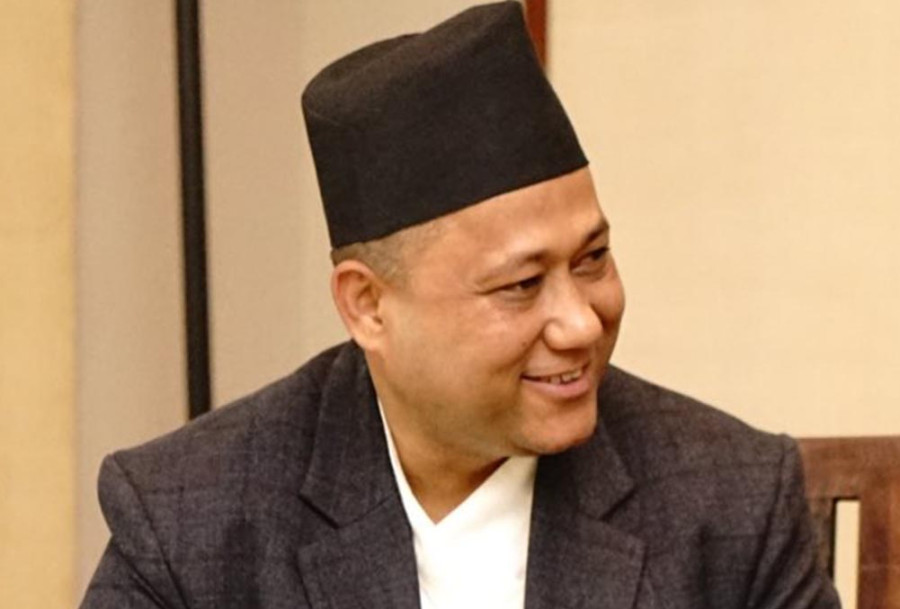
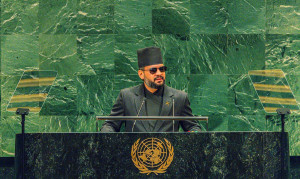
A week after wrapping up his three-day visit to India, Foreign Minister Shisir Khanal is heading to China as part of an apparent effort to maintain a balance in ties with the two neighbours.
He is leaving for Beijing on June 14 on a four-day visit at the invitation of his Chinese counterpart, Wang Yi. Besides holding bilateral talks with Wang, he will also meet leaders of the Communist Party of China (CPC).
“The foreign minister has already begun preparations following the confirmation of the visit,” said a senior foreign ministry official. “In fact, he visited New Delhi on short notice only after his trip to China was confirmed.”
While in Delhi, he met with External Affairs Minister of India S Jaishankar, National Security Adviser Ajit Doval and others and discussed a range of bilateral issues ranging from border and boundary, trade, commerce, connectivity, infrastructure, energy and fertiliser.
The foreign minister is travelling to Beijing at a time when there is growing suspicion in diplomatic circles in Beijing that Nepal’s current government is increasingly leaning towards the West, said the official, who is close to Minister Khanal.
“The foreign minister’s visit to Beijing is aimed at dispelling this perception and reassuring the Chinese leadership that Nepal remains committed to balanced diplomacy. It is also meant to demonstrate Nepal’s balanced approach to its relations with both India and China,” the official added.
Minister Khanal will meet and solicit views from former ministers, leaders, officials and China experts before leaving for Beijing.
Soon after the March elections, some CPC leaders landed in Kathmandu and held talks with senior leaders of the ruling Rastriya Swatantra Party, including Khanal, and discussed the outlook of the new government. They also inquired whether the new government would toe a pro–Western line.
The concerns from Chinese leaders prompted the RSP leadership to conclude that the new government should reassure both neighbours that it would not depart from Nepal’s principled foreign policy position.
In a meeting with the Chinese ambassador to Nepal, Zhang Maoming, on April 8, the foreign minister assured that Nepal’s stance towards China would remain unchanged under the new administration led by Prime Minister Balendra Shah.
While highlighting the priorities of the new government, Khanal assured the Chinese ambassador that Nepal upholds both the letter and spirit enshrined in the constitution and its foreign policy doctrine.
As he did in Delhi, the foreign minister will brief the Chinese leadership on the priorities of the new government and its expectations from China in the changed political context in Nepal.
Since RSP leaders, including party president Rabi Lamichhane, Khanal, and others, had maintained that “they did not carry the past baggage” during their recent India visit, if the same approach is applied in the case of China will be closely watched.
Nepal and China have, in the past, reached several understandings and agreements, including the Belt and Road Initiative (BRI), the Trans Himalayan Multi Dimensional Connectivity Network (THMDCN), and various projects like the expansion of the Chinese railway from Kerung to Kathmandu.
After the formation of the Shah government, on April 9, Minister for Physical Infrastructure, Transport and Urban Development Sunil Lamsal and Ambassador Zhang signed an agreement for widening the Ring Road’s 8.2-kilometre stretch from Kalanki to Basundhara, including the construction of a concrete bridge at Dhungedhara and three disability-friendly pedestrian bridges at Sitapaila-Balaju, Balaju-Machhapokhari, and Samakhusi-Basundhara Police Post. China will provide around Rs11 billion in grant support for the project.
On May 25, Nepal government sent its response to China regarding the implementation of the cross-border transmission line between the two countries. The letter conveyed Nepal’s commitment to the transmission line (Chilime-Kerung) project.
Likewise, the government on May 20 decided to accept a grant assistance of RMB 79.36 million (equivalent to Rs 1.8 billion) from the Chinese government for the repair and maintenance of the Araniko Highway.
In its policy and programs, the government also announced that it gives priority to the Kerung–Kathmandu railway.
The Xi’an-based China Railway First Survey and Design Institute Group Co Ltd was entrusted with carrying out its feasibility study, which was started in December 2022. The Chinese company had earlier said it would submit its report in June.
Ahead of the foreign minister’s visit, Nepal and China have concluded a review of the progress of over two-and-a-half dozen China-funded projects in Nepal.
During his stay in China, discussions are expected to focus on infrastructure development, reducing Nepal’s trade deficit, connectivity, cross-border movement, tourism revival, and projects under the Belt and Road Initiative (BRI), given China’s interest in further strengthening political and economic engagement with Nepal, said officials.
Observers say China remains in a “wait and see” mode, with perceptions in some of its diplomatic circles that Nepal’s current government tilts towards the West. They argue that the foreign minister will need to actively engage Beijing to build trust and reassure it about Kathmandu’s foreign policy direction.
“Under the overarching goals and objectives of THMDCN, we should seek to construct four corridors and two transmission lines as soon as possible,” said former Nepali ambassador to China, Krishna Prasad Oli.
“We should construct dedicated four-lane north-south corridors through Humla, Kerung-Kathmandu and other strategic areas. Second, we have to build two dedicated transmission lines, Rasuwa-Kerung and Kimathanka. Moreover, we should assure the Chinese of political, policy and economic stability in Nepal. Without that, it will be hard to develop much trust. Building trust is very important while working with China,” said Oli.
Anil Giri is a Chief Sub Editor covering diplomacy, international relations and national politics for The Kathmandu Post. Giri has been working as a journalist for more than two decades, contributing to numerous national and international media outlets.




 15.32°C Kathmandu