Earthquake survivors in Karnali still stuck in temporary shelters after two and a half years
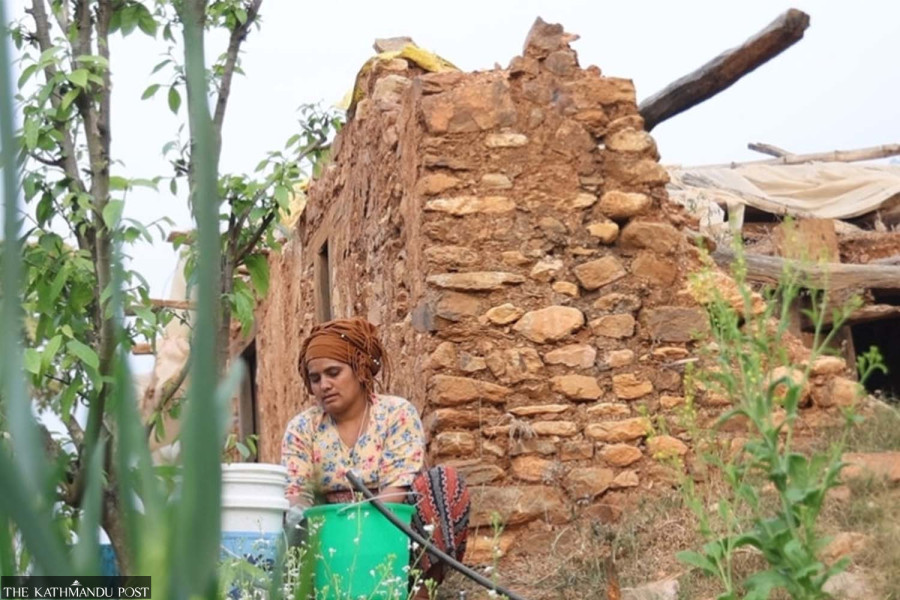
Delays in reconstruction, disputes over beneficiary lists and bureaucratic deadlock have left thousands of families facing a third monsoon in makeshift huts.MAHESH KC/TKP
More than two years after a deadly earthquake struck Karnali Province, thousands of survivors in Jajarkot and Rukum West are still living in cramped temporary shelters, waiting for promised reconstruction support that has yet to arrive.
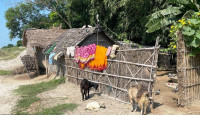
For Lanka Bahadur Chand from ward 1 of Sanibheri Rural Municipality in Rukum West, the uncertainty has become part of daily life. His family of five has been living in a narrow shack made of corrugated sheets and tarpaulin since their house was destroyed in the earthquake.
“We eat, sleep and store everything in a single small room,” Chand said. “We somehow survived two monsoons and three winters here. There is still no certainty about when our new house will be built. It now looks certain that we will spend another rainy season in this shelter.”
Chand said his family spent around six weeks under tarpaulins immediately after the quake. So far, he said, the government has provided only Rs50,000 in two instalments for temporary housing.
The frustration is similar across the quake-hit hills of Karnali Province.
Nandaram Mahar from Rawatgaun in ward 1 of Bheri Municipality in Jajarkot said he has spent the past two and a half years waiting in hope that reconstruction would finally begin.
“The shelter itself is now close to collapsing,” Mahar said. “The government still shows no sign of building our house. How much longer are we supposed to live like this?”
His family of five also remains in a temporary hut made of corrugated sheets. During rainfall, water leaks through the roof. In summer, the structure becomes unbearably hot.
Mahar said prolonged exposure to harsh weather and poor living conditions has led to repeated health problems. His wife, Mansara, and eldest daughter, Anjana, have been bedridden with fever for more than a week.
Many survivors say the disaster also destroyed their livelihoods.
Dhan Bahadur BK, 39, from Chiuri in ward 1 of Nalgad Municipality in Jajarkot, said reconstruction delays have prevented him from returning to India for seasonal labour work, his primary source of income for over a decade before the earthquake.
“The head of the family must be present to receive the instalment,” he said. “But there is no guarantee of when construction will begin. There is hardly any work available in the village. We are surviving by borrowing money from neighbours and relatives.”
He said his debt has increased by nearly Rs250,000 since the earthquake.
The November 3, 2023, earthquake, with epicentre in Barekot of Jajarkot district, killed 157 people. In the year that followed, 57 quake survivors died from cold-related causes while living in temporary shelters, according to local officials. Another 21 earthquake-affected people died in floods and landslides.
Yet reconstruction work has still not begun in the most affected areas.
Officials said the delay stems largely from disputes surrounding the Detailed Damage Assessment (DDA), a government process used to identify beneficiaries eligible for reconstruction grants.
In Rukum West, authorities identified 30,850 beneficiaries. However, reconstruction has stalled after the District Administration Office called for the damage assessment to be conducted again, despite many local units already completing agreements with beneficiaries.
Under current plans, 11,297 houses are to be fully rebuilt, while another 19,553 homes are to be retrofitted or repaired. The government’s reconstruction guidelines provide Rs400,000 for rebuilding and Rs50,000 for retrofitting support.
Local representatives accuse Chief District Officer Dinesh Prasad Thani of obstructing the process.
On April 27, Thani wrote to the Ministry of Home Affairs requesting a fresh assessment, saying public complaints suggested some genuine victims had been excluded while ineligible people had been included in beneficiary lists.
The letter said a new assessment was necessary to “collect accurate beneficiary details” and requested at least 12 civil engineers to carry out the work.
Days later, on May 5, the District Administration Office sent another letter to all six local units in Rukum West, citing widespread complaints that beneficiary selection had been influenced by political and financial interests. The letter also mentioned complaints filed with both the Commission for the Investigation of Abuse of Authority and the district administration office.
The dispute has deepened tensions between local governments and the district authorities.
Local authorities want reconstruction to proceed using the existing DDA lists, while district officials insist disputed cases must be re-evaluated first.
Birka Bahadur Bista, chairperson of Sanibheri Rural Municipality, said local representatives had repeatedly appealed to district authorities and the National Disaster Risk Reduction and Management Authority to move reconstruction forward.
“The chief district officer stopped reconstruction, claiming there were irregularities in the DDA,” Bista said. “But the technical staff conducting the assessments were deployed by the disaster authority itself. Now the blame is being shifted to local governments, and the budget that was about to be released has been halted.”
Under reconstruction procedures, funds can only be transferred to beneficiaries after agreements approved at the ward level are endorsed by the District Disaster Management Committee, chaired by the chief district officer.
Civil society activist Narendra KC said bureaucratic disputes have left genuine survivors suffering.
“The temporary shelters are already falling apart,” he said. “Reconstruction could have been completed by now if the government had acted seriously. People are still living in dangerous conditions.”
Keshav Oli, assistant chief district officer of Rukum West, denied claims that the administration intended to obstruct reconstruction.
“The reassessment will not apply to all,” he said. “Only locations where complaints have been filed will undergo reassessment. The goal is not to delay reconstruction but to ensure the process moves ahead without future disputes.”
He said a meeting of the District Disaster Management Committee had been called for Wednesday to discuss the issue.
In Jajarkot, authorities have identified 40,041 beneficiaries. Although the government provided Rs50,000 in two instalments for temporary shelters, only around 25,000 households have received the second payment.
With reconstruction stalled, many families have started rebuilding homes on their own.
In Khalanga, the district headquarters, nearly 100 families have already completed houses on their own, according to Basanta Prasad Sharma, ward chair of Bheri Municipality-4.
“The government grant is insufficient anyway, and delays made things worse,” Sharma said. “Many who could afford it have already built houses. Around another hundred homes are still under construction.”
Pushpa Shah from ward 1 of Bheri Municipality said he was forced to rebuild using loans after being excluded from the DDA list.
“There is no certainty about when government support will come,” Shah said. “We were left out due to political bias. We had only one option: to take loans and build ourselves”
Ward chair Badri Pant of Nalgad Municipality-4 said about 50 families out of roughly 450 assessed households had begun rebuilding on their own, some without technical supervision.
“People panicked because of government delays,” Pant said. “Some houses have already been completed without engineering advice, while others are being built in coordination with us.”
Chief District Officer Khadananda Adhikari of Jajarkot said reconstruction procedures had moved forward for 621 beneficiaries in Bheri Municipality, but work in other municipalities remained stalled.
According to the National Disaster Risk Reduction and Management Authority, DDA reports show that 14,245 private houses in Jajarkot require complete reconstruction, while another 12,744 houses need retrofitting or repairs. Families eligible for retrofitting support can receive grants of up to Rs300,000.
“We requested reconstruction funds from the authority last year. But no decision has been made yet,” Adhikari said. “It now appears survivors will spend another monsoon in temporary shelters.”
He added that the district had also requested a fresh DDA for 5,014 households in Bheri Municipality that were allegedly left out of the original assessment.
Bir Bahadur Giri, chairperson of Barekot Rural Municipality, said local governments have borne the anger of survivors despite having neither the authority nor the budget to manage reconstruction directly.
“If the federal government had handed responsibility to local governments, all these houses could have been completed by now,” Giri said. “We have neither the budget nor the authority, but survivors blame us because they see us every day. Another monsoon has already arrived, and not a single house has been built through the official process.”




 15.76°C Kathmandu