Repeated BP Highway closures make Pushpalal only viable option
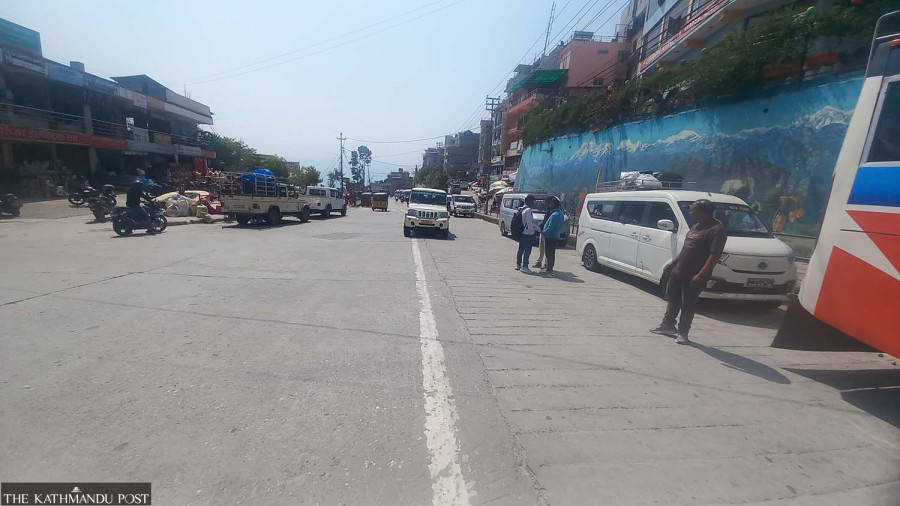
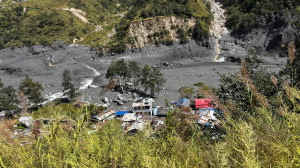
The alternative route connects Khurkot to Manthali in Ramechhap, then to Tamakoshi and Charikot in Dolakha, before linking with the Araniko Highway at Khadichaur in Sindhupalchok and finally reaching Kathmandu.The alternative route connects Khurkot to Manthali in Ramechhap, then to Tamakoshi and Charikot (pictured) in Dolakha, before linking with the Araniko Highway at Khadichaur in Sindhupalchok and finally reaching Kathmandu. Kedar Shiwakoti/TKP
With even light rainfall repeatedly blocking the BP Highway over the past one month, authorities and commuters are increasingly relying on the Pushpalal Mid-Hill Highway as a vital alternative route linking eastern Nepal to the national capital.
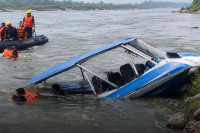
An eight-kilometre stretch of the BP Highway, built along a river diversion, has proved highly vulnerable. Each time the Roshi river swells, temporary diversions are washed away, halting traffic. Areas from Chaukidanda to Barkhe Khola, including Katunjebesi, Charasayabesi, Narke, Chiuribas, Boksikuna, Kalidhunga and Pipley, have suffered repeated damage.
“We have been reopening and closing the road frequently after floods sweep away temporary diversions,” said Suman Yogesh, chief of the Road Division Office in Bhaktapur. “Construction is underway to shift the road to higher ground where possible. Until then, vehicles must rely on riverbed diversions, which are risky during rains.”
Contractors rebuilding the damaged sections are responsible for restoring these temporary routes, officials said, adding that this has not imposed additional financial burden on the state. Still, disruptions have raised urgent questions about reliable alternatives.
For now, the answer is the Pushpalal Highway.
After devastating floods in October 2024 severely damaged the BP Highway, the Pushpalal Mid-Hill Highway has increasingly served as an alternative route. Vehicles travelling to and from districts such as Ramechhap, Okhaldhunga, Solukhumbu and Khotang have been diverted to this route whenever the main highway is blocked.
“When the BP Highway closes, this becomes the only dependable route. It is longer, but at least we can move,” said a bus driver in Manthali, the district headquarters of Ramechhap.
However, the alternative route has its own vulnerabilities. The 2024 floods eroded around 400 metres of road near the Khimti Hydropower station at Kirnetar in Tamakoshi Rural Municipality. A new track has since been opened, but full restoration remains slow.
The Sindhuli Road Division Office has awarded a contract worth Rs190 million to repair 1.2 kilometres of flood and landslide-damaged sections. “Work is ongoing, but progress has been slower than expected,” said Surdarshan Upreti, information officer at Sindhuli Road Division Office.
Officials insist that keeping the Pushpalal Highway operational is now a priority. “We are ensuring that this alternative route remains open. Contractors have been instructed to deploy machinery to quickly clear any obstructions,” said Upreti.
The route connects Khurkot to Manthali in Ramechhap, then to Tamakoshi and Charikot in Dolakha, before linking with the Araniko Highway at Khadichaur in Sindhupalchok and finally reaching Kathmandu. Much of the road is blacktopped and two-lane, although some sections remain under construction.
According to Narayan Datta Bhandari, chief of the Road Division Office in Charikot, the road has long served local communities. “Before the BP Highway became fully operational, people here depended on this route. Now it is again proving its importance,” he said.
A separate alternative route via the Sitkha motorable bridge, connecting Khurkot to Ramechhap and Sindhuli through Khandadevi Rural Municipality, has also been opened. Though longer, it provides another option during prolonged closures.
Traffic police warn that drivers must remain cautious. “The road is two-laned, but speeding can be dangerous, especially in hilly terrain,” said Thakur Prasad Bhattarai, chief of the District Traffic Police Office, Dolakha.
Meanwhile, reconstruction of the BP Highway continues, though challenges remain. Floods in October 2024 damaged 30.5 kilometres between Bhakundebesi and Nepalthok. Of this, 27.3 kilometres have been contracted out in four different packages, with work underway.
Major contracts include an 11-kilometre stretch awarded for Rs1.14 billion and another nine-kilometre section for Rs1.22 billion. Additional segments, including a 2.3-kilometre stretch, are also under construction, while a 3.2-kilometre section is being built with Japanese grant assistance worth Rs2.63 billion.
Despite these efforts, progress has been uneven. “We are working to ensure vehicles can use the road itself from mid-June, without relying on river diversions,” said Yogesh. Currently, about eight kilometres still depend on temporary diversions. More than 4,000 vehicles use the highway daily, underscoring its importance as a key trade and transport corridor.
Concern over repeated disruptions has drawn political attention. A parliamentary team led by Infrastructure Development Committee chair Ashish Gajurel conducted a field inspection on Wednesday. “Work is progressing, and machinery is being used adequately. Although travel may not be smooth before full blacktopping, it appears that traffic will not be completely halted during the monsoon,” said Gajurel.




 13.86°C Kathmandu