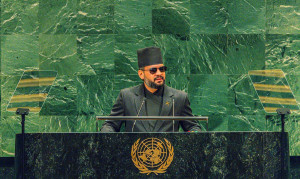
The Rastriya Swatantra Party, which commands a near two-thirds majority, is attempting to govern by ordinance, suspending the parliamentary session.
A Cabinet meeting of the Balendra Shah government decided to issue ordinances to amend laws related to the Constitutional Council and the refund of savings deposited by members of troubled cooperatives, and sent them to the Office of the President. Kiran Pokharel, press adviser to President Ramchandra Paudel, told Kantipur that the ordinances are under review.
Based on the government’s recommendation, the President had earlier summoned the session of both houses of the federal parliament for April 30. It was postponed indefinitely two days later, again on the Shah administration’s recommendation.
Even as the government argued that the House session was deferred by only a few days because the Parliament Secretariat had not completed preparations, the motive was revealed on Monday.
“It now appears that the government ended the session abruptly to issue the ordinances,” constitutional expert Bipin Adhikari said. “It is wrong for a government with such a huge representation to bypass Parliament. The party had the opportunity to establish good parliamentary practice.”
Article 114 of the Constitution states that the President may issue an ordinance, on the recommendation of the Council of Ministers, when both houses of the federal parliament are not in session and when immediate action is necessary.
This constitutional provision sets two mandatory conditions for ordinances. First, Parliament must not be in session. Second, there must be an urgent need for immediate action. Even if Parliament is not in session, the government cannot issue an ordinance unless urgent action is required.
Law Minister Sobita Gautam told Kantipur that the ordinance was necessary to fill a legal vacuum in the Constitutional Council Act, enabling the appointment of a chief justice without delay.
The original Constitutional Council Act, 2009, required that all six members of the Constitutional Council be present at meetings. It required unanimity for decisions. If unanimity was not possible, four members could decide.
Chaired by the prime minister, the council comprises the chief justice, the Speaker, the chairperson of the National Assembly, the leader of the main opposition, and the deputy Speaker.
Later governments amended this through ordinances, allowing decisions by the majority vote in the presence of at least four members. But those ordinances were never endorsed by Parliament and became inactive. It was then understood that the original provisions had also lapsed, creating a legal vacuum unless the government revived them through legislation.
However, constitutional expert Bhimarjun Acharya said the Supreme Court’s full bench had already ruled that when an ordinance becomes inactive, the earlier legal provisions automatically revive. Therefore, the original 2009 provisions of the Constitutional Council Act remain fully in force.
“The government’s claim that the ordinance was necessary to address the legal vacuum is not correct. The government needs to update itself. The provisions of the Constitutional Council Act remain intact,” he said.
A full bench of the Supreme Court last November ruled that if the ordinance is withdrawn, the original provisions are automatically revived.
A full bench of Justices Sapana Pradhan Malla, Sunil Kumar Pokharel, and Meghraj Pokharel ruled in a case related to the split Janamat Party led by CK Raut that once an ordinance lapses, the previous law automatically comes back into force.
Acharya said the ordinance is inappropriate for two additional reasons.
“Previous governments excessively misused ordinances. In particular, the government led by KP Sharma Oli dissolved the House and brought ordinances, or ended sessions just to issue the ordinances,” he said. “Those practices were against the rule of law. Now the same practice appears to be returning.”
Acharya says the Shah government's move to end the parliamentary session before it commenced has set a bad precedent. “The larger the party, the greater the responsibility. The Rastriya Swatantra Party must not set a wrong precedent.”
The opposition parties have taken serious objection to the move.
Nepali Congress spokesperson Devaraj Chalise described the practice as “highly objectionable in terms of democratic values, parliamentary dignity, and constitutional procedure.”
“This is not merely a procedural error but a clear case of executive overreach into Parliament’s legislative authority. It weakens the fundamental spirit of the rule of law and exposes the government’s distrust of Parliament,” said the main opposition party in a statement.
The Nepali Communist Party has also opposed the ordinance. A meeting of its Central Coordination Committee on Tuesday demanded that the budget session of Parliament be convened immediately.
“Pushing ordinances by suspending the parliamentary session is an undemocratic act of deceiving Parliament. We demand Parliament be convened immediately,” said a statement issued by party spokesperson Prakash Jwala.
The Rastriya Prajatantra Party has also joined the league. The party’s lawmaker, Khushbu Oli, also said that “moving ahead through ordinances while Parliament is not in session is a serious attack on parliamentary practice.”
“What reason does a government with a clear majority have to bypass Parliament and choose the ordinance route?” she asked. “Important matters like the Constitutional Council and the cooperative sector that directly affect people’s lives, should not be advanced by bypassing Parliament. As an opposition lawmaker, I strongly oppose such tendencies that render Parliament inactive...”
Five years ago, the Supreme Court had said that the repeated practice of governing through ordinances while circumventing Parliament was contrary to the principle of separation of powers.
While reviewing the validity of the citizenship ordinance issued by the then [KP] Oli government after the dissolution of the lower house, a Constitutional Bench held that issuing ordinances for executive convenience by sidestepping Parliament amounted to undue interference in the authority and effectiveness of the legislature.
It termed such ordinances “camouflaged legislation” and ruled that ordinances issued with the intention of bypassing Parliament could not gain constitutional legitimacy.
Adhikari, the law professor, said the executive’s power to issue ordinances exists in the Constitution only as an exception.
He said governments had established a wrong tradition of using ordinances to avoid Parliament and evade questions raised within it. The current government, too, has chosen the same old path by issuing ordinances instead of summoning Parliament on the eve of the budget session.
The Constitution requires the budget to be presented in Parliament by Jestha 15 (May 29 this year). Before that, the President must present the government’s policies and programmes in a joint session of Parliament, which must be endorsed. In addition, pre-budget discussions should also be completed beforehand.
For that reason, it has been customary to summon the budget session by April-end. Last year, the session was convened on April 25.
A parliament official said the time to summon the budget session is rapidly running out, and unless the House is called within a week at most, there may not be sufficient time for the policy speech and pre-budget discussions.




 23.24°C Kathmandu