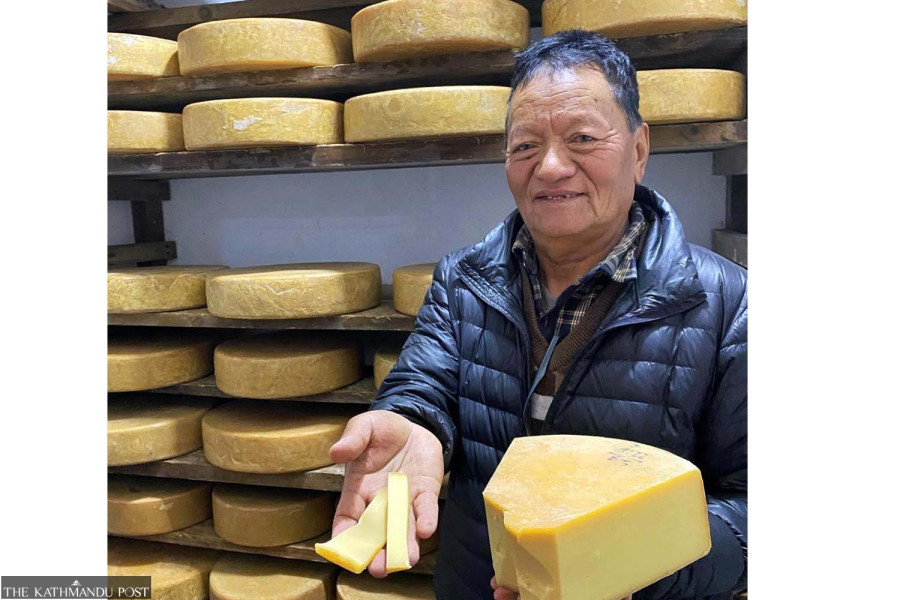
A photograph posted by Prime Minister Balendra Shah on Saturday, showing him tasting yak cheese produced by the state-owned Dairy Development Corporation (DDC), set social media abuzz and rekindled public interest in one of Nepal’s oldest commercial dairy products. But beneath the renewed attention lies a deepening crisis in an industry that once represented the pride of Nepal’s Himalayan economy.
Commercial cheese production stands as Nepal’s very first industrial dairy venture. Its history traces back to 1952, when Swiss specialist Werner Schulthess arrived in Nepal alongside renowned geologist Toni Hagen. In an era when commercial milk trading was entirely unknown in the high mountains, Schulthess identified a distinct economic opportunity.
Investing his own funds, Schulthess overcame immense geographical hardships to set up Nepal’s first production plant in the rugged Langtang valley of Rasuwa District, processing milk from nak—the female yak. Initially, the cheese was purchased by foreign tourists exploring Langtang or carried by porters down to the traditional markets of Asan in Kathmandu.
Six years later, Schulthess opened another factory in Thodung, Solukhumbu, followed by one in Patle in the same district. The DDC later expanded production by establishing factories in Gosainkunda (Rasuwa) and Jiri (Charikot) with Swiss assistance. Yak cheese eventually became Nepal’s first internationally recognised dairy product. Its global prestige echoed writer Clifton Fadiman’s famous phrase “milk’s leap to immortality.” But this legacy is now under threat in the Himalayas.
Keshar Jirel, a former manager of the Cherdung Yak Cheese Factory in Jiri, remembers the factory’s peak years vividly. Trained by Swiss experts in 1974, he spent nearly three decades working in cheese factories across Langtang and Gosainkunda.
“At that time, no country other than Nepal produced cheese commercially from chaunri milk. We learnt the skills from Swiss technicians, and yak cheese gained an international identity,” said Jirel.
Jirel recalled meeting Schulthess in 1987. “He used to say he carried sacks of coins to Langtang to buy milk and establish the first factory there. Back then, transport was difficult and everything had to be carried on foot,” he said.
According to Jirel, yak cheese became widely known after King Birendra took it as a gift during his visit to France in the mid-1970s. Later, officials from Bhutan and China visited Nepal to learn cheese-making techniques.
“At one point, foreign governments sent people here for training. We even trained visitors from Bhutan and China,” said Jirel. He said that in 1999, he spent four months each in Switzerland and the Philippines studying cheese production from goat and cow milk, and also worked in several factories there.
The industry expanded rapidly during the 1990s. Jirel said the Jiri factory alone used to produce around 18,000 kilograms of cheese and 6,000 kilograms of butter annually. Other factories in mountain districts produced between 5,000 and 10,000 kilograms every year.
“We produced cheese in the mountains and sent it to the corporation,” he said. “From Kathmandu, it reached foreign markets.”
Once the yak products were a major source of income for Himalayan households. But the industry has steadily weakened over the years as younger generations abandon yak and chaunri, a hybrid of yak and cow, herding. Producers say difficult living conditions, lack of veterinary services, shrinking grazing areas and poor government support have pushed many herders out of the occupation.
“When I retired in 1999, the Cherdung factory still produced around 6,000 kilograms of cheese. Now people in the mountains are giving up yak farming altogether. Factories are shutting down one after another,” said Jirel.
Dolakha currently has two DDC-owned factories in Jiri and Chankhu of Gaurishankar Rural Municipality. Together, they now produce barely 400 kilograms of cheese during the production season. A privately run factory in Kalinchok is also struggling because of milk shortages.
Jirel warned that Nepal risks losing a product closely tied to its Himalayan identity if urgent steps are not taken to encourage yak herding. “It is painful to watch a product with such a proud history slowly disappear,” he said. “Yak cheese once introduced Nepal to the world. Today, even finding it has become difficult.”




 13.86°C Kathmandu