Everest route through Khumbu Icefall finally opened after 19-day delay
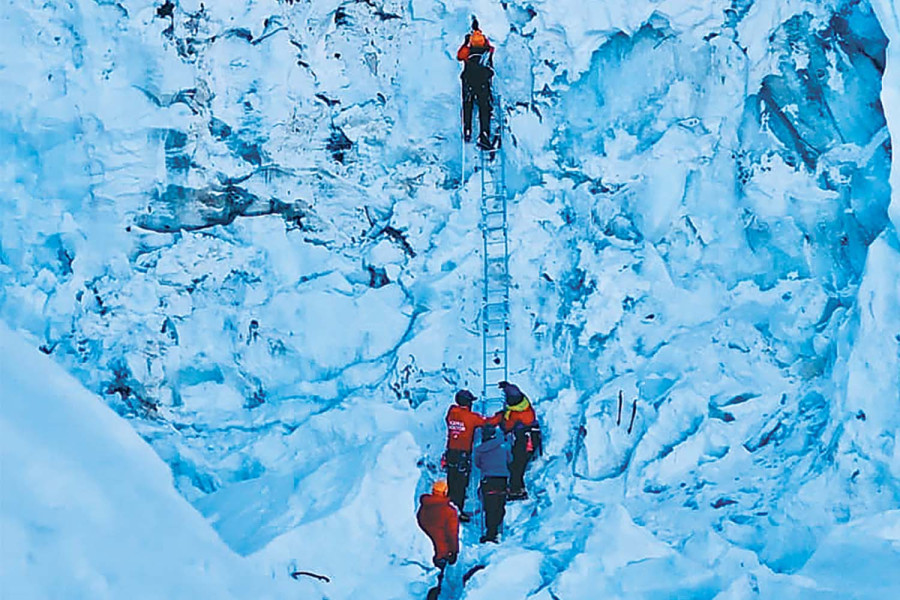
Climbers to begin acclimatisation as teams fix path beyond serac. A ladder being set up to climb up the Khumbu Icefall in Solukhumbu. Courtesy of the Department of Tourism
After 19 days of delay in preparing the route to climb Everest, there is finally some relief for hundreds of climbers and guides who have been waiting anxiously at base camp.
The world’s highest peak had effectively remained blocked by millions of tonnes of towering ice in the Khumbu Icefall—the treacherous and constantly shifting section of the route that has claimed numerous lives over the years.
The Department of Tourism on Tuesday confirmed a major breakthrough, raising hopes that the climbing season can now proceed, albeit with some delay and heightened caution.
A passage through the Khumbu Icefall, which had been obstructed by a massive and unstable serac formation, has now been opened. By Tuesday, route setters had managed to establish a track leading close to Camp II, marking significant progress in what had become one of the most challenging early-season preparations in recent years.
Ram Krishna Lamichhane, director general of the Department of Tourism—the government agency overseeing mountaineering activities—said a team of experienced high-altitude climbing guides had successfully opened the route, though some delays in the climbing schedule are still expected.
“After a few days, climbers will begin acclimatisation rotations—moving up and down the mountain to allow their bodies to adjust to altitude,” he said. He added that in order to complete route fixing all the way to the summit, authorities have recommended boosting manpower deployment and ensuring the timely delivery of logistics.
The newly opened route broadly follows the path used in previous years, although conditions this season have been far more unstable due to the unusually large and fractured serac blocking the way.
According to a report by the Sagarmatha Pollution Control Committee (SPCC), the body responsible for preparing the route up to Camp II, the serac that caused the obstruction measures approximately 55 metres in length, 37 metres in width and 28 metres in height.
The structure has developed multiple cracks and remains at risk of collapse at any time, making route selection extremely risky.
“Good morning and good news: Khumbu Icefall route opened,” Seven Summit Treks, Nepal’s largest expedition operator, announced on its official social media page early Tuesday.
“We would like to confirm that, as of April 28, the Khumbu Icefall route is officially open, with the fixing team successfully reaching Camp I today. The route has been fully established with ladders, ropes and anchors through the Icefall,” the company said.
“With this critical section now secured, rotations to Camp I will begin shortly for more than 400 climbers currently waiting at Everest Base Camp for expeditions to Everest, Lhotse and Nuptse, along with a large number of Sherpa support teams preparing for summit pushes.”
Mingma Sherpa, chairman of Seven Summit Treks, said that once camps at Camp I and Camp II are fully set up, acclimatisation rotations will begin in earnest.
“It will take three to four days to establish the camps properly,” he said. “Completing the route fixing work all the way to the summit may take around 10 more days.”
According to a detailed statement issued by the SPCC, at approximately 4:00 pm on Tuesday, eight Icefall Doctors, along with 16 mountain guides from various expedition operators, safely returned to base camp after successfully opening the route up to the Nuptse face, very close to Camp II.
The Icefall Doctors had initially begun route preparation on March 16 and had secured a safe passage up to the rockfall point by April 8, 2026. This section of the Khumbu Icefall lies along the route traversing the base of the Mt. Nuptse ridge, where climbers must pass directly beneath steep, unstable slopes.
The entire Khumbu Icefall—widely considered the most dangerous section of the Everest climb—lies between elevations of 5,486 metres and 6,100 metres. The terrain is highly unstable, with massive seracs, shifting ice blocks and frequent rockfall posing constant threats as the glacier moves and collapses along a nearly 600-metre descent.
After April 8, however, the Icefall Doctors were unable to make further progress due to the presence of a massive serac that completely blocked the route. According to the SPCC, the formation was closely monitored through repeated on-site inspections as well as drone imaging.
Although a portion of the serac collapsed during this monitoring period, the remaining mass continues to pose a significant and unpredictable danger.
As the narrow climbing window approached, the SPCC coordinated closely with the Department of Tourism and the Expedition Operators Association-Nepal to assess possible solutions. A joint helicopter inspection was conducted on April 25, followed by a ground-level site visit to the rockfall point on April 26.
“Both assessments confirmed that severe risks remain at the location,” the SPCC said in its statement.
On April 26, the SPCC was informed that a separate team led by Mingma G had attempted to establish an alternative route through the affected section. Building on that effort, Icefall Doctors and 15 additional mountain guides departed base camp on Tuesday to reassess the situation on the ground.
The team evaluated a proposed vertical route that would pass above the serac. However, this option was ultimately deemed too dangerous, as it would have required the installation of around 10 vertical ladders on unstable ice formations.
Additionally, Icefall Doctors reported observing significant rockfall activity in the area during warmer daytime temperatures over recent weeks, further complicating any attempt to reroute climbers above the hazard.
“After ruling out the vertical route suggested by the Mingma G team, our Icefall Doctors explored an alternative path through the centre of the section, but no safer option could be identified,” the SPCC said.
“Given the circumstances and the limited time remaining before the peak climbing season, the team had no alternative but to open the route passing below the serac.”
Mingma G, managing director of Imagine Nepal, said his team had earlier conducted an independent assessment of the route on April 25.
“Our team left around 6:30 am to work on our own plan,” he said. “They reached the blockage area and explored possible alternatives, eventually deciding to climb the wall.”
He said that conditions beyond the wall resembled those of the previous year, with the route aligning closely with earlier paths.
“The team was close to Camp I when they encountered a whiteout, but by then the key work had already been completed,” he said.
Despite the opening of the route, authorities have stressed that the risk has not been eliminated. The SPCC has issued strict safety protocols that all climbers and expedition operators must follow while crossing the “rockfall point” section.
Climbers have been instructed to move quickly through the rockfall zone to minimise exposure time, limit the loads carried by high-altitude workers, ensure that only one person crosses a ladder at a time, and remain clipped into safety ropes on both sides while traversing ladders.
At present, eight ladders have been installed across three key sections, though Icefall Doctors anticipate that more will be required as crevasses continue to widen with rising temperatures.
The SPCC has cautioned that although the route is technically open, it remains unsafe at the rockfall point due to the unstable serac above. In the event of any emergency, climbers have been instructed to immediately report incidents via radio frequency 144.200.
Milan Pandey, co-founder of Airlift Technology—a company assisting with logistics using drones—said they had already begun supporting operations.
“We supplied four aluminium ladders and five rolls of rope via drone up to Camp I on Tuesday,” he said. “As per SPCC instructions, we remain on standby to deliver oxygen cylinders and other essential logistics as required.”
The Khumbu Icefall has a long and deadly history. On April 18, 2014, a collapsing serac triggered an avalanche that killed 16 Sherpa guides, marking one of the deadliest single incidents on Everest and forcing the cancellation of that year’s climbing season. The tragedy led to adjustments in route planning to reduce exposure to similar zones.
More recently, on April 12, 2023, three Sherpa guides were killed in another avalanche triggered by a massive icefall collapse in the same area.
As of Monday, the Department of Tourism had issued Everest climbing permits to 425 climbers, indicating a strong turnout for this year’s season despite the early challenges.
Sangam Prasain is Business Editor at The Kathmandu Post, covering tourism, agriculture, mountaineering, aviation, infrastructure and other economic affairs. He joined The Kathmandu Post in October 2009.




 13.58°C Kathmandu