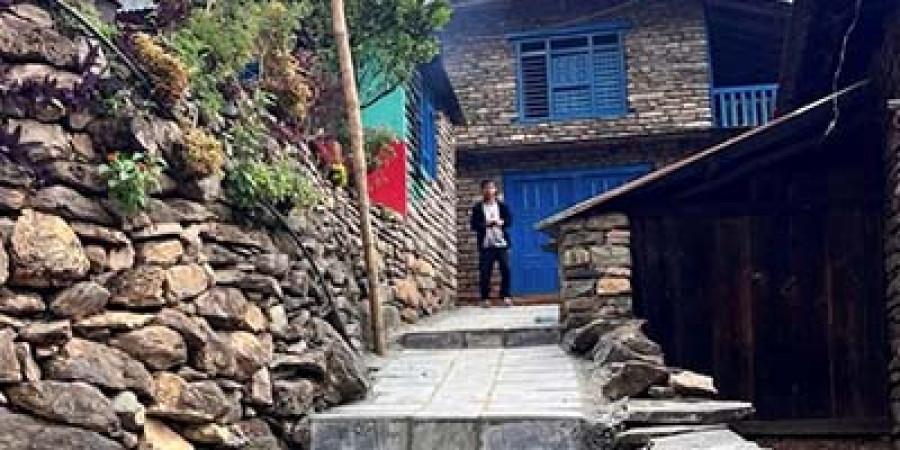
Active support from local people in cleaning and road building has begun to ease long-standing problems in Harichaur, Galkot Municipality-5, Baglung.
In the past, footpaths were slippery and unsafe, houses were run down, and roads were full of potholes. Even the historic Galkot Durbar, a reminder of the Baise-Chaubise period, was close to collapse.
The palace has now been repaired and repainted as part of a plan to turn it into a key tourist site. The ward’s drive for full sanitation and safe drinking water has addressed long-standing complaints in a short time.
Damaged stretches of road in the bazaar have now been concreted. In a joint effort between the ward and residents, a motorable bridge over the Khahare stream was built at a cost of Rs 2.5 million. Pavements have been marked with yellow paint to separate pedestrians and vehicles, while paved walkways have been added where vehicles do not operate. Homes have been provided with waste bins, helping keep streets and villages clean. The upgrade of the old health post into a municipal hospital has also turned the once-quiet market into a busy centre.
The hospital now treats more than 150 patients a day. Located near the Mid-Hill Highway, it attracts people from nearby areas and districts. Yogesh Bhandari, a resident of Galkot, said business is growing in the market, which was once little known. Empty houses are being reoccupied as families move in from places such as Tarakhola and Bhujunge.
These families have repaired and decorated their homes, improving the appearance of the village. This change began after the municipality allocated budgets at the ward and municipal levels to clean old markets and repair damaged roads. The Khahare Khola Small Irrigation Project has helped control floods and landslides, while two concrete bridges funded by the ward have ended monsoon-related problems. Work is also underway to blacktop the road from Harichaur Bazaar to Teuwa via Kauleni.
Improved roads have brought more visitors to the sculpture project in Teuwa, which displays works created in 2019 by artists from ten countries, including Nepal. A trekking route has also been developed from Teuwa to the 11,000-foot Ghumte Peak. Fairs are held there every New Year and on Baisakh Purnima, although visitors come throughout the year. Ward chair Pawan Hamal said proper use of funds has made Harichaur clean and orderly.
“We built this infrastructure by combining the budget with voluntary local labour,” Hamal said. “When spending and work match the plan, projects succeed.” He is often seen helping with tasks such as carrying stones, mixing cement and building roads. Municipal chief administrative officer Damber GC said strict cost-sharing has helped ensure quality work.
Local resident Tulasi Niure said development planning has been easier as all parts of the ward are within a 5km drive of the Mid-Hill Highway. The main road from Hatiya to Tarakhola, which passes through Harichaur, has been blacktopped with provincial funds, while smaller roads were funded by the ward and municipality.
“Since the hospital was built, people have supported development through voluntary work,” Hamal said, adding that he aims to make the ward a model for sanitation. He noted that most homes now have taps under the ‘One House, One Tap’ campaign. In Teuwa, where the elevation makes water supply more difficult, plans for a lift system are under way, with tanks and shared taps already in place.
The ward has also built a sports ground and a child-friendly park. People living abroad have also contributed, donating an ambulance and supporting other projects. Residents in Japan even helped set up an eye treatment centre. For the current fiscal year, Galkot Municipality has allocated Rs 82.8 million for infrastructure, with small ward projects receiving between Rs 100,000 and Rs 300,000 each.
Other traditional markets—Narethanti in ward 2, Hatiya in ward 3, Kharuwa in ward 4, Kandebas in ward 8, and Baskhola in ward 9—have also been improved.
Bal Bahadur Khatri, chair of ward 4, said blacktopping and cleaning have made these places more attractive to visitors. The municipality plans to connect all ward offices with blacktopped roads, although Pandavkhani in ward 10 and Righa in ward 11 are still pending due to distance and payment issues with contractors.




 23.12°C Kathmandu
.jpg)