The man who mastered Nepali politics couldn’t master himself
For six decades, Sher Bahadur Deuba outlasted rivals, outwitted kings, and came back from every political near-death. His final undoing was of his own making.
On December 22, 2024, Sher Bahadur Deuba, then-president of Nepali Congress, was in Biratnagar to attend the party’s Koshi provincial conference. During his address, then-General Secretary Gagan Thapa said, “Our party president does not talk much.”
When his turn came, Deuba returned the favour. “The general secretary has already said a lot, so I will say just one thing: I speak less,” he said. “Those who talk a lot shoot themselves in the foot. Those who talk less finish others off.”
In that moment, Deuba summed himself up. The politician, now 80 with a political career spanning over six decades, has long faced criticism—at times ridicule—for his reticence. He rarely tried to deflect it, nor did he seem particularly bothered by it.
The Biratnagar event was one of the rare occasions when Deuba spoke about not speaking much. Yet his career has consistently suggested something else—that to be in power, one does not necessarily need oratory skills and that politics is an art that can be mastered even without the gift of the gab.
What transpired in Biratnagar—the exchange of words between Thapa and Deuba—however, was an indication that not everything was right in the grand old party. The seeds of discord had just begun to sprout.
But that episode took place months before the Gen Z protests that drastically changed not only Nepal’s political landscape but also the way the public viewed the country’s socio-politics.
On the second day of the protests, on September 9, Deuba and his wife, Arzu, were manhandled by demonstrators at their home, which was also set on fire. The Deubas were among the politicians in Nepal who were long viewed as power elites.
How did a man from the far-west, which still ranks low on different parameters of the HDI, become one of Nepal’s most powerful persons—serving five times as prime minister?
Deuba’s story is one of struggle, prison terms, democratic movements, and organisation-building. As if he was born to do politics, to live politics. But then the time came when the fall started. His political arc is such that he rose and rose, but then the democratic values he once espoused began to diminish—one step at a time.
Born on June 13, 1946, in Ruwakhola, Asigram in Dadeldhura, Deuba cut his teeth in politics as a student leader.
Nepali Congress’s founding father, BP Koirala, was in Banaras, India, in exile then.
Deuba was one of the candidates to lead Nepal Students Union (NeBi Sangh), the newly formed student wing of the Nepali Congress, in the convention of the organisation held in 1980 in Bharatpur.
As the favoured choice of BP Koirala, Subarna Shumsher, Ganesh Man Singh, and Krishna Prasad Bhattarai—the stalwarts of the Nepali Congress—Deuba was elected unopposed.
About two years ago, at a function organised in Sudurpaschim, Deuba was invited as chief guest. He narrated a story about how he had first reached Kathmandu after the School Leaving Certificate exams in 1962.
“I walked on foot to reach Dhangadhi. Then crossed over to India to take a train to reach Lucknow the following day. I switched trains to reach Muzaffarpur and then to Raxaul in Bihar,” he said. “From there, I crossed over into Nepal [Birgunj] to travel to Kathmandu.”
As he narrated his three- to four-day-long arduous journey to Kathmandu—from where he would lead the country five times—people from his region were grumbling about how the far-west was still lagging behind in economic indicators.
Deuba’s contemporaries say that had he not had the backing of BP, Ganeshman, and KP Bhattarai, a man from a humble background in one of the remotest regions in the country would not have become the “lion” (English translation of his Nepali name Sher) of Nepali politics.
According to Bal Bahadur KC, one of Deuba’s contemporaries, he was picked by NC stalwarts to lead the region as a commander. “Its effect in due course was bound to be seen in national politics,” KC said. “It’s not that the far-west did not have other leaders. But Deuba had the backing; he had already made his name before the top leadership.”
In Kathmandu, Deuba joined Tri-Chandra College in 1964. He later completed his master’s in political science from Tribhuvan University. Congress leader Chiranjivi Wagle (who left active politics following corruption charges) was Deuba’s college mate at Tri-Chandra.
The founding leader of NeBi Sangh, Bipin Koirala, attributes Deuba’s rise also to the lack of competition, as there were no other leaders in Koshi, Gandaki, and other comparatively accessible and urban centres.
“At the time of the 1980referendum, when BP went to the west, he took Deuba along,” Koirala recalls. “Deuba got a chance to share the stage with BP, which then paved the way for him into national politics.”
During the 1991 election, the first after the restoration of democracy a year before, then acting party president KP Bhattarai and general secretary Girija Prasad (GP) Koirala entrusted him with the responsibility of distributing tickets in all 19 constituencies in the far-west.
Except for Darchula-2, Congress swept the elections, winning 18 constituencies. That deserved a reward. GP made Deuba home minister in his Cabinet. This was Deuba’s first tryst with real power. His appetite for power from then on just grew bigger, never to be satiated.
Then acting party president KP Bhattarai and general secretary Girija Prasad (GP) Koirala entrusted him with the responsibility of distributing tickets in all 19 constituencies in the far-west in 1991. Post File Photo
“Deuba was never out of power once he acquired it since becoming home minister,” says Bipin Koirala.
It is part luck, part artfulness that Deuba almost always managed to emerge as the “indispensable alternative.”
His contemporaries call Deuba a master player of power and equations. He not only became prime minister five times. Since the reinstatement of multiparty democracy, he always remained in a decisive role, either to make governments or break them.
“Power became a habit, a lifestyle for Deuba. He traded off his ideology for power,” says Bipin Koirala. “A norm was established that if you are not in power, you cannot win elections; without power, there is no survival. That made him forge all kinds of natural and unnatural alliances.”
The fall, however, was gradual.
Around a dozen of his contemporaries and analysts Kantipur spoke to say Deuba’s focus was never on personal or material gains until he became prime minister for a second time. They described him as a politician invested in power play rather than money.
Chiranjivi Wagle, who served as minister twice in Deuba-led governments, says that during his tenure as home minister, Deuba’s image was not of someone with materialistic greed. He had not courted political controversy either. According to Wagle, Deuba’s cupidity started to take root after he became prime minister.
He recalls an incident from Deuba’s tenure as home minister: “The government had decided to buy 20 vehicles for the Home Ministry. An agent met Deuba, proposing that if 20 vehicles were bought through him, he would gift one to Deuba.”
“After the vehicles were bought, the agent came to ask in whose name that extra car should be registered,” said Wagle. “Sher Bahadur ji said under the Home Ministry. The vehicle was registered in the ministry’s name.”
Many say Deuba’s life—and personality—took a sharp turn after his marriage to Arzu Rana in 1993.
A joke in NC circles did quite a few rounds after Deuba’s marriage. KP Bhattarai had taken a jab: “So, Sher Bahadurji until now was our man; now he has become Arzu’s man,” NC leaders share while recalling those moments. However, there is no unanimity among them on what Bhattarai, who often spoke in metaphors, actually meant.
Some said Bhattarai was hinting at the entry of a Rana lifestyle into Deuba’s life. Others said it was a jest about a potential makeover of Deuba’s bachelor’s pad, at his footloose and carefree lifestyle.
Nevertheless, inside the NC, a narrative had been brewing for quite a while, especially in the last decade—how “daju and bhauju” were spinning a money machine by abusing power, how Arzu controlled and traded off appointments and dealt with the price. Arzu’s involvement in the Bhutanese refugee scam—a well-coordinated fraud in which refugees from Bhutan living in Nepal were sent abroad, including to the US, by preparing documents identifying them as Nepali citizens—had also become a matter of public discussion.
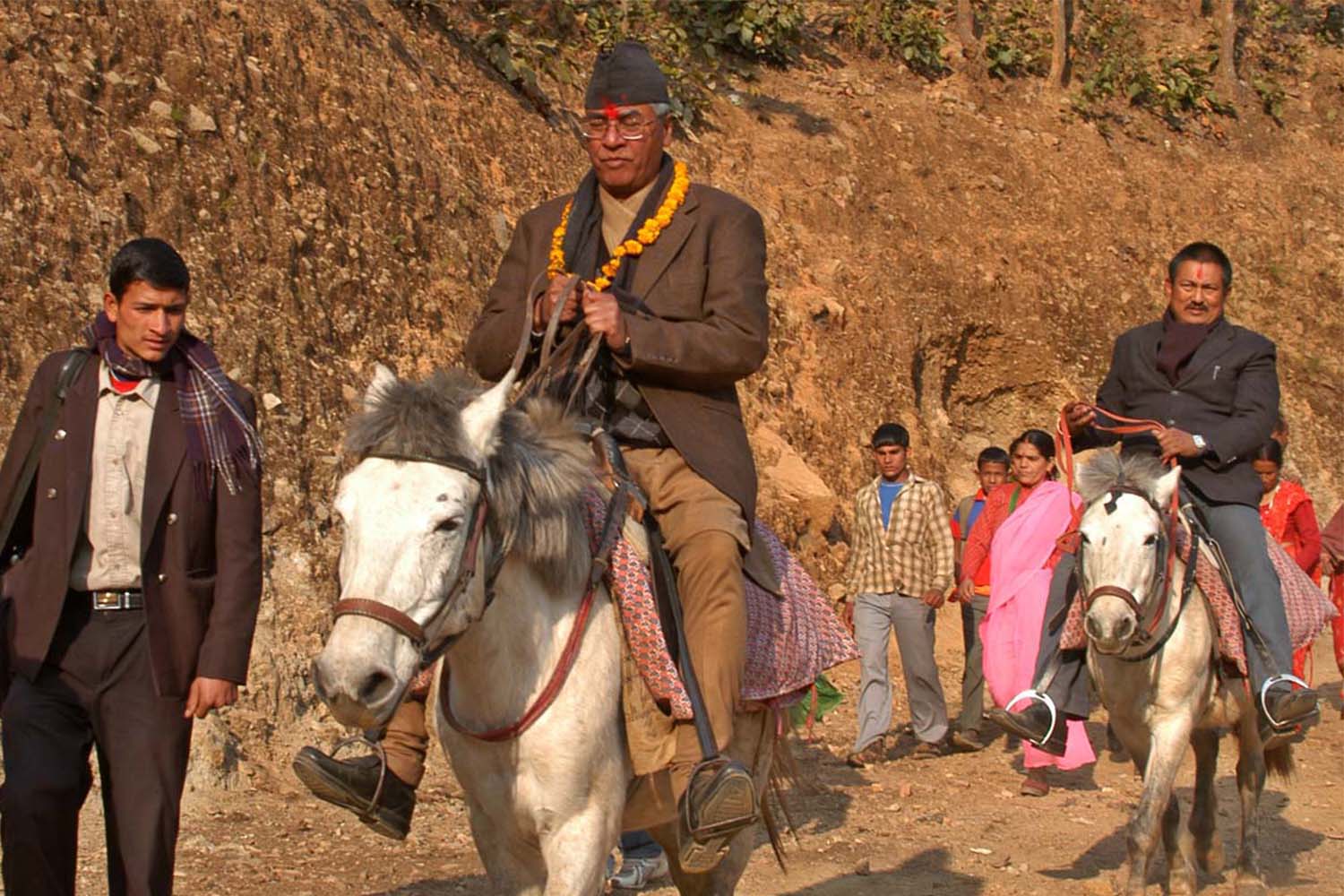
Deuba and Bal Krishna Khand on horseback. Post File Photo
When the 1990 pro-democracy movement was at its peak, Deuba was in the United Kingdom pursuing his studies.
During that time, some leaders speculated that Deuba was inclined towards the party-less Panchayat system, and that Bhattarai had sent him to the UK to keep him away.
Some also claim that even after the 1990 People’s Movement, Deuba was reluctant to return to Nepal. In conversations with Kantipur, some leaders said that after the movement ended—and multi-party democracy was restored—Deuba planned to stay in the UK for some more time and returned only after repeated calls from Nepal.
However, Gyanendra Bahadur Karki, one of Deuba’s close associates, rejected this claim.
“He returned soon after the 1990 People’s Movement ended,” Karki said. “It is not true that he wanted to stay behind in the UK.”
However, according to another close associate, Deuba had considered going to the United States for an internship from the UK.
“He got in touch with a leader who was studying in the US and expressed his desire to go there for an internship. I told him, ‘Democracy has been restored in Nepal. You should not stay abroad anymore—you must return,’” the leader said in a conversation with Kantipur.
“Sher Bahadur ji said, ‘I haven’t seen America yet. I would like to go there. I am not the first man of Krishna Prasad Bhattarai or Girija Prasad Koirala—why should I return immediately?’ Meanwhile, friends from Nepal were urging him to come back. Eventually, he returned to Nepal instead of going to the US.”
After overseeing the drafting of the interim constitution as prime minister, when Nepal held its first elections since the fall of the Panchayat in 1991, Bhattarai lost.
It was when GP Koirala appointed Deuba as home minister.
But over the years, Deuba changed. “We saw a huge transformation in him, but for the worse,” says an old Congress leader who once was in Deuba’s committee in NeBi Sangh.
“He is a world apart from what he used to be,” said Soviyat Bahadur Adhikari, a Nepali Congress leader. “He was once brave, like what his name suggests—someone who would fight for a cause, someone who inspired confidence in party members.”
What stood out, he says, was that Deuba “was a simple man.”
“He was frugal,” Adhikari said. “He had an image of a politician who did not have monetary greed until he was home minister.”
But simplicity is a trait not all human beings can preserve for long. For Deuba—the “Sher”—the taste of power became like a lion getting a taste of blood. Power politics was his game, which required resources, and managing resources needed manipulation.
When he became prime minister for the first time in 1995, GP Koirala got suspicious that Deuba was building his own power centre. After all, the Congress was known as the Koiralas’ party.
A former minister in Deuba’s cabinet recalled that he once shared with some ministers that GP was getting increasingly suspicious of him. The late Chakra Prasad Bastola was the foreign minister then.
Bastola passed on an idea, the former minister said.
The idea was: if Deuba wanted to maintain good relations with GP, he should go and meet him every morning and hand him cash. GP needed money to run the party.
“GP would never hoard money, as he would immediately distribute it among party workers,” the former minister said, recalling what Bastola had told Deuba. “If you do that, GP will be happy.”
Deuba did as advised, but his relationship with GP did not last long.
This was just after the nine-month-long Manmohan Adhikari government had fallen.
Deuba had managed to secure the support of the Rastriya Prajatantra Party (RPP) and Sadbhawana Party to become prime minister. He was 49.
Deuba quickly learned the ropes of control—rather than supplying money to GP to maintain a relationship, Deuba saw the use of resources as a way to consolidate his own power centre.
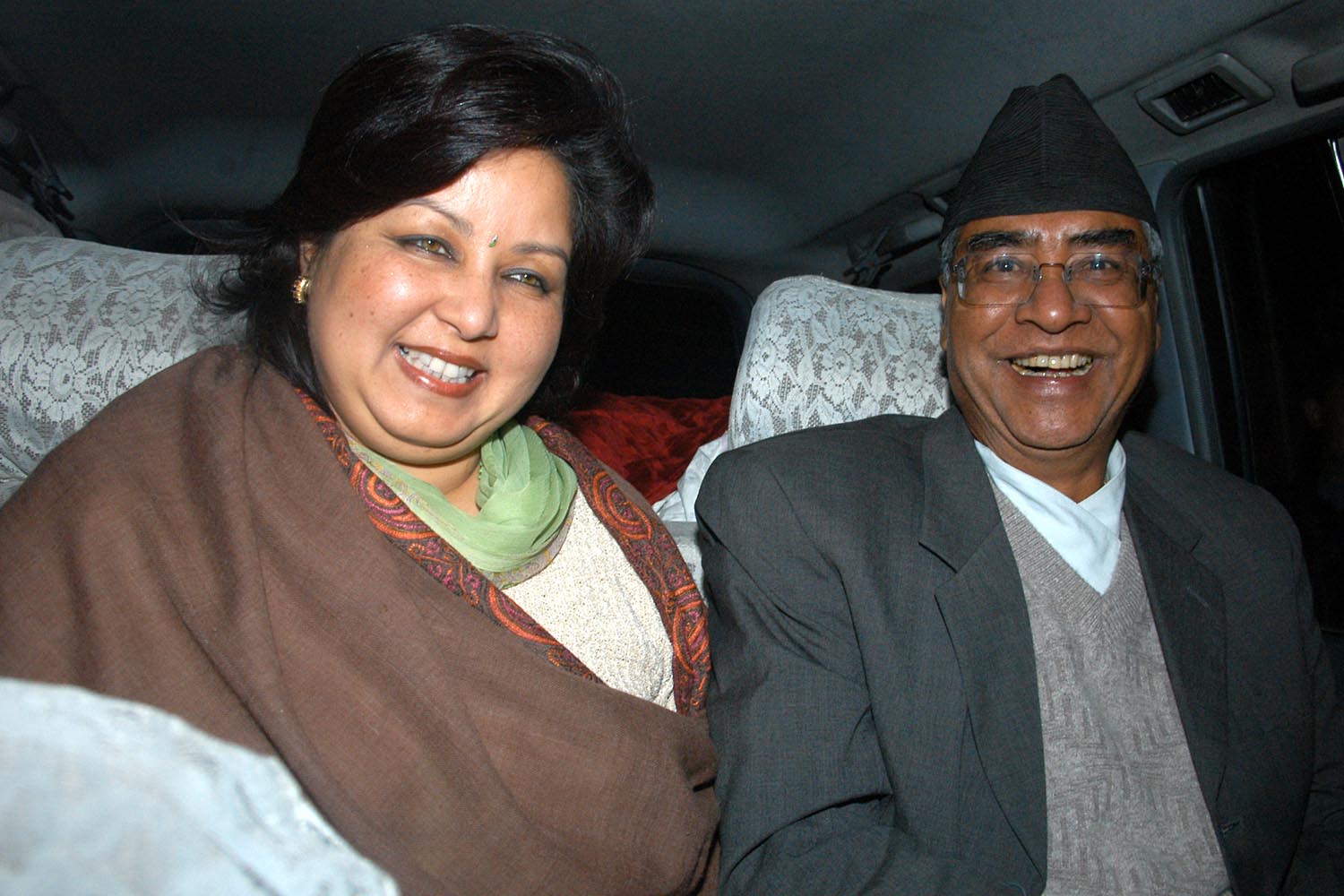
Deuba with his wife Arzu Rana. Post File Photo
Though Deuba got married to Arzu when he was home minister, he built his own house only when he became prime minister for the second time in 2001. When he was the leader of the opposition for the first time, he stayed at the government quarters provided to the leader of the opposition in Maharajgunj. He also stayed in Chundevi for some time in a rented apartment. Once, he lived in Thapathali in Bharat Shumsher Rana’s house.
Last, he was living in his mansion-like house in Budhanilkantha, which is currently in ruins, where half-burned bundles of cash were found after it was set on fire by demonstrators.
“Regardless of how one interprets it, whatever change that came in Deuba came after his marriage,” said a leader who has known him since the 1980s. “In the past decade or so, if Deuba was so deeply invested in power and money, it was because of Arzu.”
The common understanding among his party leaders is that his unnatural greed and ambitions led to the downfall of his political career at the fag end of his life.
Soviyat Bahadur Adhikari admits that an unusual change began to be seen in Deuba after his second term as prime minister.
“He was fine until he served as home minister and even during his first term as prime minister. After that, ordinary Congress workers began to sense a change in him,” Adhikari says. “Gradually, selfless, committed, and honest party workers were sidelined, while sycophants, cronies, greedy individuals, and wealthy people grew closer to him.”
The Budhanilkantha house—said to have been received as dowry from his in-laws around 1993—initially sat on around three ropanis [0.13 acres] of land. Arzu has repeatedly stated that the land was gifted by her parents. Leaders close to the Deuba family say that, over time, plots were added, and the property has now expanded to more than seven ropanis [0.89 acres]—an area astronomically large for a family house by Nepali standards.
Wagle acknowledges that Deuba had increasingly given in to financial temptations in recent years.
“In the earlier days, he was a politician with a zeal to do something,” Wagle said. “He is someone who came through a long struggle and even spent time in prison. But in recent years, especially after 2013/14, he appears to have been more consumed by greed. During the Panchayat era, people used to say the kings themselves were fine but those around them spoiled things; similarly, some now say that Sher Bahadur was influenced negatively by Arzu.”
Wagle added, “Rather than blaming Arzu, Sher Bahadur himself should reflect on this.”
What makes Deuba’s political career infamous is the corrosive culture he infused into parliamentary democracy.
Journalist Hari Bahadur Thapa recalls that the first Deuba government passed a decision to grant 90 percent customs exemption for Indian vehicles for the lawmakers and 50 percent for high-end vehicles.
“Deuba gave the nod to that policy based on an all-party agreement,” Thapa said. “Lawmakers bought Prados and Pajeros. To make things worse, they bought the vehicles under tax exemption, but sold them. This vehicle episode is the starting point of the pernicious ‘Pajero and Prado culture’ in Nepali politics.”
That Deuba could go to any length to be in power is reflected in another incident as well.
In the first week of December 1996, the CPN-UML, backed by RPP’s Lokendra Bahadur Chand, tabled a no-confidence motion against Deuba. The voting was slated for December 24. Deuba had become prime minister with the support of the RPP and Sadbhawana Party, among others. But when RPP’s Chand faction sided with UML, Deuba’s premiership was in crisis.
What Deuba did was unprecedented. Lawmakers who could potentially vote against him were lodged in a star hotel in Kathmandu. Some supporting him would get bagfuls of cash.
“It was during that time, on the parliamentary premises, that people talked about 17 kg bagfuls of cash—a ballpark figure suggesting that Rs10 million in thousand-rupee notes would weigh about 17 kg,” recalls Thapa.
Thapa also recalls that Deuba handed over 2,000 dollars each to five ministers who could potentially vote against him and sent them off to Bangkok.
“He used all the tricks in the book to remain in power. He survived the December 24 vote of no confidence, but could not last long,” said Thapa.
Such was the quirk of fate that the UML, which had moved the no-confidence motion, could not guarantee the numbers to form a government. This necessitated Deuba to prove that the House had confidence in him. So he went for a floor test.
“Dipak Bahadur Shahi and Chakra Bahadur Shahi of Deuba’s own party did not show up,” said Thapa, who extensively reported on Parliament at that time. “Deuba’s 575-day-long tenure came to an end.”
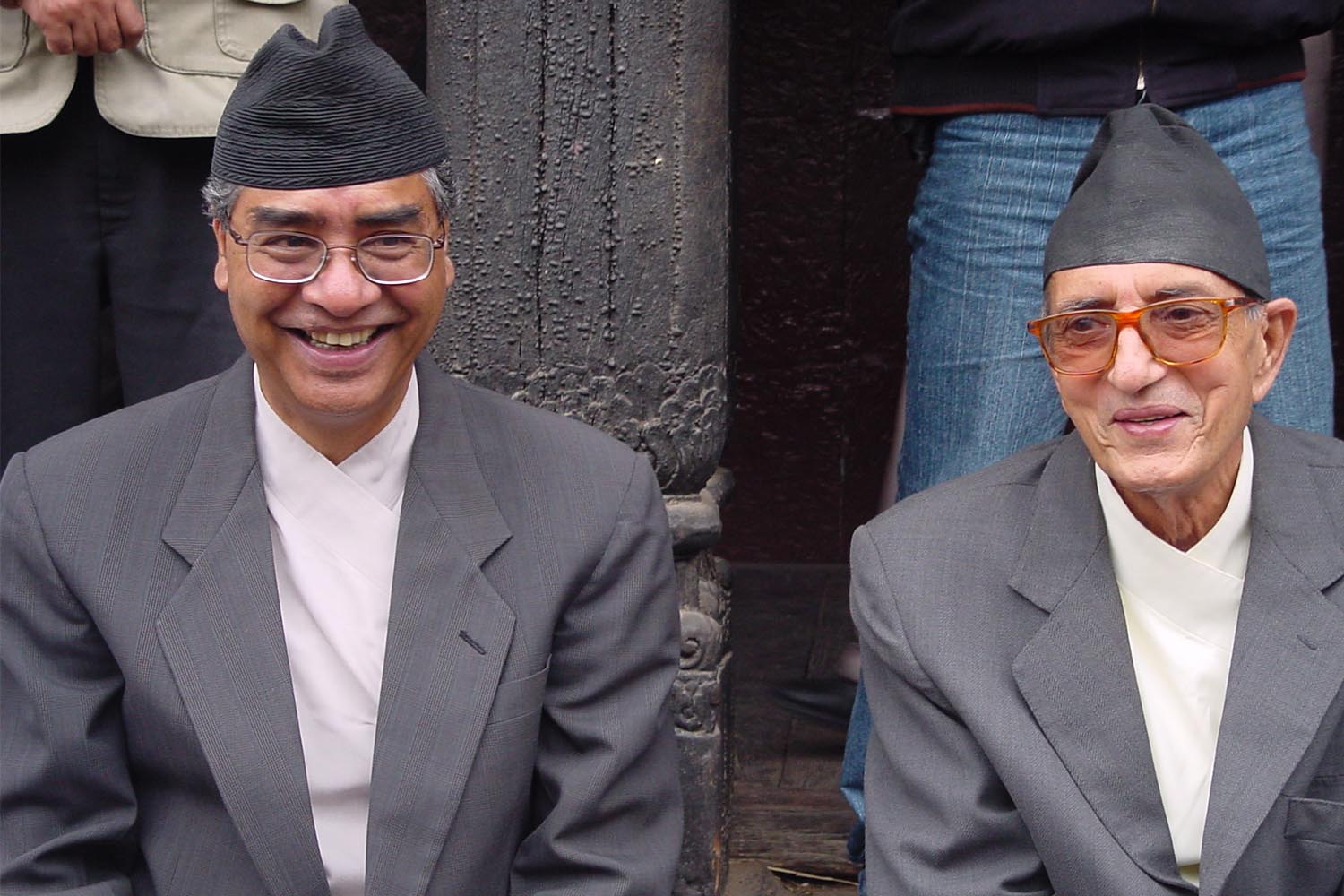
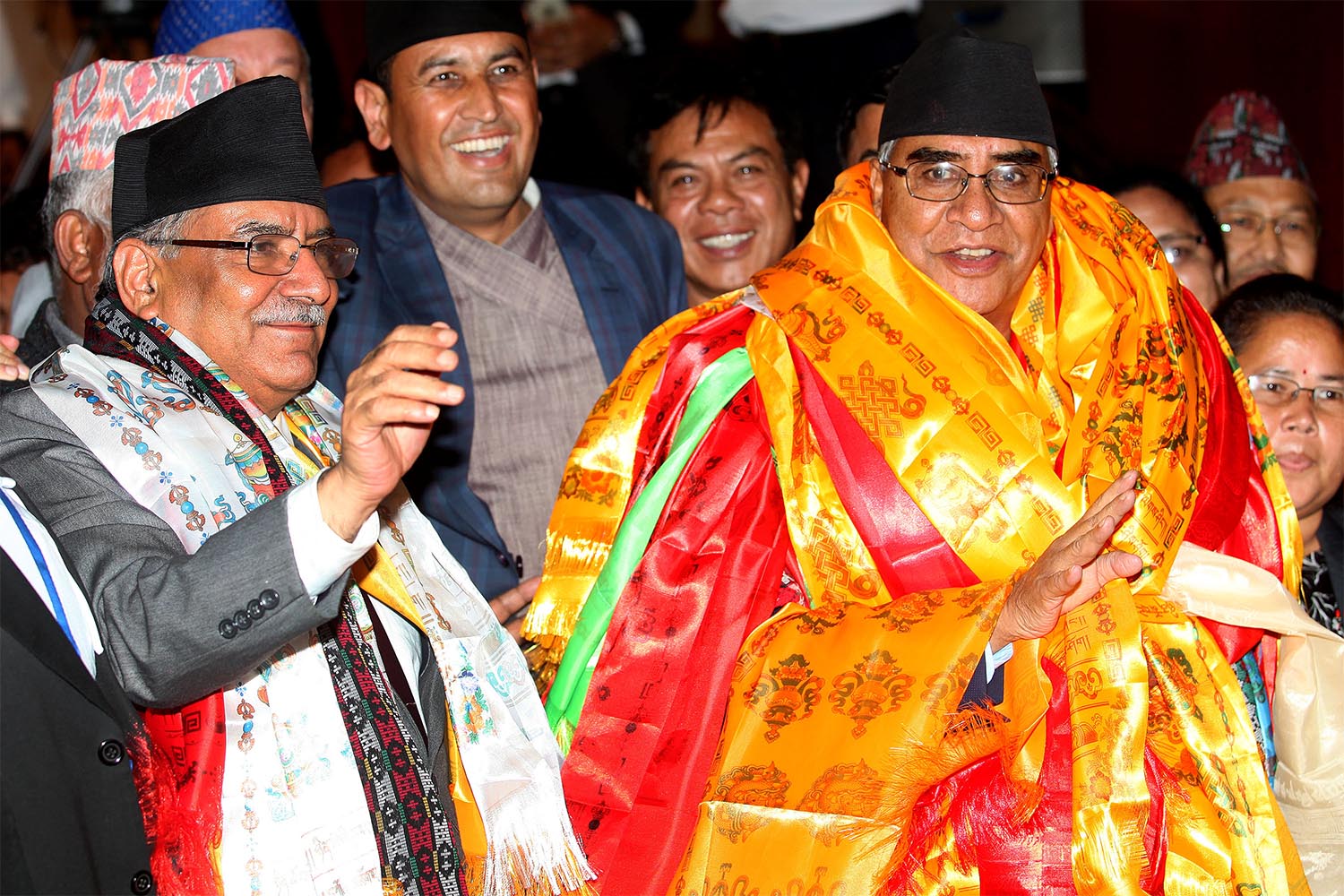
Nepali Communist Party coordinator Pushpa Kamal Dahal(left) with Deuba. Post File Photo
Deuba’s second stint as prime minister began on July 26, 2001, after GP Koirala resigned from the premiership, stating that the then Royal Nepal Army, deployed against the Maoists in Holeri, Rolpa, had refused to follow the government’s orders.
Then King Gyanendra appointed Deuba with the objective of controlling the armed Maoist insurgency. Soon after assuming office, he declared a state of emergency. A subsequent cabinet meeting on April 23, 2002, drew controversy when the government placed bounties on the heads of underground Maoist leaders.
At the time, rewards ranging from Rs2.5 million to Rs5 million were announced. The government declared that anyone who captured Maoist leaders alive or handed over their heads—even if dead—to the police would receive up to Rs5 million. The first most-wanted list included Maoist leaders Pushpa Kamal Dahal ‘Prachanda’, Baburam Bhattarai, and Mohan Baidya ‘Kiran’, each with a bounty of Rs5 million.
In response, there was a bomb attack targeting the vehicle Deuba was travelling in. He narrowly escaped.
The state of emergency imposed by Deuba to intensify action against the Maoists eventually became a cause for a split within his own party.
Amid an ongoing dispute over whether the emergency should be extended, on May 22, 2002, elections were announced for the following November. But the vote never took place.
The party, meanwhile, sought explanation from Deuba and expelled him for three years.
On June 19, 2002 the Nepali Congress officially split, and Deuba formed the Nepali Congress (Democratic) party. Soon after, on October 5, 2002, King Gyanendra Shah removed Deuba from office.
But fate had something else in store for him. To calm the movement of seven political parties, the king appointed Deuba as prime minister again on June 2, 2004.
Deuba said the “Gorkhali king” had delivered justice.
Eight months later, on February 1, 2005, King Gyanendra sacked Deuba in a coup and assumed absolute power.
The king whom Deuba said had delivered justice jailed him for corruption. He was released only after the Supreme Court declared the royal commission that had brought the case against Deuba unconstitutional.
On September 26, 2007, Deuba returned to the mother party.
He was elected party president at the 13th convention in March 2016 and again at the 14th convention in December 2021.
Another leader who has known Deuba up close for years says the real decline of Deuba—and the Congress—began in July 2016, when the NC and Maoists joined hands to move a no-confidence motion against the KP Oli government.
It was just after Nepal promulgated its constitution.
Deuba forged a deal with Maoist chairman Pushpa Kamal Dahal—unseating Oli, and in return, Dahal would lead the government.
The deal worked fine. Dahal led the government for 10 months and handed over the reins to Deuba, who oversaw the following general elections. The master politician of Nepal was back in power for the fourth term.
Quirks of Nepali politics were in full display. Dahal sided with Deuba to oust Oli. In the election held under Deuba’s government, Dahal and Oli’s parties—the Maoist Centre and UML—fought under an alliance. Eventually, the two communist parties merged to form the Nepal Communist Party (NCP).
The saying that politics makes strange bedfellows probably cannot take a quirkier turn than what Dahal and Oli did—and before that, what Dahal and Deuba had done.
Dahal and Deuba—who had joined hands to remove Oli—were once nemeses.
During the Maoist war, both were in a bid to finish each other off.
“Exactly from hereon, Deuba pushed the Congress on the path of decline, and in doing so, he also laid the groundwork for his own downfall,” a leader who has worked with Deuba for a long time said. “Deuba got involved in all kinds of immoral alliances, earning him the image of an unscrupulous politician.”
Bipin Koirala says Deuba is a case study of how a good, committed party soldier can gradually become unscrupulous and end up corrupt.
That Deuba was a politician with a cause, committed to democratic values—equality and social justice—is evident in his initial days in power.
During his first term as prime minister, he resolved the long-debated Mahakali dispute.
With the support of the main opposition party, UML, he succeeded in getting the Mahakali Treaty with India passed by Parliament. The treaty, which ensures equal rights for both Nepal and India over the waters of the Mahakali River flowing along their border, had been highly controversial since the time of GP Koirala.
During that period, Deuba also introduced the “KA-D-MA-JA-M” (Karnali, Dalit, Mahila, Janajati, Madhesh) concept—aimed at bringing backward regions and marginalised groups into the mainstream of politics.
Deuba has repeatedly cited this as one of the most positive works of his tenure. During his government, the abolition of the kamaiya (bonded labour) system was also declared. In 2001, the cabinet led by Deuba decided to implement modern land reform, which ended dual land ownership.
In his second term, Deuba took a major step toward economic reform by introducing Value Added Tax (VAT). Under his leadership, laws were also enacted to empower the Commission for the Investigation of Abuse of Authority (CIAA).
During his tenure, 22 permanent bridges, including the Karnali Chisapani bridge, were constructed, connecting the Far West region with the capital. Decisions were also made to form commissions for women, indigenous nationalities, and Dalits.
The government has issued a red notice against Deuba to probe the money laundering case. Post File Photo
Many Congress leaders say that since Deuba became party president, politics started revolving around power. That marked the beginning of his decline in both party and government roles. He adopted the belief that power is everything. And, in what appears to be a twist of fate, the situation would unfold in Deuba’s favour. The 2018 unification of the communist forces failed. After an acrimonious struggle between Dahal and Oli, the Nepal Communist Party (NCP) split in 2021. Oli got his CPN-UML and Dahal his Maoist Centre.
The Supreme Court, meanwhile, overturned Oli’s House dissolution for a second time and, in July 2021, ordered the appointment of Deuba as prime minister. For the four-time prime minister, the post this time came to him, perhaps for the first time, when he was not too keen on it.
The 2022 elections were on the horizon.
Deuba pushed his party to participate in the elections under an alliance with the Maoists and emerged as the leader of the largest party. Naturally, he was eyeing the prime ministerial post, but Dahal sided with Oli, who offered him the PM chair.
What surprised many was that he forced the NC to vote in favour of Dahal when he sought a vote of confidence—a rare moment in Nepal’s parliamentary history, as that decision by Deuba rendered the Parliament effectively opposition-less.
For a person angling for a sixth term, who had become habituated to power, Deuba was in a perpetual search for an opportunity to unseat Dahal, who had the backing of the UML, the second-largest party.
For Dahal, whose party structure was crumbling, his legacy was in crisis. His government decided to expedite some corruption cases, including the Bhutanese refugee scam. Congress leader Bal Krishna Khand was already in jail in connection with the case. So was Top Bahadur Rayamajhi, a former Maoist leader.
Media reports pointed to Arzu’s involvement, but a formal case against her was not filed. Many say the only way to pre-empt any action was to be in control of power. Deuba knew Oli would not give him that chance.
After decades in politics, Deuba had become a master manipulator. In mid-July, he suddenly drove to Oli’s residence to have “dahi chiura”—a tradition observed by eating yoghurt and beaten rice on the 15th of the Nepali month of Asar.
Within a week, Deuba and Oli signed a seven-point deal, the latter replacing Dahal in Singha Durbar. Deuba installed Arzu as foreign minister in the Oli cabinet. The deal had it that Oli would hand over power to Deuba after a year and a half or so.
But that moment never came. In early September, a storm arrived in the form of Gen Z protests.
Deuba disappeared from public view for a month, only to appear in late October at the party headquarters, where he read out a written speech and announced that he was stepping aside. He left for Singapore for treatment, just as his party struggled to find a new way to remain relevant in the changed context.
A month-long central committee meeting failed to take any decision. Deuba, who was pulling strings from Singapore, returned after a month, displaying his signature trend—speaking less but stamping authority.
The seeds of discord that had begun to sprout had grown into a full-blown rift, hastened by the Gen Z protests.
The dissident group in the NC, led by then-General Secretary Thapa, then decided that they had had enough. A January special convention elected Thapa as the new party president. Deuba was denied a ticket for the March 5 elections. Feeling ditched and dumped, Deuba, who had never lost any election since 1991, along with Arzu, left for Singapore, days before the vote.
The NC faced an unprecedented drubbing, with even its newly minted president Thapa facing a humiliating defeat at the hands of an old Congressman—Amresh Kumar Singh.
The RSP won big. As the Balendra Shah government swung into action, a money laundering investigation against the Deubas is now underway.
Deuba has reacted just once—through social media, rejecting the charges.
“Once in power, everyone tries to exert influence, contest elections, protect cadres, and even donate to temples by arranging money. There is no way Sher Bahadur ji would not have done the same,” said another leader close to him since the early 1980s. “It was Sher Bahadur Deuba and Prachanda who together toppled KP Oli’s government at one point. Not only did they engage in alternating power-sharing and both fair and unfair alliances, but even Deepak Bhatta—who is now under investigation for money laundering—was nurtured under political protection from that time onward.”
Will Deuba return to Nepal? No one knows.
What many do understand though is that the reticent Deuba’s quiet political obituary is already in the making.




 20.77°C Kathmandu