



 16.12°C Kathmandu

Fri, Apr 3, 2026
National
Nepal hikes jet fuel to historic high as West Asia war drives global surge
Aviation fuel sold to domestic airlines surges by up to 97.6 percent, pushing up airfares and widening Nepal Oil Corporation losses. ATF prices for international airlines surged by 77.63 percent.
bookmark![]()
![]()
![]()
Sangam Prasain
Published at : April 1, 2026
Updated at : April 2, 2026 09:19
Kathmadnu
Nepal’s state-owned oil monopoly on Wednesday sharply increased aviation fuel prices to a historic high, citing soaring global energy costs triggered by the ongoing conflict in West Asia.
The Nepal Oil Corporation said the price of aviation turbine fuel (ATF) for international airlines surged by 77.63 percent to $1,716 per kilolitre in Kathmandu, with similar increases reported in other major cities—Pokhara and Bhairahawa. The previous highest rate was recorded on June 19, 2022, when ATF was raised to $1,645 per kilolitre.
For domestic carriers, ATF prices have nearly doubled, jumping 97.63 percent to Rs251 per litre, marking an unprecedented spike. The earlier high Rs190 per litre on September 1, 2022.
“This is the biggest hike in aviation fuel prices in history,” said Manoj Kumar Thakur, spokesperson for the corporation, attributing the surge to reduced global production and heightened demand.
Aviation turbine fuel constitutes a significant portion of airlines’ operating expenses, and sustained price increases are likely to translate into higher airfares, affecting both domestic and international passengers.
Domestic carriers are required to revise fuel surcharges when prices rise or fall by Rs4 per litre under the formula set by the Civil Aviation Authority of Nepal.
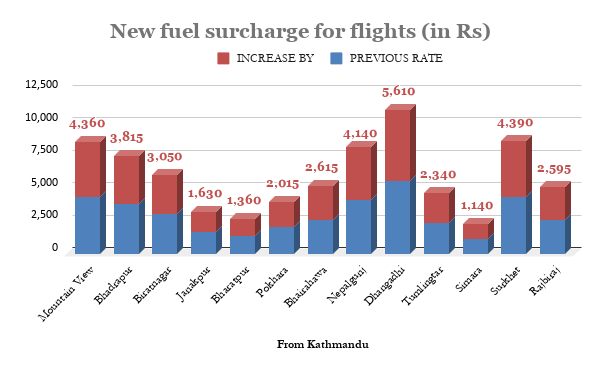
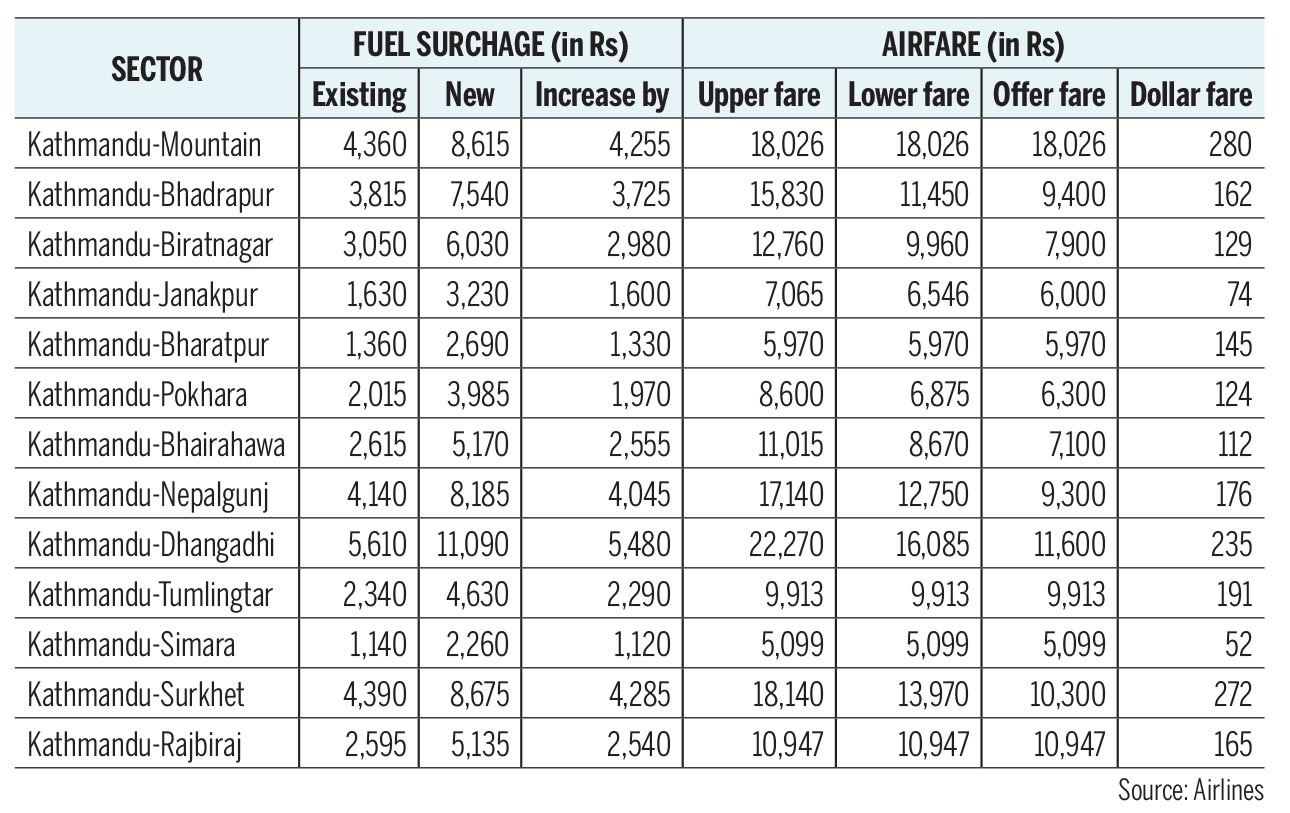
Accordingly, the fuel surcharge on the Kathmandu–Dhangadhi sector, the longest domestic route, has increased by Rs5,480.
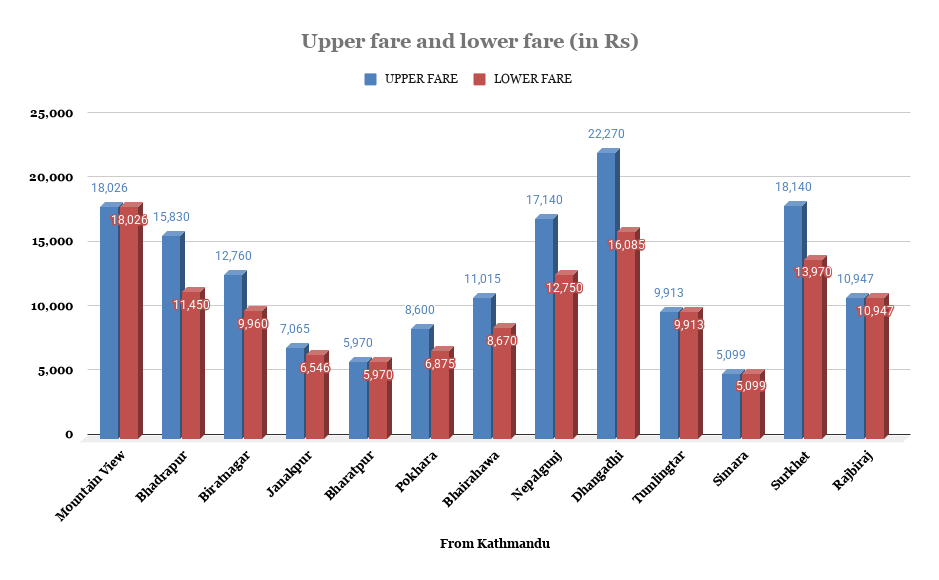
The upper fare on the Kathmandu–Dhangadhi route has risen to Rs22,270 one way. This includes Rs2,504 as VAT and Rs500 as passenger service charge.
After the latest revision, the lower fare on the Kathmandu–Dhangadhi sector stands at Rs16,085, while the offer (scheme) fare is Rs11,600 one way.
The fuel surcharge on the Kathmandu–Simara route, the country’s shortest, has increased by Rs1,140. With this, the total fare has reached Rs5,099, including Rs529 VAT and Rs500 passenger service charge. Simara and Bharatpur, the shortest routes, have only one fare category.
Pratap Jung Pandey, president of the Airlines Operators Association of Nepal, said airlines were already in survival mode due to the appreciation of the US dollar against the Nepali rupee, as most aviation-related expenses are denominated in dollars.
“It’s the steepest hike ever,” he said. “While fuel prices have increased globally, in Nepal the government has nearly doubled the price.”
He added that the timing, during the peak tourist season, has heightened concerns. “Most helicopter and fixed-wing operators have already sold tickets for the spring season. This will result in significant losses.”
Anil Manandhar, corporate director at Shree Airlines, said the hike is a major setback for the industry, as it will affect both passenger demand and airline operations.
The latest revision follows two recent increases in petrol and diesel prices within the past month, and adds to the mounting pressure on Nepal’s energy sector amid global supply disruptions.
The corporation said international petroleum prices have been rising over the past month due to the West Asia conflict.
Based on purchase prices received from the Indian Oil Corporation, the oil utility said the automatic pricing mechanism has not been able to fully adjust domestic prices, resulting in losses of Rs5 billion over the 15-day period from March 16 to March 31.
According to new purchase rates received on March 31, the price of petrol has increased by Rs41.60 per litre, diesel by Rs94.93 per litre, aviation fuel by Rs123.8 per litre, and liquefied petroleum gas (LPG) by Rs190.36 per cylinder. Previously, on March 25, the corporation had adjusted retail prices by only Rs15 per litre for both petrol and diesel.
“Due to the inability to adjust prices based on the March 16 purchase rates, the corporation is incurring losses of Rs47.12 per litre on petrol, Rs133.45 per litre on diesel, and Rs416.37 per cylinder on LPG,” the corporation said in a statement.
With continued increases in international petroleum prices and limited room for domestic adjustment, the corporation projects a monthly loss of Rs13.21 billion.
Although supplies from the Indian Oil Corporation are being received as per demand, delays in timely payments could affect supply management, the corporation warned.
Sangam Prasain
Sangam Prasain is Business Editor at The Kathmandu Post, covering tourism, agriculture, mountaineering, aviation, infrastructure and other economic affairs. He joined The Kathmandu Post in October 2009.




Most Read from National

14 ministers in Balendra Shah Cabinet finalised

Ex-PM KP Sharma Oli, former home minister Ramesh Lekhak detained over Gen Z protest crackdown

Businessman Deepak Bhatta under money laundering probe, barred from leaving Nepal
Government unveils ambitious 100-point roadmap for effective governance
Karki commission’s recommendations on the Gen Z protests, explained in 10 points
Editor's Picks

Nepal risks losing up to 132,000 jobs, $1 billion after LDC exit

Raped and left to die, teenager’s family wants answers

Bengal tigers move to mid-hills. Sighted in Palpa, Arghakhanchi

Escaping poverty at home, Nepali women fall into the Gulf trap
Once the heartbeat of Nepali democracy, now a ghostly shell
E-PAPER | April 03, 2026

×