Sunil Sah left country aiming to build his parents a house. Now they struggle to bring his body home
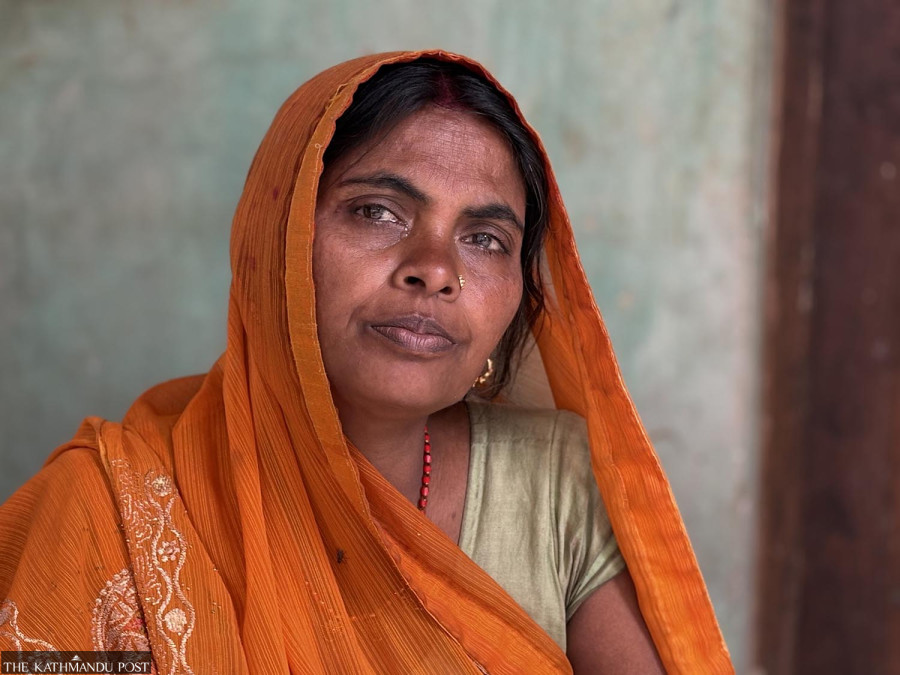
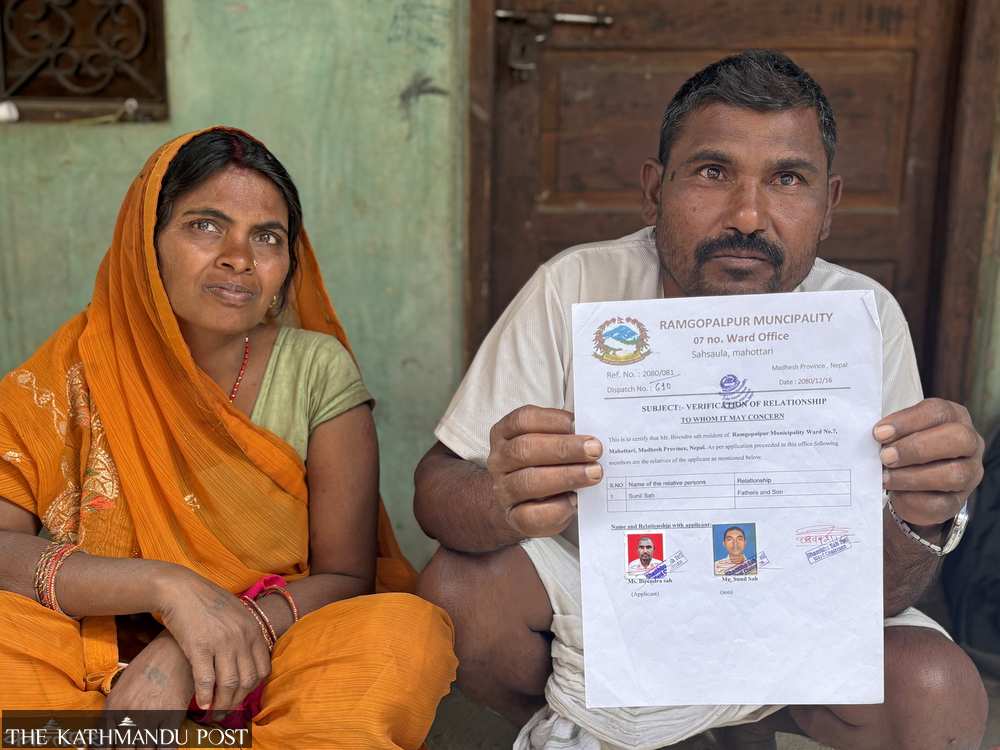
DNA hurdles and bureaucratic delays leave a Mahottari family in limbo two years after a deadly industrial fire in Saudi Arabia. Somshila Devi Sah, 50, lost her son to a workplace fire in Saudi Arabia in March, 2024. Santosh Singh/TKP
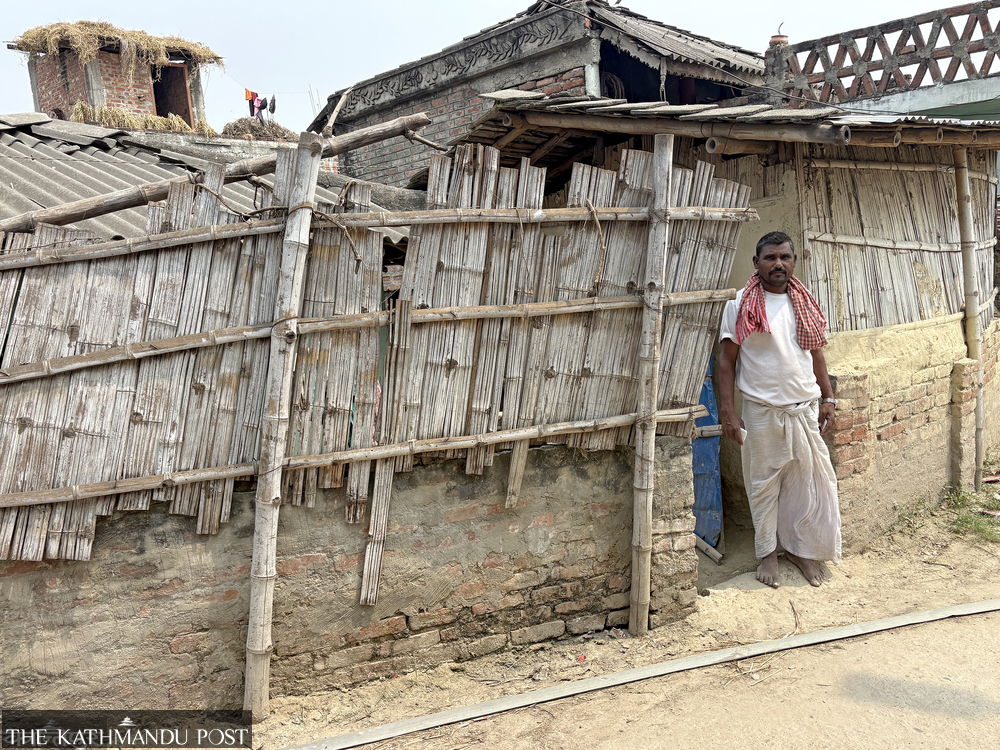
In the midst of sturdy concrete houses in Ramgopalpur Municipality-7 of Mahottari stands a modest dwelling enclosed by bamboo fencing on a tiny patch of land. Seated in the front courtyard, 50-year-old Somshila Devi Sah stares blankly. She is indifferent to the comings and goings around her; her world has been frozen for over two years.
“My wife, Somshila, wants to speak to no one. It has been over two years since she last laughed,” says her husband, Birendra Sah, aged 52. “She has lost her appetite. She cannot sleep through the night. Her body is wasting away from exhaustion, yet when we take her to the doctors, they find no physical disease. All of this is the result of the anxiety over our son Sunil’s body, which is still stuck in Saudi Arabia.”
It was the dream of replacing the bamboo-walled hut with a permanent brick house that made 21-year-old Sunil Sah board a flight to Saudi Arabia on April 7, 2022. Recruited through Frontline Recruitment Pvt Ltd, Sunil worked as a labourer at Bunyan Industrial Company Limited in the Al-Kharj industrial zone, in the eastern region of the kingdom, earning a monthly salary of 1,000 Riyals. On March 11, 2024, exactly a month before his employment contract was due to expire, a catastrophic fire broke out at his workplace. Sunil died in the inferno.
More than 750 days since his departure and over two years since the incident, the Sah couple is no closer to getting his remains. There is still no definitive timeline for when the body might return home.
A life cut short
Sunil was the eldest son among five children born to the Sah couple in Sasaula of Ramgopalpur Municipality-7. While his eldest sister is married, his two younger sisters and one younger brother are still in school. Sunil had completed his grade 12 education in his village and even trained as an excavator operator.
To fund his journey abroad, the family took out a loan of Rs200,000 at a staggering monthly interest rate of three percent (36 percent annual). For a time, the investment seemed to pay off. Sunil sent home between Rs30,000 and Rs40,000 every month, providing a lifeline for the family.
“My son went abroad to earn, to feed well, and to build us a house. He died there,” says Somshila, her voice trembling. “Can the government bring my son back alive? No. I lost my son, I could not get his body, and there has been no compensation.”
Since the news of his death reached the village, Somshila has spent a part of every day in tears. The pain of his memory was so sharp that she deleted all his photos from her mobile phone. However, she clings to the handset itself—the device Sunil sent home so he could make a video call to his mother. Now, that phone only rings when the Nepali Embassy in Riyadh calls with updates.
“I keep this phone close, thinking maybe my son will call. The embassy calls to update us on the process of sending the body. Without the body, I cannot even perform the final rites,” she laments.
In Sunil’s absence, Birendra has returned to daily wage labour to support his five-member family and keep his children in school. “If Sunil was alive, I wouldn’t have to do this back-breaking work. The money he sent was what kept our household running,” says Birendra.
The last time Birendra spoke to his son was just two days before the fire. “He mentioned the work was difficult. He talked about coming home around the time of Holi. We were so happy. That happiness didn't even last two days. On the second day after the fire, Shuva Narayan Mandal, who worked with Sunil, broke the news to us.”
Birendra has travelled to Kathmandu many times to seek help, adding a heavy burden of debt to their grief. “I have lost count of how many times I have gone to the capital. Every trip adds another Rs10,000 to Rs12,000 to our debt. We are poor people; we have no land. We live hand-to-mouth.”
The DNA deadlock
The fire at the Bunyan company claimed the lives of three workers, including Sunil. The intensity of the blaze burned the bodies beyond recognition. According to a letter sent by the company to the Nepali Embassy on April 5, 2024, the cause of the fire remains officially ‘undisclosed.’
In Saudi Arabia, the process of repatriating a body requires three important documents—a police report, a death certificate, and a medical report. Because the victims—a Bangladeshi, a Chinese, and a Nepali—could not be visually identified, the Saudi authorities could not determine which remains belonged to whom. DNA testing was the only solution.
Without a DNA match, a police report cannot be finalised. However, the process was stalled due to a lack of official communication. It took the Nepali Embassy in Riyadh eight months just to receive the official notification of Sunil’s death. In that period, the embassy followed up with the company and police every week, only to be told that the reports were not ready every time.
On November 25, 2024, the Ministry of Foreign Affairs of Saudi Arabia sent an ‘urgent’ letter to the Nepali Embassy. “No close family members of the deceased Sunil were found within Saudi Arabia,” the letter stated. “To determine the identity of the remains found after the fire, DNA samples must be collected. A team from the Criminal Evidence Department may need to be sent to Nepal to collect samples from relatives.”
The Saudi authorities eventually suggested a more efficient alternative: collecting the genetic material in Nepal and sending it to Riyadh.
Upon receiving this request, the embassy notified the Department of Consular Services in Tripureshwar, Kathmandu. Birendra was summoned to the national capital via Ward Chairman Shambhu Sah. Carrying letters from the Consular Department, Birendra navigated a labyrinth of bureaucracy: from the Police Headquarters in Naxal to the Police Office in Maharajgunj, and finally to the TU Teaching Hospital.
“It was so difficult. I didn’t know where to go,” recalls Birendra. “A man from a small village like me, wandering through these massive city offices... It was exhausting.”
At the Teaching Hospital, his blood sample was finally collected and sent back through the same network.
50 percent match with father, DNA sample of mother sought as well
Three months after the Saudi request, the DNA report reached the embassy in Riyadh on February 1, 2025. However, the embassy could not simply hand the report to the Dilam Police Station in Al-Kharj, located 90 kilometres away. It had to be formally submitted to the Saudi Ministry of Foreign Affairs, which then routed it through the Ministry of Interior, the Police Headquarters, and the Criminal Evidence Department before it finally reached the local station.
“We kept checking with the Dilam police if the report had arrived. They kept saying no,” says Kabiraj Upreti, Labour Counsellor at the embassy. “We had to follow up all over again. Navigating all those departments consumed a great deal of time.”
Finally, on December 28, 2025—eleven months after the report was first submitted—the Dilam police said: the DNA match with the father was only 50 percent. They now required a sample from the mother.
Standard forensic practice prioritises maternal DNA, but this technical detail had been overlooked by the Consular Department and the hospital in Nepal. Frustrated by the prospect of another long delay, the embassy wrote to the Saudi Foreign Ministry on February 3, asking if the current match would suffice. The request was denied.
The lack of a police report does not just prevent the return of the body; it also halts all compensation from the Saudi General Organisation for Social Insurance (GOSI), the Foreign Employment Board in Nepal, and private insurance.
On February 17 this year, the embassy held a virtual meeting with the family and Ward Chairman Shambhu Sah to discuss whether they wished to proceed or authorise a local burial in Saudi Arabia. The family insisted on bringing the body home. Somshila travelled to Kathmandu last month to provide her DNA sample.
“It has been a month since we returned after submitting Somshila’s sample. Surely, it must match this time,” says Birendra. However, that report has yet to reach the embassy. Once it does, the cycle begins again: the embassy to the foreign ministry, to the interior ministry, to the police headquarters, to forensics, and finally to Dilam. Whether this will take another year is a question no official can answer.
The battle for compensation
According to Saudi labour laws, employers must enroll workers in the GOSI. Two percent of a worker’s monthly salary is deducted for this social security. In the event of a workplace death, the family is entitled to a payout equivalent to 84 months of salary, capped at 330,000 Saudi Riyals.
If there is only one legal heir, they receive 50 percent; if two, 75 percent; and if three or more, the full amount is distributed among them. Eligible heirs include spouses, children, parents, grandparents, brothers, unmarried sisters, grandsons and unmarried granddaughters.
“We lost our son. We have no idea when his body will come,” says Somshila, tears welling in her eyes. “If we could at least get the compensation, perhaps we could find some peace.”
However, claiming GOSI benefits requires a complete set of documents, including the elusive police report and death certificate. Historically, many Nepali families have struggled for decades to claim these funds due to missing paperwork. Beyond GOSI, there is also the possibility of ‘blood money,’ but this requires the embassy to fight a lengthy and arduous legal battle in Saudi courts.
The scale of the tragedy is vast. Dwarika Upreti, executive director of the Foreign Employment Board, said that a total of 1,019 bodies of Nepali workers were repatriated from Saudi Arabia in the past three years alone. Employers usually bear the cost of repatriation.
“The board only covers the repatriation costs for those remains that are stranded or cannot be brought back to Nepal due to a lack of financial resources,” said Upreti.
Hom Karki is a reporter with two decades experience covering migrant workers issues and the Nepali diaspora. He was previously based in the Gulf for Kantipur Daily.




 18.95°C Kathmandu