Physical and Urban Development for this infrastructure expert
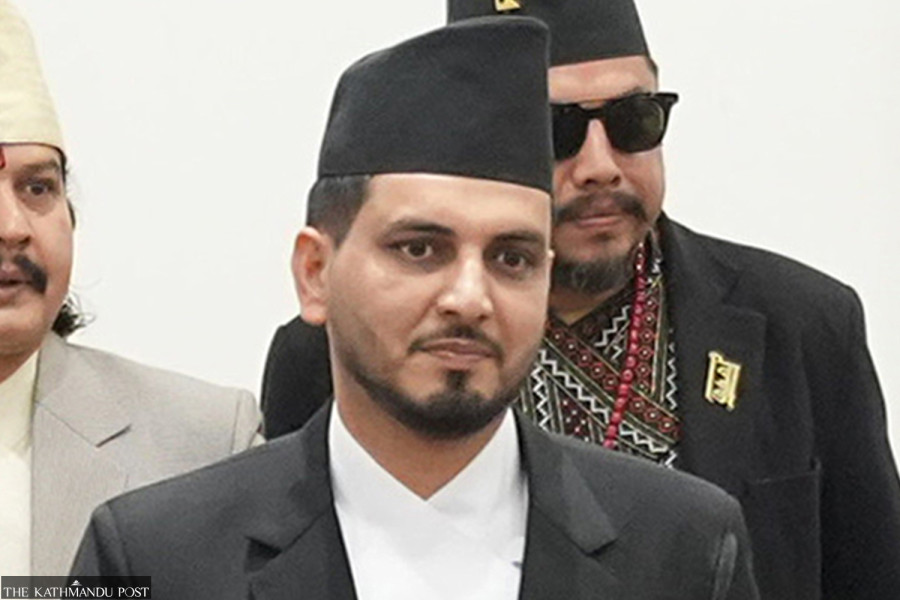
Sunil Lamsal, newly appointed minister for Physical Infrastructure and Transport and Urban Development, faces the daunting task of addressing a host of long-standing irregularities. Sunil Lamsal, physical infrastructure minister Post photo
The 35-year-old Lamsal from ward 7 of Tilottama Municipality in Rupandehi district has been entrusted with overseeing the ministries responsible for the bulk of Nepal’s development and construction work.
Lamsal holds a bachelor’s degree in civil engineering from Lumbini Engineering College and a master’s degree in structural engineering from Neeti Minakshi Institute of Technology in India. He is also the youngest minister to have ever led these two ministries.
Elected from Rupandehi 1 constituency on a Rastriya Swatantra Party ticket, Lamsal previously served as an infrastructure and environment expert during Balendra Shah’s tenure as mayor of Kathmandu Metropolitan City.
Having spent years in infrastructure, urban planning, and governance reform, Lamsal must now translate his expertise into action at the helm of two ministries plagued by systemic problems.
Among development-focused ministries, the Ministry of Physical Infrastructure and Transport receives the largest share of the national budget. This year, the Ministry of Urban Development—also considered a development-oriented ministry—has also received a sizeable allocation.
But the ministries that command the biggest budgets are also riddled with irregularities. Ministry officials and subordinate agencies are often accused of trying to influence ministers in their favour, a trap Lamsal will need to avoid.
The ministries are also responsible for issues that directly affect citizens’ daily lives. A prominent example is the driving licence.
The Department of Transport Management operates under the Ministry of Physical Infrastructure and Transport, while 42 transport management offices across the country fall under provincial governments. Until provinces begin printing licences themselves, the department continues to coordinate the printing process.
Since 2022, more than 2.7 million driving licences—both new and renewed—remain unprinted. As a result, service seekers have been forced to carry payment receipts as temporary proof. Daily demand for new licences alone stands at around 2,500 to 3,000 applications.
Similarly, the implementation of the embossed number plate system remains uncertain.
During the Gen Z protests, a fire at the department destroyed the plant producing embossed number plates and the machines used to print driving licences.
All embossed number plates that had been prepared for distribution to provincial transport offices were burned.
The government had planned to install embossed plates on 2.5 million vehicles, but so far only around 100,000 vehicles have been fitted.
Department data show that by mid-August 2025, a total of 819,059 plates had been produced. Of these, around 200,000 had been dispatched to provincial offices, while the remaining plates were stored at the department and were destroyed in the fire.
Preliminary estimates suggest that 619,000 number plates were lost.
The project itself has long been controversial from the start. A joint venture between Bangladesh-based and US-based Decatur-Tiger IT won the contract in May 2016 to install embossed number plates on 2.5 million vehicles within five years.
Progress has been slow. The original contract deadline expired in June 2021, then was extended twice, but work remains incomplete.
The initial contract value was Rs4.16 billion (excluding VAT), later increased by 22.5 percent following extensions.
Infrastructure projects in the road sector also face serious challenges.
Many projects that have shown progress have failed to receive adequate budgets. For instance, only Rs700 million was allocated this fiscal year for widening the Suryabinayak-Dhulikhel section of the Araniko Highway, including its bridges, even though the project had sought Rs3 billion.
Due to insufficient funding, the road expansion has been proceeding in small piecemeal phases.
Similarly, the Narayanghat-Butwal road expansion, which began seven years ago, remains incomplete. Work continues on a 14-kilometre section in Daunne.
Other major road projects—including the Nagdhunga-Mugling, Ambukhaireni-Pokhara, Kamala-Kanchanpur, and Kakarbhitta-Laukahi corridors—have also struggled to gain momentum.
Experts say poor coordination among ministries often results in repeated demolition and reconstruction during infrastructure development.
Former secretary Arjun Jung Thapa says one of the first tasks of the new minister should be clearing long-pending payments to construction contractors.
“Many contractors have not received payments for completed work,” he said. “Another major problem lies in the Narayanghat-Butwal road section. Work must be completed before the next monsoon to avoid further hardship for travellers.”
He also stressed the need to prioritise national pride projects such as the Postal Highway, Mid-Hill Highway, and the Koshi, Kali Gandaki and Karnali corridors.
“If these road networks are completed within the next two years, the country could witness significant economic progress,” he said.
Meanwhile, the Urban Development Ministry faces its own challenges.
In the upcoming fiscal year’s budget, the ministry has included 3,983 small projects costing between Rs1,000 and Rs9.9 million, representing 59 percent of its total programmes.
Federal budget guidelines stipulate that projects costing less than Rs30 million should not be included, yet the ministry has continued to allocate funds to hundreds of fragmented schemes.
Former urban development secretary Maniram Gelal says the ministry should prioritise waste management in the Kathmandu Valley.
“This falls within the jurisdiction of local governments,” he said. “But the ministry must coordinate efforts.”
He also stressed the need to address river pollution and manage settlements along riverbanks.
The new minister will also have to oversee delayed projects such as the new Parliament building at Singha Durbar, the reconstruction of Dharahara, and the rebuilding of structures damaged during the Gen Z protests, including the Birendra International Convention Centre [former federal parliament building] in New Baneshwar.
Seven years after construction began, the new Parliament building remains incomplete, while the Dharahara reconstruction project has been repeatedly delayed.
With numerous stalled projects, systemic irregularities and mounting public expectations, Minister Lamsal faces a formidable task ahead.




 14.81°C Kathmandu