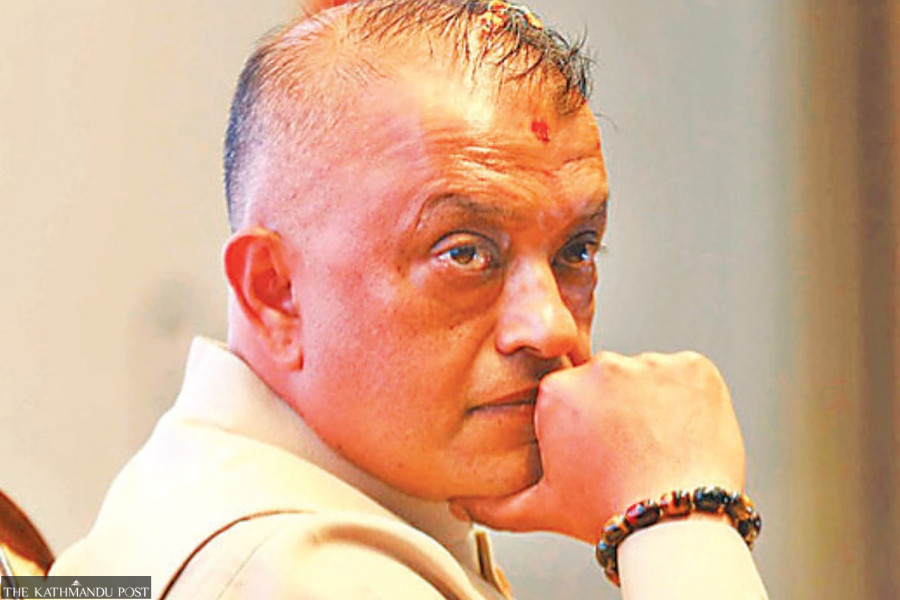
The Central Working Committee meeting of the Nepali Congress, scheduled for Friday, is unlikely to endorse the resignation of party president Gagan Thapa.
Thapa tendered his resignation to party vice-president Bishwa Prakash Sharma on Wednesday, taking moral responsibility for the party’s crushing defeat in the March 5 parliamentary elections.
Though the central committee meeting is scheduled to review the election results and performance, Sharma will present a proposal to reject Thapa’s resignation at the start and proceed to other agendas, according to Congress leaders.
“Saying ‘I take moral responsibility is positive,” Sharma wrote on the social media platform X. “However, the primary moral duty at this moment is to handle and stabilise the situation. In the meeting, an initial review [of election loss], a resignation letter, and a proposal to reject the resignation will be presented. It is not fair to blame the person who went to extinguish the wildfire for causing the fire itself!”
Even as all office-bearers, including Thapa, were defeated in the March 5 House of Representatives election, the president resigned his position, taking responsibility for the outcome.
According to a Congress office-bearer, Thapa has urged Sharma to endorse his resignation through Friday’s meeting.
But Sharma denied, arguing that it was a collective failure and not a defeat of one single person, said the office bearer.
“The meeting will touch upon reasons behind the election defeat,” said Guru Raj Ghimire, a Congress general secretary.
Thapa had lost the elections in Sarlahi-4 to Rastriya Swatantra Party’s Amresh Kumar Singh. Right after losing the election and when the party's poor performance became apparent, Thapa had discussed his resignation with Sharma, but the latter advised him not to quit in haste.
In his resignation letter, Thapa stated that after the special general convention, assuming the responsibility of party president and leading the party in such a short time to the election was both an opportunity and a challenge for him.
“The special general convention had not only brought about a change in leadership, but it also marked the beginning of multi-dimensional reforms and self-reflection in the Nepali Congress. While the changes within the party ignited enthusiasm among the workers, there was not enough time to effectively convey the message of a "changed Congress" to the general voters. Among the major reasons for the poor outcome this time, I believe the limited time available was a key factor,” Thapa stated in his letter.
While taking responsibility for the party’s poor performance, Thapa also stated that if a special general convention had not taken place, the election results would have been worse.
Thapa, in his letter, has revealed that he was prepared to resign immediately after the election results, but he waited until the election's formal conclusion because he had some election-related tasks to complete as party president.
He said he will visit various parts of the country and will engage with party leaders and cadres.
Therefore, this decision of mine is not the end — it is an initial step towards self-reflection, accountability, and revival of the Nepali Congress, Thapa wrote in the letter.
He stated that his resignation is not an end but an initial step towards self-assessment, accountability, and revival of the Nepali Congress. "Therefore, my decision is not an end, it is an initial step towards self-assessment, accountability, and revival of the Nepali Congress," he said.
Under Thapa's leadership, the Nepali Congress fielded candidates in all 165 constituencies, but only 18 of them won. Including its proportional representation seats, the party has sent 38 lawmakers to the lower house.
Thapa was elected party president through the Special General Convention held from January 11 to 14 at Bhrikutimandap, Kathmandu. A new Central Working Committee was also elected. A week after the convention, the party had to decide its candidates for all 165 electoral constituencies. There clearly was not enough time for poll preparations, another Congress office bearer said. Thapa, in his resignation letter, also blamed time constraints for the poor election results.
Besides a change in party leadership by throwing out the old guard, the special convention introduced transformative decisions not only for the party but also national politics.
However, the legitimacy of the new leadership is sub judice in the Supreme Court. A writ petition was filed, shortly after the convention, by former president Sher Bahadur Deuba and acting president Purna Bahadur Khadka. Despite their disagreement with the convention, some leaders from the Deuba faction contested the elections under Thapa’s signature.
Amid opposition from the Deuba faction, Thapa and Sharma, then serving as general secretaries, organised the special general convention based on the signatures of 54 percent general convention delegates.
Under mounting pressure following the party’s poor performance in the elections, Thapa mulled for days over resigning. He conveyed his intention to Sharma during a meeting on March 9, even before the proportional representation results were announced.
His decision to resign drew mixed reactions within and outside the party. Despite pressure not to step down, Thapa went ahead with his decision.
“Resignation is the fundamental right of the party president. The meeting will discuss the content of his resignation letter after it is read out in the meeting. Then we will discuss his letter,” said Ghimire.
“We are of the view that Thapa led the party in a difficult situation. He also took responsibility for the election defeat on moral grounds.”
Another responsibility that Thapa has to shoulder is organising the regular 15th convention of the party, said Ghimire. “Without holding the general convention, he cannot take a rest.”
As per the Congress charter, the regular convention must be held within a year of the special convention.
Party spokesperson Devaraj Chalise said the central committee meeting—the first since the elections—will review the results, leadership accountability and organisational weaknesses.
“The changed image of the Congress following the special general convention remained limited to only party workers and did not reach the broader public. There may be other reasons for the defeat as well,” Chalise said. “Reports are coming in from the districts. We will have detailed discussions to identify the causes of the defeat and make further moves to strengthen the party. The issue of regular general convention will also be discussed.”
Anil Giri is a Chief Sub Editor covering diplomacy, international relations and national politics for The Kathmandu Post. Giri has been working as a journalist for more than two decades, contributing to numerous national and international media outlets.




 14.82°C Kathmandu