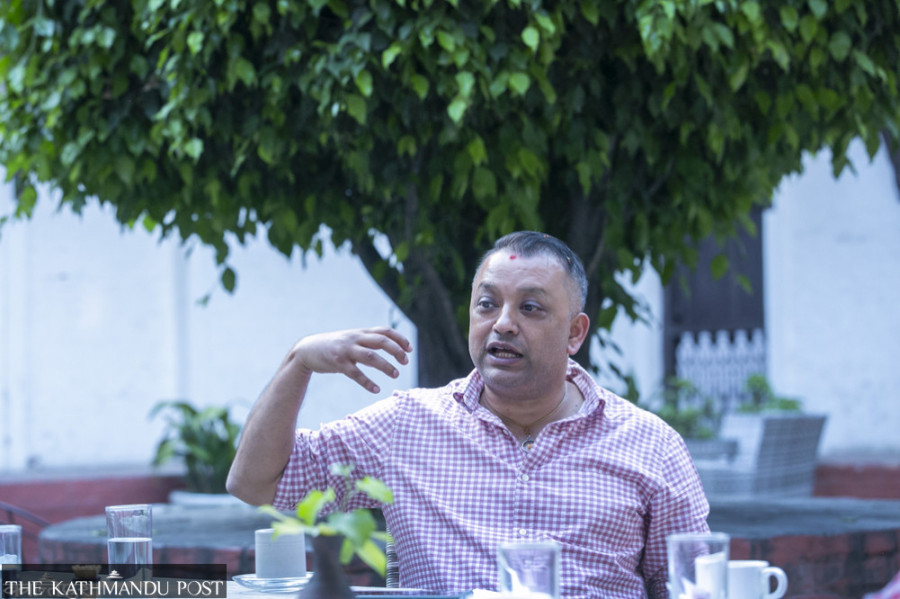
Following an unexpected defeat in the recently concluded parliamentary elections, Nepali Congress President Gagan Thapa has resigned from his post on moral grounds. He submitted his resignation to Vice-President Bishwa Prakash Sharma shortly after the date for the party Central Working Committee meeting was fixed. However, the party has not made his resignation public.
“A Central Working Committee meeting has been called for March 20, where the president’s resignation will be formally discussed. The decision to resign lies with the president, and he has done so,” a party office-bearer said, confirming Thapa’s resignation. “But it is the prerogative of the Central Working Committee to decide whether to accept the resignation.”
The Congress Special General Convention held from January 11 to 14 at Bhrikutimandap had elected a new Central Working Committee under Thapa’s leadership. However, its legitimacy remains under review at the Supreme Court following a writ petition filed by former president Sher Bahadur Deuba and acting president Purna Bahadur Khadka. Despite their disagreement with the convention, leaders from their faction had contested the elections under Thapa’s signature.
Amid opposition from the Deuba faction, Thapa and Sharma, then serving as general secretaries, had convened the special general convention based on signatures from 54 percent of convention delegates. The party statute mandates that a special convention must be called within three months if at least 40 percent of delegates demand it.
When the Deuba faction attempted to delay the process, citing the March 5 elections, Thapa and Sharma organised the convention in what was described as a “rebellious” move within the party. The convention dissolved the Deuba-led Central Working Committee (CWC) and formed a new 134-member committee under Thapa.
The Election Commission recognised the convention and updated the party’s leadership under Thapa on January 18, rejecting an application filed by the Deuba faction claiming that the Deuba-led CWC was legitimate. Deuba and Khadka subsequently challenged the decision at the Supreme Court.
Thapa had expected improved electoral performance after replacing the previous leadership, which was widely seen as unpopular. The special convention had introduced transformative decisions not only within the party but also in national politics and policy.
However, after the party delivered a poor performance in the polls, Thapa chose to resign in a bid to steer the party towards a regular general convention, it has been said. Despite the slogan “This time, over 100 seats,” the Congress was limited to 38 seats—18 under the first-past-the-post system and 20 under the proportional representation category.
Thapa himself lost from Sarlahi-4 by a wide margin to Amaresh Kumar Singh of the Rastriya Swatantra Party. Singh secured 35,688 votes, while Thapa received 22,831.
Under mounting pressure following the party’s poor performance in the elections, Thapa had been preparing to resign for several days. He had already conveyed his intention to Sharma during a meeting on March 9, even before the proportional representation results were finalised.
His decision to resign drew mixed reactions within and outside the party. Despite pressure not to step down, Thapa proceeded with his decision. Sharma has accepted the resignation and is preparing to table it at the committee meeting, it has been learnt.
Party spokesperson Devaraj Chalise said the upcoming meeting—the first since the elections—will review the results, leadership accountability and organisational weaknesses.
Earlier, a central committee meeting chaired by Thapa was held to finalise the list of lawmakers elected under the proportional representation system. However, the meeting did not address other issues.
According to Chalise, Vice President Sharma, as coordinator of the election mobilisation committee, will present a review report at the meeting.
“The changed image of the Congress following the special general convention remained limited to only party workers and did not reach the broader public. There may be other reasons for the defeat as well,” Chalise said. “Reports are incoming from districts. We will have detailed discussions to identify the causes of the defeat and take further moves to strengthen the party. The issue of the regular general convention will also be discussed.”
A special general convention does not count as a regular convention under party rules. According to the party statute, its general convention is generally held every four years. The 14th general convention was held in the Nepali month of Mangsir, 2078, and the 15th general convention must be completed by Mangsir, 2082.
If not held within that timeframe, the statute allows a one-year extension, while the constitution permits an additional six months, meaning the term cannot exceed five and a half years.
Before the special convention, the Deuba-led central committee had already approved a schedule to hold the 15th general convention by May 10-14, 2026. Even if not held within that timeframe, Thapa and Sharma are reported to be preparing to complete it by mid-May to mid-June
The central committee elected through the special convention does not include any members from the Deuba faction. Sharma is reported to be holding discussions with leaders, including Khadka and Ramesh Lekhak, to bring that faction on board for the convention.
However, uncertainty remains within the Deuba camp as Deuba is currently abroad. Deuba, who did not even cast his vote in the elections, travelled to Singapore on February 25 and has yet to return. His spouse, Arzu Rana Deuba, who had travelled to India on February 22, later joined him in Singapore.
Due to Deuba’s absence, the establishment faction remains unclear on how to proceed. Nain Singh Mahar, a leader from the Deuba faction, said there is no alternative to holding the general convention immediately to unify the party.
“The election result was like a tsunami that swept everything away. We must rebuild the party from scratch and move towards party unity and strengthening,” he said. “For that, we must immediately proceed to the general convention.”




 24.12°C Kathmandu