At least seven Nepali nationals have been detained by the authorities of the United Arab Emirates, Saudi Arabia and Kuwait for sharing “misleading” videos and contents related to the ongoing war in West Asia on social media.
“Despite repeated warnings by our embassies urging Nepalis not to post unverified or misleading content on social media, three Nepali nationals working in UAE and Saudi, each, and one in Kuwait, were arrested by the local authorities,” said foreign ministry spokesperson Lok Bahadur Chettri.
The Nepali Embassy in Abu Dhabi has stated that under UAE law, those involved in such activities can face a prison sentence of at least 1 to 2 years and a fine between 100,000 to 200,000 dirhams [1 dirham is around Rs41]. For this reason, Nepali embassies in West Asia have been issuing frequent notices urging people not to post unverified or misleading content on social media.
People should stop taking the local law and ongoing war lightly, said Chettri, adding that those living in Gulf countries should be mindful of local rules.
“Understanding the seriousness of this sensitive situation, the embassy once again urges all members of the Nepali community in the UAE not to post, publish, or broadcast any content related to the current situation on social media, and not to capture or share photos/videos that could spread confusion about the security situation here,” the Nepali Embassy in Abu Dhabi stated.
According to Chettri, so far, one Nepali has died and 20 others have been injured in different countries in the region during the attacks and counterattacks by the US-Israel coalition, and Iran. The injured Nepalis have already returned to work after treatment, he added.
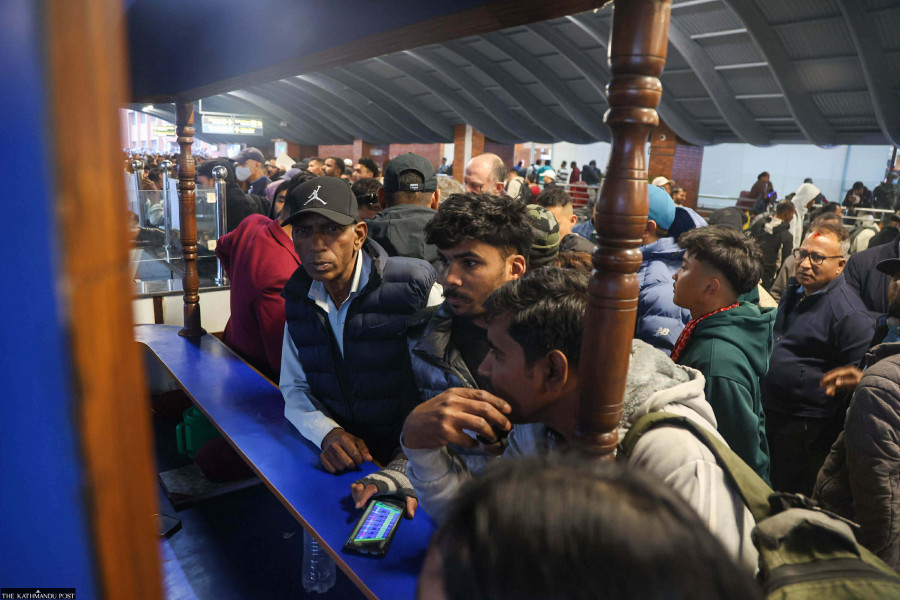
But officials are worried that, despite the ongoing war and chaos in West Asia, Nepali nationals continue to travel to various Gulf countries.
“Since we relaxed the provision of the visit visas [for those who must return to work], Nepali nationals are leaving Nepal and going to different Gulf nations despite the chaos and uncertainty in the region,” an official at the Emergency Response Team told the Post.
The government earlier formed the response team, a cross-ministerial panel headed by foreign secretary Amrit Bahadur Rai, to monitor the situation in the Gulf and make evacuation plans if and when needed.
“Although we stopped Nepali nationals from travelling to West Asia after the US-Israel coalition attacked Iran [on February 28], we are receiving reports that several have reached Gulf countries via India, Sri Lanka, Bangladesh and other destinations. Once they reach the Gulf, it becomes easier to disperse to other countries,” the official added.
If the war continues to escalate, the Emergency Response Team is considering several evacuation options.
“No country has started evacuating its citizens yet, so there won’t be immediate evacuation. But we are exploring multiple alternatives. Evacuation by plane and ship is possible, but a blanket evacuation is not feasible. Once other countries begin evacuations, we will also start bringing our people back,” said the official at ERT who is monitoring the situation closely on a daily basis.
According to the Ministry of Foreign Affairs, 1.7 million Nepalis are officially working and living in the Gulf region, and along with others who are not on government records, the total is over two million.
Evacuating by air and sea involves major logistical challenges. “One ship can carry 7,000 people on a trip, either to Mumbai or Kolkata. From there we need to bring them to Nepal. It will be costly,” the official said. “As per our estimate, it will require at least Rs 1 billion to bring back 5,000 people.”
“During peak evacuation, fares could rise 200 to 500 percent due to high demand,” the official told the Post. “We need at least 1,000 ships to evacuate Nepalis living in the UAE. It will not be easy.”
Meanwhile, Chhetri said the government is considering various options. “As per the needs of the people, the government has opened re-entry for Nepalis in the Gulf region. Many who returned to Nepal for holidays or to vote in the recent elections will be allowed to go back to their work stations. If someone wants to return for other reasons, we will allow them after assessing the security situation,” he said.
As per conservative estimates, over 2,500 Nepalis might need to return to various Gulf countries. “If we don’t allow them to return, they could lose their jobs, so we have decided to facilitate their return,” he told the Post.
“Despite all these odds, we are committed to the safety of our people, and in case evacuation becomes necessary, we will mobilise all available resources.”
Anil Giri is a Chief Sub Editor covering diplomacy, international relations and national politics for The Kathmandu Post. Giri has been working as a journalist for more than two decades, contributing to numerous national and international media outlets.




 14.7°C Kathmandu