All the political parties that gained national status in the March 5 snap parliamentary elections have selected their lawmakers under the proportional representation (PR) system from their closed lists and submitted the names to the Election Commission.
Of the six parties that gained national status, CPN-UML and Shram Shanskriti Party (SSP) finalised their candidates on Saturday, while the remaining parties—the Rastriya Swatantra Party, Nepali Congress, Nepali Communist Party (NCP) and Rastriya Prajantra Party (RPP)—picked their representatives on Sunday.
All six parties crossed the threshold of 3 percent of the total valid votes to win the status of national party and be eligible for PR seats. Apart from crossing the 3 percent PR vote requirement, a political party must win a seat under the direct election to retain national status.
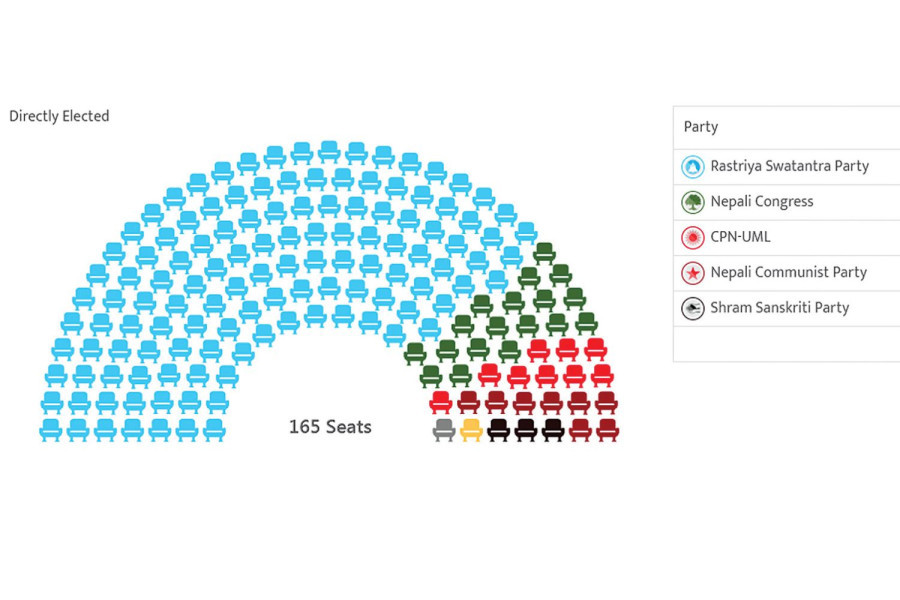
The RSP, which emerged as the largest political party from the recently concluded elections, in both systems, finalised a list of 57 candidates under the PR system for members of parliament. The party obtained 125 seats in the direct category, tallying its total seats to 182, just two seats short of a two-thirds majority.
According to RSP spokesperson Manish Jha, the list has 48 women and 9 men.
RSP chief Rabi Lamichhane participated in the party’s secretariat meeting virtually citing health reasons. However, the meeting was not attended by senior leader Balendra Shah, who has been projected as the party's prime ministerial candidate. Shah has yet to be inducted to the party secretariat, according to a party leader.
Of the selected individuals, 17 are from the Khas-Arya cluster, 16 from the Indigenous nationalities, 9 from the Madheshi community, 8 from the Dalit community, 4 from the Tharu community, and 3 from the Muslim cluster.
The list was submitted to the Election Commission on Sunday, the spokesperson added.
“The party has not disclosed the names of the candidates selected from each cluster. They will only be made public after the Election Commission reviews and approves the list,” said Jha.
Earlier on Saturday, the UML, the third-largest party in parliament with 25 seats (including 16 PR) and the SSP, the fifth-largest party with seven seats (four PR), finalised their PR members.
Likewise, the Congress, the second largest party in the House with 38 seats (20 PR), also submitted the names of its PR list to the Election Commission.
At a meeting of the party’s executive committee held in Sanepa on Sunday, the party agreed to forward the names of 15 women and 5 men to the commission. Among the five men, those ranked at the top of their respective clusters have been included, according to party spokesperson Devraj Chalise.
The Congress also said that the names of candidates submitted by the party will be made public by the election body itself.
The NCP, which secured a total of 17 seats in the House, including nine PR seats, also submitted its list to the commission. The party has sent the names of five males and four females for the PR seats.
The nominees include Balawati Sharma, Pramesh Hamal, Prem Bahadur Bayak, Bhim Kumari Budha, Parshuram Tamang, Jog Kumar Barbariya Yadav, Ganesh Bishwakarma, Parbati Bishwakarma, and Nirasha Chaudhary Dagaura, according to the party secretariat, Ganesh Bahadur Pun.
The monarchist RPP also decided four candidates under the PR category.
A meeting of the party’s executive committee, held on Sunday, recommended the names to ensure representation from different clusters.
Under this arrangement, Bharat Giri has been nominated from the Khas-Arya male category, while Tahir Ali has been nominated from the Muslim male category. Khushbu Oli has been nominated from the Khas-Arya female category, and Saraswati Lama from the Janajati female category.
In the March 5 House of Representatives elections, the RPP secured one seat under the direct system in Jumla.
Meanwhile, the RSP secretariat meeting, held to finalise the PR candidates, did not touch on other issues, including governmentformation, according to party leaders.
Party leaders claimed that they would entrust party chair Lamichhane and senior leader Shah—also the party's candidate for prime minister as per the seven-point agreement reached between them on December 28—with selecting ministerial candidates. However, the party has not formally convened a discussion on the matter, according to Bipin Acharya, the party's joint general secretary.
Under Article 76 (1) of the constitution, the President appoints as prime minister the ‘leader of the parliamentary party’ that has a clear majority in the House of Representatives.
Article 66, sub-clause 8 of the RSP statute says that the leader should be chosen through a contest among interested candidates already selected–either under the PR or direct system–before the federal election.
“The leader of the parliamentary party in the House of Representatives shall be elected through a vote among interested candidates from among those selected by the party as candidates under the PR or direct systems for the federal election,” the statute states.
Although the party projected Shah as its prime ministerial candidate prior to the election, it cannot nominate him for the post without amending the clause. The party leaders claim that the amendment process will begin only after the Election Commission issues certificates to PR lawmakers.
“The Election Commission has its own vetting process for PR candidates once a party submits the list of its lawmaker candidates,” Acharya said. “The process for statute amendment will start only after the PR members get the certificate from the Election Commission.”




 13.46°C Kathmandu