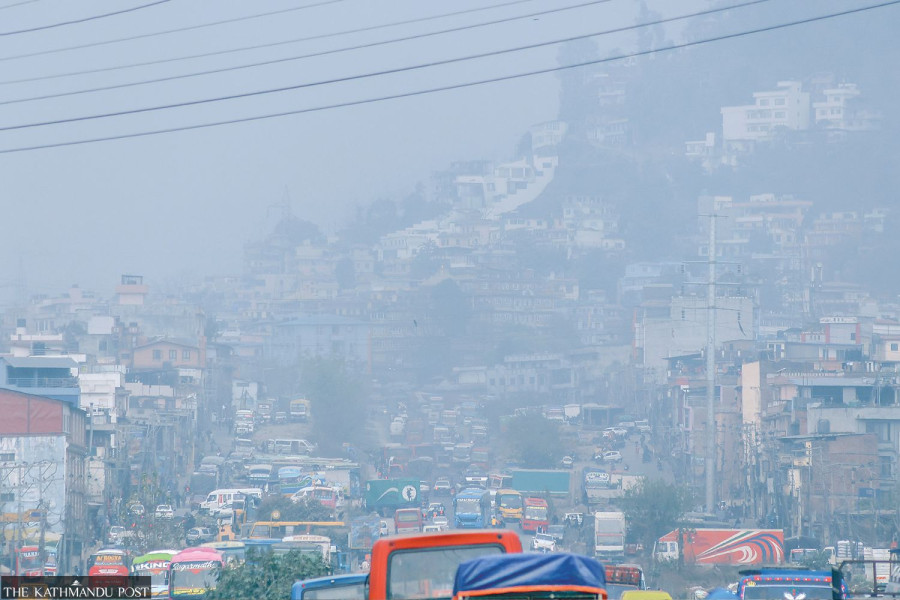
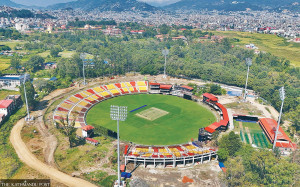
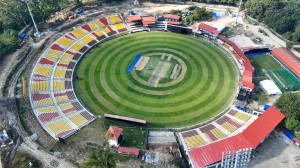
Met officials predicted light rainfall on Monday in one or two places across the Koshi, Bagmati, Gandaki, and Karnali provinces, but it will not clear out air pollution and hazy conditions. A general view of the Sitapaila area in Kathmandu seen on Monday evening. Kathmandu has ranked among world’s most polluted cities lately. POST PHOTO: SURYAMS UPRETI
Haze mixed with polluted air blanketed most parts of the Koshi, Bagmati, Gandaki, and Karnali provinces throughout Monday as well.
The Meteorological Forecasting Division of the Department of Hydrology and Meteorology said that a high-pressure system in the upper atmosphere and a low-pressure area in the lower atmosphere near the eastern region were responsible for haze and semi-cloudy conditions in most hilly and mountainous areas over the last four days.
“The same conditions will continue for the next couple of days,” said Rojan Lamichhane, a meteorologist at the division. “The lack of rainfall to wash away air pollution and the absence of a system to trigger strong winds to disperse it are responsible for the hazy conditions.”
Meteorologists see a possibility of light rain and snow with thunder and lightning at a few places in Koshi, Madhesh, Bagmati, Gandaki, and Lumbini provinces, and at one or two places in the hilly and mountainous regions of Karnali and Sudurpashchim provinces.
However, for the polluted air to wash out, moderate rainfall is needed, and there is no system in place to cause it.
They say that hazy conditions and rising air pollution are not unusual in the pre-monsoon season, as the country experiences such weather almost every year. Last year, the country witnessed similar weather conditions for about two weeks.
Met experts say that pre-monsoon activities such as rain,and strong winds will intensify only after hazy conditions end and the sun shines.
“Last year, we also witnessed hazy conditions for several days,” said Madan Sigdel, associate professor at the Central Department of Hydrology and Meteorology, Tribhuvan University. “This is a usual phenomenon. Air quality has deteriorated of late while drought-like conditions prolong.”
These days, Kathmandu Valley has ranked among the world's most polluted cities, with PM2.5 levels soaring to very unhealthy and hazardous levels. Experts say air quality in Kathmandu has worsened due to the valley’s bowl-shaped geography.
IQAir, a Swiss group that collects air-quality data from around the world, ranked Kathmandu the third most polluted city in the world on Monday, with PM2.5 levels reaching 241 micrograms per cubic metre (μg/m3),
PM2.5 refers to particulate matter (solid or liquid droplets) in the air less than 2.5 micrometres in diameter. It is among the most dangerous pollutants that can get past the nose and throat to penetrate the lungs and even the bloodstream. PM2.5 particles are small and likely to remain suspended in the air for a long time, increasing the likelihood that people inhale them.
As per the US Environmental Protection Agency’s air quality index, an air quality reading of 151–200 is considered unhealthy; everyone may experience problems, with sensitive groups feeling more severe effects. When air quality reaches 201-300, it is considered very unhealthy, and health risks increase for everyone in the area. When it exceeds 300, it falls under the hazardous level, indicating extremely poor air quality that poses serious health risks to everyone.
The worsening air quality has aggravated respiratory illness among the general public. Major hospitals in the Valley have reported a sharp rise in cases of flu, viral fever, cough, and respiratory disease. The Ministry of Health and Population has urged the general public to remain indoors to avoid the adverse effects of deteriorating air quality.
Nepal is one of the world’s most vulnerable countries to the climate crisis and has witnessed extreme weather events in the past decade and a half.
Evidence indicates that the maximum temperature in Nepal is rising at a greater rate (0.05 degrees Celsius per year) than the minimum temperature (0.03 degrees Celsius per year).
The country has been experiencing a hot, dry winter for the past four years. Experts say extreme weather events—excess rainfall in short periods, continuous rains for several days after the monsoon, dry spells, droughts, below-average precipitation, and above-normal winter temperatures—have become more frequent in recent years.




 25.92°C Kathmandu