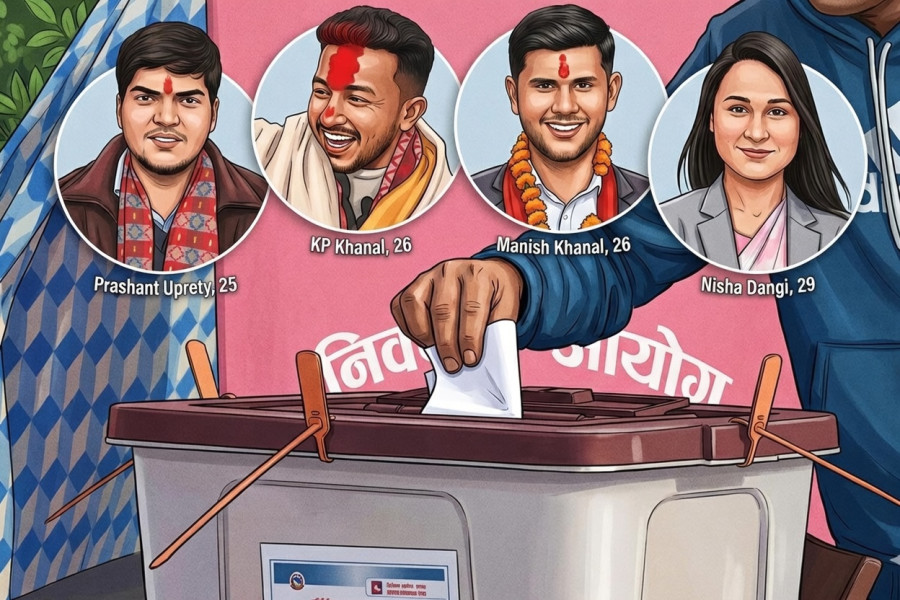
The newly elected House of Representatives is set to witness a significant generational shift, with a commanding presence of young lawmakers emerging from the latest parliamentary polls.
The election results from 159 constituencies released by Sunday evening show that 59 candidates—or around 38 percent—aged below 40 have been elected to the federal legislature, signalling a transformation in the age profile of the country’s political leadership.
The country’s average is just 26 yet the parliament has long been dominated by much older politicians. For instance, in the last parliament elected in 2022, the largest representation came from the 51–60 age group—while only 11 percent members were under 40 years of age. Likewise, the House elected from the 2017 elections had just 13 percent members who were under 40.
The surge of younger representatives this time has been driven largely by the Rastriya Swatantra Party (RSP), which has dominated the under-40 category. Of the 59 young lawmakers elected as we went to press, 51 belong to the RSP. The Nepali Congress has four representatives in this age group, while the CPN-UML has two. A Rastriya Prajatantra Party candidate has won, too.
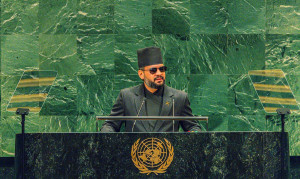
Among the prominent young faces entering parliament are 35-year-old Balendra Shah from Jhapa Constituency 5, 30-year-old Sobita Gautam from Chitwan-3, 28-year-old Sulav Kharel from Rupandehi-2 and 31-year-old Rubina Acharya from Morang-6. Similarly, 29-year-old Nisha Dangi from Jhapa-1, 30-year-old Ranju Neupane (Darshana) from Kathmandu-1 and 29-year-old Sasmit Pokhrel from Kathmandu-5 are also among the youngest members of the new legislature.
Other young lawmakers include 30-year-old Shiva Shankar Yadav from Siraha-2, 31-year-old Sushant Vaidik from Pyuthan-1 and 25-year-old Prashant Upreti from Makawanpur-2, one of the youngest candidates to secure a parliamentary seat in this election.
The election results also show a strong presence of lawmakers in the 41–50 age group. So far, 55 candidates in this group have been elected to the House of Representatives. The RSP again holds a commanding share, with 41 representatives in this age category. The Nepali Congress has five winners in the same group, while the Nepali Communist Party has four, the UML has three and the Shram Sanskriti Party has two representatives.
Among those elected in their forties are 42-year-old Hari Dhakal from Chitwan-1, 48-year-old Dr Lekh Jung Thapa from Rupandehi-3, 45-year-old Manish Jha from Dhanusha-3, 46-year-old Khadkaraj Paudel from Kaski-1 and 47-year-old Buddharatna Maharjan from Lalitpur-1.
Other representatives in this age bracket include 45-year-old Basana Thapa from Dailekh-1 representing the Nepali Congress, 46-year-old Mohammad Ishtiyaq Rai from Banke-2 representing the UML and 43-year-old Harkaraj Rai from Sunsari-1 representing the Shram Sanskriti Party.
Candidates aged between 51 and 60 constitute another sizeable group in the new parliament. So far, 36 lawmakers in this age range have been elected. Of them, 28 represent the RSP, while four belong to the Nepali Congress. Two lawmakers each from the UML and the Nepali Communist Party also fall into this category.
Among the winners in this group are 55-year-old Indira Rana Magar from Jhapa-2, 51-year-old Swarnim Wagle from Tanahun-1, 51-year-old Dol Prasad Aryal from Kathmandu-9, 53-year-old Narendra Sah Kalwar from Sarlahi-3 and 53-year-old Bina Gurung from Kaski-3. Others include 58-year-old Bishnu Bahadur Khadka from Surkhet-1 representing the Nepali Congress and 54-year-old Barshaman Pun from Rolpa representing the Nepali Communist Party.
By contrast, relatively few candidates aged above 60 have secured seats so far. As the presence of younger leaders in Parliament grows, the number of candidates over 60 elected to the House of Representatives remains comparatively low.
According to results made public so far, only nine candidates above the age of 60 have been elected to the House. While most of them represent established political parties, a few are independent or affiliated with newer forces.
From this age group, Prakash Singh Karki, 62, of the Nepali Congress won from Solukhumbu. He secured 13,166 votes, while his closest rival, Ashim Rai of the Nepal Communist Party, received 9,414 votes.
In Kapilvastu-2, Vikram Thapa, 63, of the Rastriya Swatantra Party was elected with 27,635 votes, defeating Nepali Congress candidate Surendra Raj Acharya, who received 21,527 votes.
Similarly, Laxmi Prasad Pokharel, 63, of the CPN-UML won from Dailekh–2 with 13,889 votes, while Nepali Congress candidate Dikpal Kumar Shahi secured 9,552 votes.
In Saptari-4, RSP’s Sitaram Sah, 65, won by a notable margin. He garnered 36,412 votes, while Congress candidate Tejulal Chaudhary received only 13,103 votes.
From Sudurpaschim Province, Bharat Bahadur Khadka, 68, of the Nepali Congress was elected from Doti with 14,897 votes. His closest rival, Deepak Bahadur Dhami of the UML, received 14,110 votes.
Likewise, Bharat Kumar Swar, 70, of the Congress won from Achham-1, with 10,759 votes, while his nearest competitor, Bhim Bahadur Rawal of the Nepali Communist Party, received 10,233 votes.
Pushpa Kamal Dahal, 70, chairman of the NCP, was elected from Rukum East. He secured 10,240 votes, while UML candidate Lilamani Gautam received 3,462 votes.
In Manang, Tek Bahadur Gurung, 71, of the Nepali Congress won with 2,415 votes, defeating NCP candidate Yashoda Gurung (Subedi), who received 454 votes.
Similarly, independent candidate Mahabir Pun, 71, was elected from Myagdi. He secured 22,850 votes, while UML’s Hari Krishna Shrestha received 7,919 votes.
Political analyst Sucheta Pyakuryal notes that the rise of young leadership signals a possible shift in policy priorities, particularly in areas such as education, digital governance, climate policy, and job creation.
However, Pyakuryal also cautions that the administrative system largely remains structured around older institutional practices, which could create challenges in coordination between younger political leaders and the bureaucracy.
“Governance cannot run on popular slogans alone. Populist policies introduced without sufficient research can create long-term problems,” Pyakuryal said. According to her, public perception towards youth leadership reflects “about 70 percent hope and 30 percent scepticism”.
“If a balance can be struck between experience and fresh thinking, Nepal’s governance system could see positive transformation,” she added.
Young political analyst Nabin Tiwari views the growing presence of youth in Parliament as a positive sign, but says it would be wrong to expect change based on age alone.
According to him, in politics what matters more than age is the intent, integrity and clarity of vision of those in leadership.
“The election of young leaders is itself a positive development, but age alone is not decisive in politics,” Tiwari said. “What truly matters is their intent, honesty and vision, and the kind of impact that leadership creates in society.”
He argues that the poor governance associated with older political leaders in the past cannot be attributed solely to their age. “The problem was mainly about intent. Real change is possible only when there is a clean intention and a genuine willingness to work,” he said.
Tiwari also warned that the growing tendency of seeking popularity on social media is increasingly visible in politics and could have long-term consequences. “The trend of performing for Facebook and influencing people through cheap popularity is also visible among young leaders. The long-term impact of such behaviour is something we must seriously reflect on,” he said.
He also cited an example to underline that leadership depends more on perspective and vision than age. “When Nelson Mandela assumed leadership at the age of 76, he still managed to unite the country and guide it in the right direction,” he said. “So youthful energy alone is not enough for political success; it must be accompanied by clear vision, a sense of responsibility and integrity.”




 20.85°C Kathmandu