Parliament building still under construction. Where will new lawmakers convene?
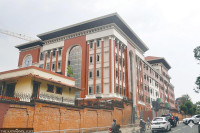
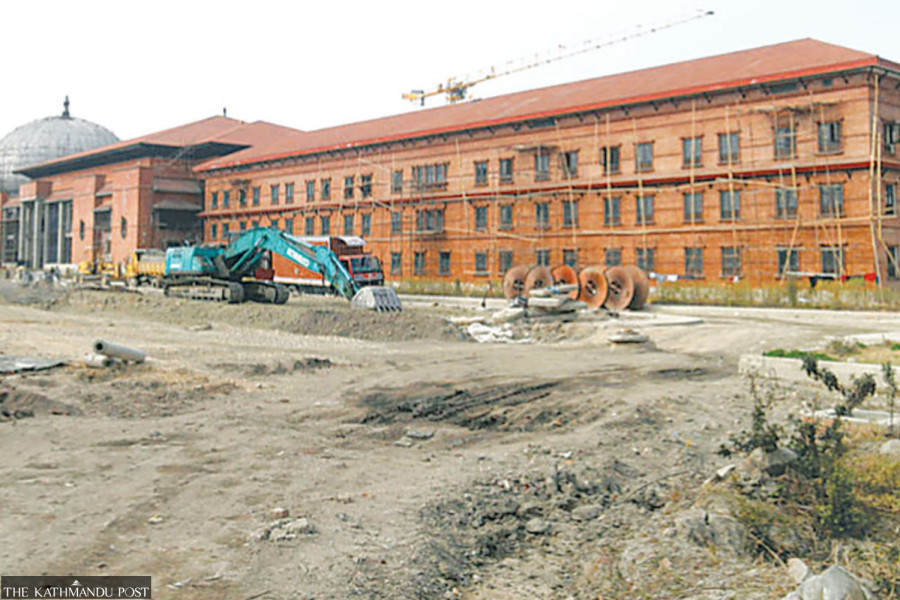
The building was originally scheduled to be ready by 2022, but work faced repeated delays, and officials plan a sixth extension. The new Parliament building is being constructed on the Singha Durbar premises by a joint venture of China‐based Second Harbor Engineering Company and Nepal’s Tundi Construction. This photo was taken a few days ago. POST PHOTO
As vote counting from March 5 House of Representatives (HoR) elections nears completion, the country is preparing to welcome a new cohort of lawmakers. Yet a basic question remains unresolved—where will the country’s newly elected representatives convene?
The federal parliament secretariat says it still does not have a confirmed venue to host the first session of the HoR, despite the fact that the new parliament building inside Singha Durbar remains under construction and is nowhere near completion.
According to the Election Commission, the final results including the proportional representation vote are expected to come within a few days. Once the results are finalised, all 275 HoR members must be sworn in before the new parliamentary session begins. But officials admit that the infrastructure required to host the oath-taking ceremony and subsequent sessions has not yet been secured.
Ekram Giri, spokesperson for the federal parliament secretariat, said the absence of a functional parliament hall has created growing concern within the institution tasked with managing the legislature.
“We urgently need a hall for the House of Representatives. At the very least, we need space for parliamentary leaders, offices for political parties and facilities for staff directly involved in conducting sessions,” said Giri. “So far, the agency responsible for building construction has assured us the work will be completed soon, but progress has not been as fast as expected.”
The secretariat had been relying on assurances from the Ministry of Urban Development that the building would be handed over in mid-March. As a result, it has not pursued alternative venues.
“Unfortunately, we do not even have a hall large enough to administer the oath of office to all members of parliament together. Legally, the House session must be convened within 30 days of the final election results being formally submitted to the President and made public,” said Giri.
According to joint secretary Giri, running a parliamentary session requires complex logistical arrangements. Seating for lawmakers must be allocated according to party strength, while separate areas must be prepared for government officials, journalists, observers and visitors.
“We cannot run parliament the way we conduct an ordinary meeting. We must determine where members will sit according to party representation, where the public gallery will be, where government officials will stay and where journalists will be accommodated. All these arrangements must be finalised before the session begins,” he said. Even preparatory work for the session normally takes seven to ten days, he said. “We are already under severe time pressure.”
The secretariat had repeatedly urged construction authorities to accelerate work on the new parliament complex after the Dashain festival in October last year, but the pace has continued to lag behind expectations.
Senior political leaders have also inspected the project several times. Both the Speaker of the HoR and the chair of the National Assembly visited the construction site on multiple occasions, urging contractors to expedite the work. The President and the Prime Minister have similarly instructed officials to ensure timely completion.
“From our side, we have carried out the necessary coordination and raised the issue wherever needed. Even if the entire complex is not finished, the plan was to hand over the House chamber and six additional buildings first. However, none of them are fully ready yet,” said Giri.
The parliament complex project was originally contracted on October 3, 2019, with a deadline of October 2, 2022. The goal was to ensure that the parliament formed after the next elections would convene in the new building.
The construction contract, worth Rs5.67 billion, was awarded to Tundi–Sec JV. However, the project has missed multiple deadlines. After failing to meet the initial completion date, the deadline was extended five times and most recently until December 31, 2025. Authorities are now preparing to grant yet another extension.
Parliamentary committees have also repeatedly monitored the project and urged faster progress. On Tuesday, a high-level team including Federal Parliament Secretary General Padma Prasad Pandey and Chief Secretary Suman Raj Aryal inspected the construction site.
Roshan Shrestha, chief of the Special Building Construction Project under the Ministry of Urban Development, said work has continued without interruption, even during holidays and election day.
“So far, about 94 percent of the construction has been completed. The work is being carried out with the goal of hosting the new parliament session in the building. The main building and party offices should be ready,” said Shrestha. “We initially aimed to complete the work by mid-March, but despite our efforts we could not finish on time. Now we are targeting to complete by March fourth week.” However, Shrestha acknowledged that only essential facilities would be ready initially, and completing the entire complex could take about two more months.
The parliament complex is being built on 156 ropani (7.94 hectares) of land within the Singha Durbar premises and consists of several five-storey buildings. The project includes separate buildings for the House of Representatives and the National Assembly, a central lobby, offices for high-ranking officials, a library and a museum.
Additional facilities include buildings for parliamentary party offices, parliamentary committees, the parliament secretariat, a cafeteria and a press and printing centre. The complex is also designed to accommodate parking for 476 four-wheelers and 800 motorcycles, along with separate accommodation for security personnel.
Meanwhile, the building that previously hosted parliamentary sessions—the Birendra International Convention Centre at New Baneshwar—is no longer available. The parliament secretariat decided not to renew its agreement with the convention centre after protesters vandalised and set parts of the building on fire during demonstrations on September 9 last year.
In the meantime, the National Assembly has been operating from an older hall previously used by the parliamentary agriculture committee on the Singha Durbar premises.
Urban Development Minister Kumar Ingnam acknowledged that the government had failed to complete the project within the current Nepali month but insisted the House chamber would soon be ready.
“Despite all efforts, we could not finish the building by mid-March. However, we are working to ensure that the parliament can convene there soon.” According to the minister, work is currently focused on the central lobby and finishing touches inside the House chamber, including the installation of a false ceiling.
“The ceiling work should be completed within three or four days. Because the hall is very high, the work has been technically challenging,” said Minister Ingnam. He expressed confidence that construction would be sufficiently complete by March 24 to host the new parliament.




 19.4°C Kathmandu
.png&w=200&height=120)