Every update from Gulf makes hearts race in Nepali homes
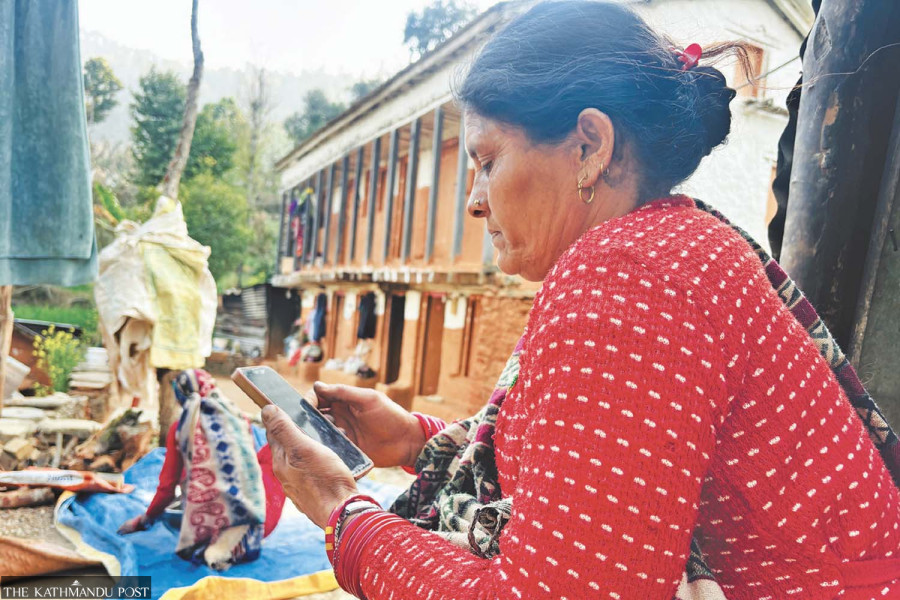
Parents receive any piece of information nervously as rumours and reports of missile strikes fuel their fears. Manasara Dhungana, 50, of ward 5 in Mangalsen, Achham checks her phone for updates. Post Photo
As the ongoing war in the Persian Gulf reverberates across the region, the tremors are being felt far and wide. The families of Nepalis working in Gulf countries are anxious and glued to mobile phones and radio bulletins, fearing that a distant conflict could shatter their fragile lifelines.
Following attacks on Iran by the United States and Israel, Tehran has retaliated by targeting American military bases in Qatar, Saudi Arabia, Bahrain, Kuwait, the United Arab Emirates and Oman. The conflict has left the families of migrant workers restless.
Fifty-year-old Manasara Dhungana from ward 5 of Mangalsen Municipality in Achham hardly leaves her phone out of sight. Seated in the courtyard of her modest home, she scrolls through Facebook and listens intently to FM radio updates. A recent headline about a missile strike in the United Arab Emirates and the reported death of a Nepali youth from Gorkha left her shaken.
“My heart beats faster with fear that something might happen to my son at any moment. Unless I speak to him, I cannot steady myself. Even when the phone rings, I am terrified it might be bad news,” said Manasara.
Her 24-year-old son, Dipraj Dhungana, works in Dubai. Like thousands of young Nepalis, he left home in search of economic opportunity. For Mansara and her husband Bhimraj, he is their main support after the death of their youngest son three years ago. Their daughter serves in the Nepali Army, but it is Dipraj’s earnings that sustain the household.
Social media videos purporting to show missile strikes and unverified claims that Dubai is unsafe have compounded her distress. “Money can be earned later. I want my son back home safely. We value his life more than anything,” said Mansara, her voice quivering.
Despite her son’s reassurances, fear lingers. Over the phone, Dipraj tells his parents he is safe and that his residence is far from any reported targets. “There is a risk around American military bases,” he explains. “But where I stay, nothing has happened so far.” He acknowledges, however, that rumours of missiles and drones have created uncertainty. His company has granted leave from Sunday to Wednesday as a precaution. “Living in fear in a foreign land is difficult,” he admits. “I wish I could return home.”
Deumal BK, aged 55, of the same ward endures his anxiety in darkness. Visually impaired, he cannot watch the alarming videos circulating online, but he hears fragments of news from neighbours. His 22-year-old son Ekindra BK left for Dubai seven months ago, hoping to lift the family out of poverty and support his ageing father.
“He has only just begun working. I worry less about the money he sends and more about his life. I pray day and night that I do not hear anything terrible,” said Deumal. Unable to operate a smartphone, he relies on others for updates, each rumour unsettling his already fragile peace of mind.
While the families in home grapple with dread, many Nepalis in the Gulf insist that conditions remain stable. In ward 7 of Baglung Municipality, Yashoda Sharma recalls her panic upon hearing about regional tensions. She immediately called her husband Ram Prasad, who works in Dubai. “At first, we were panic-stricken. But after seeing him on video call and hearing that he is safe, we felt relieved,” she said.
Ram Prasad confirms that although occasional distant blasts have been heard, they have caused no harm. “Sometimes we hear sounds of explosions. But everything coming this way is intercepted,” Yashoda quoted her husband as saying. According to him, the authorities have advised residents to avoid open spaces, and the Nepali embassy has urged nationals to report any difficulties.
Workers in both Dubai and Qatar say internal security systems are robust. Santosh Chhetri, employed in Qatar, said that the government issued strict guidelines, including staying indoors during alerts. “If we follow the rules, there is no problem. We have been told not to go to rooftops or open windows unnecessarily. One night we heard a loud sound, but since then it has been quiet,” he said.
Chhetri said that daily life continues largely uninterrupted. Construction activities in certain outdoor sectors have been paused as a precaution, but employers have ensured food and accommodation. “There is no chaos here. Families back in Nepal imagine missiles constantly falling, but the security systems here make the situation manageable,” he added.
The Nepali Embassy in Qatar has also circulated notices encouraging migrants to remain calm and maintain contact. According to local migrant support organisations, companies have also allowed some employees to work from within residential compounds. Visas for visitors have reportedly been extended automatically, easing concerns for those awaiting documentation.
Back home, local authorities are trying to quell panic. Ganga Kumari Sharma, a counsellor at the Migrant Resource Centre in Baglung, says they are in regular contact with families. “We are prepared to support anyone facing difficulties,” she explains.
Krishna Prasad Acharya, Chief District Officer of Baglung, confirms that the administration has been disseminating accurate information to prevent the spread of rumours. “The situation is not as alarming as some fear. We are advising families to rely on verified sources,” he said.
The anxiety gripping rural households underscores Nepal’s deep economic reliance on Gulf migration. Data suggests that the direct impact of conflict in the Gulf will be felt in Nepal’s tourism, remittance inflows, foreign trade and labour migration. At present, around 1.7 million Nepali workers are employed across the Gulf region. Of the approximately 700,000 Nepalis who leave each year for foreign employment, nearly 65 percent—about 450,000—head to the Gulf.
These migrant workers contribute approximately 41 percent of Nepal’s total remittance inflows. In the fiscal year 2024-25, Nepal received Rs1.702 trillion in remittances, of which Rs673 billion came from Gulf countries. In the first six months of the current fiscal year 2025-26 alone, Rs1.03 trillion was remitted to Nepal, with Rs422 billion—about 41 percent of the total during that period—originating from the Gulf.




 15.78°C Kathmandu
.jpg)