Nepal advises its citizens to follow safety measures as tensions flare in West Asia
Foreign Ministry urges Nepalis in conflict zones to minimise outdoor activities, stay indoors as much as possible and remain alert to local advisories.Passengers wait in the departure hall at the Tribhuvan International Airport in Kathmandu on Saturday after a Qatar Airways flight was delayed following tensions in West Asia. Travellers were seen anxiously monitoring updates on display boards and contacting airlinerepresentatives as uncertainty over revised departure times continued throughout the day. Suryams Upreti/TKP
As soon as the United States and Israel launched a series of attacks on Iran and Iran took retaliatory measures on Saturday, the safety and security of over 1.7 million Nepali nationals living and working across the region has become paramount.
The Ministry of Foreign Affairs has issued a comprehensive advisory to Nepali nationals residing in Israel, Iran, and other countries in West Asia, urging them to remain vigilant amid escalating tensions in the region.
In retaliation, Iran has attacked several Gulf Cooperation Council countries. But there is no information about Nepali nationals being hurt, according to Nepal’s foreign ministry.
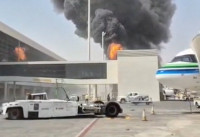
The advisory comes in the wake of military escalations, including a joint attack by the US and Israel on Iran, followed by retaliatory missile strikes by Iran targeting US bases in countries such as the UAE, Kuwait, Saudi Arabia, Bahrain, Jordan and Qatar.
The ministry has asked Nepalis in conflict-affected areas to follow local security advisories and adhere strictly to instructions of competent authorities in Israel, Iran, and other countries where Nepalis live.
The ministry also asked Nepali nationals to minimise outdoor activities, stay indoors as much as possible, remain alert, and exercise caution.
“Avoid unauthorised travel, do not travel without prior authorisation from relevant local authorities. Maintain regular communication, keep in contact with Nepali communities, embassies, and the ministry in Kathmandu,” the ministry urged.
It also asked Nepalis to defer non-essential travel while those planning to visit Israel or Iran have been strongly advised to postpone their trips until the situation stabilises.
We are closely monitoring the situation, foreign ministry spokesperson Lok Bahadur Paudel Kshetri told the Post, embassies/consulate generals in the region are in touch with Nepali community, and with the host country authorities.
“They have also issued advisories, to stay indoors, follow safety guidelines, stay in touch and report/inform if anything, any help needed. At the moment, safety/security of Nepali nationals is our top priority.”
The Nepali Embassy in Israel issued an advisory to the Nepali citizens living and working in Israel. It has urged citizens to follow Israeli authorities’ directives, avoid unnecessary travel, and stay near safe zones. Regular updates will be issued as the situation develops, the embassy stated.
In the notice, the embassy asked Nepali nationals to strictly follow security instructions issued by Israeli authorities and the Home Front Command, remain indoors as much as possible, and avoid travelling without prior authorisation.
The embassy urged the Nepalis to closely monitor local news and emergency alerts, stay in regular contact with the Nepali community and the embassy, and stay near designated shelters or safe spaces.
With approximately 700,000 Nepalis residing in the UAE, the embassy has urged caution following missile attacks by Iran on US military bases in the region. Citizens are asked to avoid unnecessary travel and stay in contact with the embassy for support (Tel: +971-508180280).
“In the context of the evolving situation in the Middle East, Nepali citizens residing in the United Arab Emirates are requested to refrain from unnecessary travel, remain vigilant, and follow the security guidelines and information issued by the UAE government,” the embassy said.
The Embassy of Nepal in Doha, Qatar, has urged Nepalis residing in Iran to travel only after obtaining prior permission from local authorities.
The embassy in Doha, which also oversees Iran, made this request through a notice issued on Saturday. “Do not travel without prior approval from the relevant Iranian authorities,” the embassy said.
The Embassy of Nepal in Doha stated that it is closely monitoring the evolving situation in the Middle East.
“Strictly follow the security advisories and instructions issued by Iranian authorities,” the embassy said. “Stay indoors as much as possible, remain alert, take necessary precautions, and maintain regular contact with the Nepali community.”
The embassy has asked any Nepalis in Iran facing problems to contact it (Tel: +974-66214419)
As tension escalated in West Asia (Middle East), political leaders also expressed concerns over safety and security of the Nepali nationals.
Nepali Congress President Gagan Thapa expressed concern over the situation, emphasising the importance of Nepalis following safety guidelines. “The safety of our citizens in the Middle East is extremely sensitive. I urge all Nepalis to stay informed and adhere to security measures. The Government of Nepal and Nepali embassies must monitor the situation closely and take prompt action for citizens’ safety,” he stated.
CPN-UML Chair KP Sharma Oli also urged Nepalis in affected regions to remain safe and vigilant, calling on the government and embassies to mobilise immediately for citizens’ protection.
Rastriya Swatantra Party President Rabi Lamichhane also issued a statement and said that recent developments in the Middle East have caused serious concern for the global community.
“From the perspective of international relations and geopolitical balance, the situation is extremely sensitive. We call on all parties to exercise maximum restraint and seek solutions through dialogue and diplomatic means,” Lamichhane said.
The evolving situation in the region has heightened security risk in Gulf countries such as the UAE, Qatar and Bahrain, Lamichhane said. As millions of Nepalis are working in these countries, serious concern has arisen regarding their lives, employment, and safety, he stressed.
“We urge the government to keep Nepali embassies in the concerned countries on high alert, prepare for immediate evacuation and safe movement if necessary, strengthen emergency contact mechanisms, and regularly publish factual updates on the condition of Nepalis,” Lamichhhane said.
Other party leaders have also expressed safety and security of the Nepali citizens in West Asia.
Senior RSP leader Balendra Shah issued his own statement on Saturday night.
“A special appeal to all Nepali brothers and sisters residing in various countries of the Middle East,” Shah said.
“The Nepali embassies there have urged everyone to exercise high vigilance in light of the current unusual situation.
“You are requested to stay safely indoors as much as possible, fully follow the instructions of local security authorities, avoid travel except in emergencies, and be aware of nearby safe shelters.”
Nepali Communist Party Chairman Pushpa Kamal Dahal also said that the attacks on Iran by the United States and Israel, and the subsequent developments, have created serious tensions in the Middle East.
The aerial and missile attacks have also created difficulties for travellers to the Gulf region. The Tribhuvan International Airport Office has warned that flights to the war-affected region may be delayed, rescheduled, or cancelled due to airspace restrictions. Passengers are urged to confirm the latest flight status with airlines before travelling to the airport, the airport office said in a statement. “Efforts are underway to manage stranded passengers.”
The Ministry of Foreign Affairs has provided contacts for those in need of assistance: MoFA, Kathmandu, Tel: +977-9862678437 | Email: [email protected]; Embassy of Nepal, Tel Aviv, Israel, Tel: +972-545582077 | Email: [email protected]; Embassy of Nepal, Doha, Qatar, Tel: +974-66214419 | Email: [email protected].
Anil Giri is a Chief Sub Editor covering diplomacy, international relations and national politics for The Kathmandu Post. Giri has been working as a journalist for more than two decades, contributing to numerous national and international media outlets.




 14.7°C Kathmandu