20 identified out of 669 flood victims as Nepal prepares mass burials
Overflowing mortuaries mean that authorities have the practical option of taking DNA and other forensic records and laying unidentified remains to rest. The body of a flood victim being carried after a DNA test in Bharatpur Hospital, Chitwan on Saturday. RSS
Only 20 of the 669 bodies recovered after Wednesday’s Bhotekoshi and Trishuli floods had been identified by relatives as of Saturday evening, leaving authorities racing to preserve evidence and find space for the dead as hospital mortuaries fill up and remains decompose.
Many of the dead were carried dozens of kilometres downstream from the flood’s epicentre in Rasuwa through Nuwakot, while others were recovered mutilated or in pieces after being buried in mud and debris. With hospital mortuaries and temporary holding centres filling up and bodies beginning to decompose, authorities are preparing emergency burials after preserving DNA and other identifying records.
The government has issued an emergency directive under Section 22(a) of the Nepal Police Act (1955) to govern the handling of unidentified and unclaimed bodies when normal storage and identification procedures can no longer cope with the scale of a disaster.
Under the usual legal framework, unclaimed bodies can be offered to medical teaching institutions or handed to local governments and philanthropic organisations for funeral rites. The new Unidentified and Unclaimed Bodies Management Directive allows security forces and district authorities to document, preserve and bury unidentified remains when mortuary capacity is exhausted.
Deputy Inspector General Abi Narayan Kafle, the Nepal Police spokesperson, said the distance over which bodies have been carried by the floodwaters has made identification particularly difficult.
“Of the 669 bodies recovered, 211 were found as mutilated, partial or severed remains, making visual identification extraordinarily difficult,” Kafle said. “Many remains were buried under thick mud and water for two to three days.”
Police teams clean recovered remains, conduct inquests and take detailed photographs before attempting to match them with reports of missing people. But identifying bodies recovered far downstream, including in Rupandehi, Bhairahawa, Chitwan and Pokhara, has created major logistical challenges, he said.
Mortuaries across the Narayani river basin have already reached capacity. Nawalparasi East has transferred bodies to facilities outside the district, including 41 to Pokhara in Kaski and eight to Palpa. Jagadishwar Upadhyay, chief district officer in Nawalparasi East, said the district had been forced to seek storage space in neighbouring areas after local facilities filled up. Other bodies have been sent to hospitals in Rupandehi and Kapilvastu.
A senior Nepal Police officer said burial had become necessary in some areas to prevent a public health crisis.
“Our absolute priority is returning every victim to their families,” the officer said. “But where visual identification is impossible and remains have begun to decompose rapidly, we must secure DNA profiles and proceed with dignified burial.”
Under the emergency procedure, authorities must first make extensive efforts to identify victims through public notices, social media and national media. Forensic teams can then compare thumbprints, iris scans, dental records, forensic imaging and DNA with government databases and other records.
Every recovered body has to receive a permanent identification number. Jewellery, cash, clothing, identity documents and other belongings must be separately sealed and stored under the same tracking number. Photographs showing facial features, tattoos and other distinguishing marks are also to be archived digitally.
If remains cannot be identified and storage space is exhausted, an eight-member district management committee chaired by the chief district officer can authorise burial in coordination with local governments.
“Each body managed underground will have its photograph, DNA sample, assigned tracking code, physical description, identification file, autopsy report, inquest documentation, burial date and exact plot location permanently archived,” Kafle said.
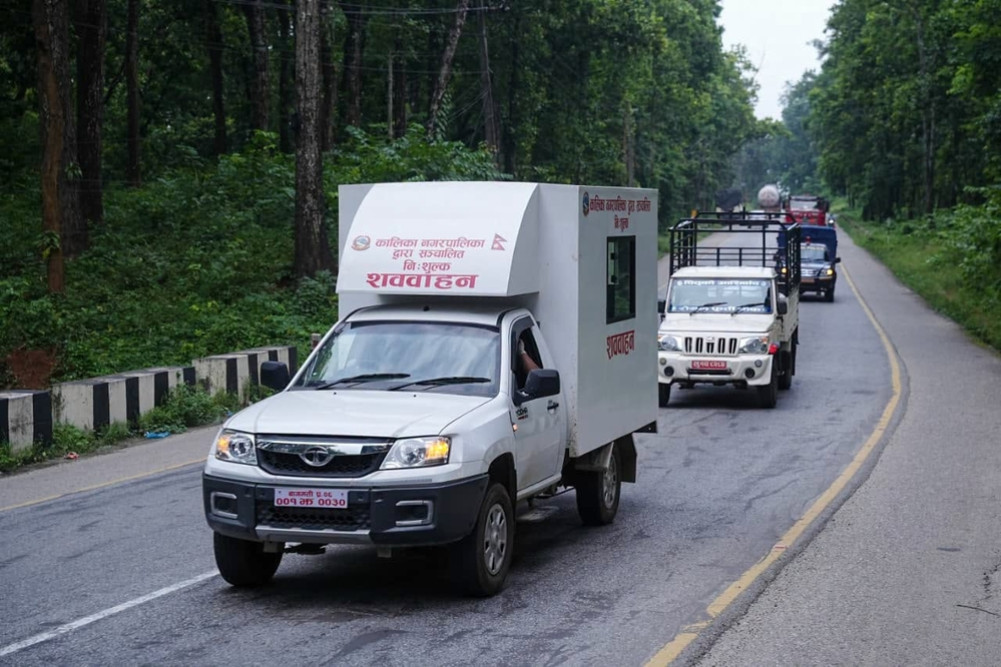
Authorities transport the remains of Bhotekoshi flash flood victims, recovered downstream in the Narayani river, to a forest in the Devghat area for burial on Saturday. Nepal Photo Library
“If family members come forward in the future to claim a missing relative, these scientific and legal records will allow us to confirm identity and locate the exact burial plot.”
These preparations are under way in Chitwan, where 233 bodies have been recovered from riverbanks and surrounding areas since the Rasuwa disaster. Only four have been identified, leaving 229 in local hospitals and temporary holding centres.
The Chitwan District Security Committee has selected an open public site in Devghat, Bharatpur Metropolitan City-1, for burial.
Ganesh Aryal, chief district officer of Chitwan, said authorities had finalised the site after ensuring that DNA samples would be collected from the remains before burial.
At a temporary holding facility near the Chitwan Association of Industries complex, medical teams have already extracted DNA samples from 80 bodies. Aryal said those remains would form the first batch transferred to Devghat.
A 40-member medical team, including seven forensic pathologists and seven dental surgeons, is handling the identification work. The specialists have been drawn from Bharatpur Hospital, Chitwan Medical College, Bheri Hospital, Lumbini Medical College and Nepal Medical College in Kathmandu.
Dr Bishwabandhu Bagale, medical superintendent at Bharatpur Hospital, said DNA sampling of the remains at the temporary holding centre had been completed, allowing the bodies to be transferred for burial. Forensic teams are continuing to collect samples from bodies in hospital mortuaries so they can be moved to the burial site once processing is complete.
The district’s mortuary capacity is tiny compared with the scale of the disaster. Public and private hospitals in Chitwan together can store only about 50 bodies. The arrival of 233 remains has overwhelmed that capacity, prompting authorities to move towards emergency burial.
Other districts are preparing similar measures.
Ishwor Raj Paudel, chief district officer of Kathmandu, said the District Disaster Management Committee had spent Saturday identifying possible burial sites.
“The committee met throughout the day on Saturday and identified several prospective burial sites,” Paudel said. “Formal decisions regarding site selection in the capital are expected on Sunday.”




 13.46°C Kathmandu