Nepal flood rescuers battle treacherous terrain and shortages to find the missing
Soldiers, police and specialist teams search buried tunnels, collapsed structures and debris three days after the Bhotekoshi disaster, battling treacherous terrain and equipment shortages. Specialised teams drill a rock in Trishuli on Saturday in search of a hydropower project tunnel to rescue people trapped inside, in Rasuwa. RSS
On Friday afternoon, an Armed Police Force rescue team reached the wreckage of a security post in Timure, a remote settlement in Rasuwa bordering China.
The rescuers were searching through the debris left by Wednesday’s devastating flood when one of them heard something unexpected: a child crying.
“At the surface, nothing was visible,” said APF Deputy Inspector General Netra Bahadur Karki. “We suspected someone was trapped beneath the debris. The team immediately began digging through the collapsed structure and successfully pulled a six-year-old girl out alive.”
The team belonged to the APF’s Collapsed Structure Search and Rescue unit, created in 2011 for major disasters. It has 285 trained personnel equipped to cut through concrete, steel and timber in difficult terrain. Members are also trained in combat medical care.
The girl was stabilised at the scene and taken to the Border Outpost in Timure. Bad weather prevented her immediate evacuation to hospitals in Dhunche or Bidur.
Her rescue was one of many taking place across the flood zone as Nepal’s security forces race against time to find people still trapped, missing or cut off.
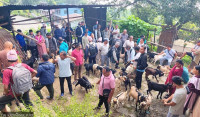
The APF has deployed 4,203 personnel in specialist teams, including search-and-rescue dog squads, diving teams, rope rescuers, medical units, drone operators and personnel managing temporary holding centres.
“Our dog squads are locating five to seven bodies daily based on scent cues,” Karki said.
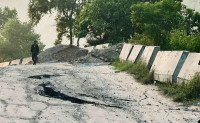
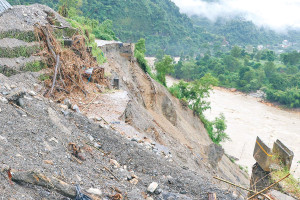
The disaster struck at about 8:40 am on Wednesday, when a huge surge swept down the Bhotekoshi and Trishuli river corridors, destroying roads, bridges, settlements and other infrastructure across central Nepal.
Seven Nepali Army helicopters and eight private aircraft have since been flying rescue and relief missions.
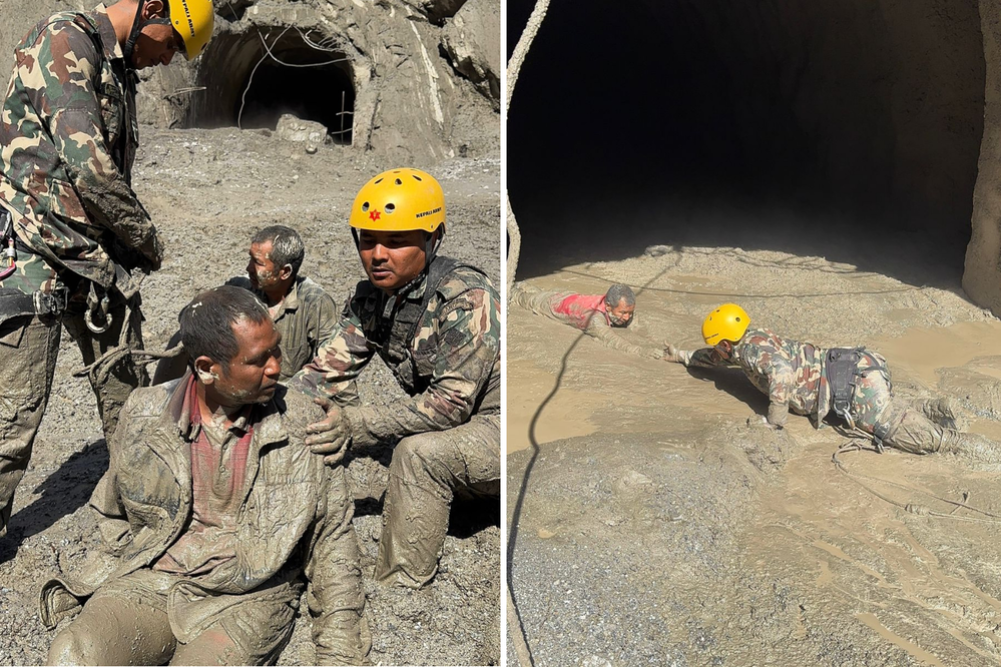
Among those deployed are troops from the Army’s elite Ranger Battalion. On Friday, they rescued four workers trapped inside an intake tunnel at Rasuwa Hydropower Project.
The tunnel entrance had been buried under thick slurry and the surrounding terrain was so badly altered that rescuers could not immediately locate it.
“The entire land structure had shifted; there was no visual landmark left to identify the entrance,” said Brigadier General Rajaram Basnet, the Army spokesperson, who is coordinating military operations from the Bidur barracks.
Army officers worked with project engineers and used structural plans to determine the tunnel’s location. Military engineers then used specialised equipment to break through the obstruction.
Images from the rescue show workers crawling towards the light through thick mud as soldiers moved in to extract them.
Rescuers lowered a heavy basket from a hovering helicopter and, secured by harnesses, crawled through the mud to reach the trapped men. The four survivors were then lifted out and flown to Kathmandu for treatment.
The operation illustrates the central problem facing rescue teams: in many places, the flood has not simply blocked access but erased the landscape itself.
Across the river basin, 84 frontline officers from the Army, Nepal Police and APF are involved in high-risk searches. In total, 4,811 Nepal Police personnel have been deployed for rescue, body recovery and logistics.
By 3:30 pm on Saturday, security forces had recovered 669 bodies from eight districts downstream, according to Senior Superintendent Abi Narayan Kafle, the police spokesperson.
Police commanders have positioned retrieval teams along the river corridor from Rasuwa to the southern plains, using drones to scan riverbanks and debris fields.
When sensors detect human remains beneath wreckage or sediment, ground teams equipped with hydraulic cutters and other power tools move in.
Once a body is recovered, it is tagged, placed in an airtight body bag and taken to a designated hospital.
Authorities record photographs and distinguishing features and, when necessary, collect fingerprints and biological samples for identification.
The scale of the disaster is already overwhelming those systems. Police say nearly 2,000 people have been reported missing by relatives in Makwanpur, Dhading, Kavre, Sindhupalchok, Dolakha, Ramechhap, Sindhuli, Chitwan and Nuwakot, while figures for Rasuwa were still being compiled.
“Given the sheer volume of casualties, storing bodies indefinitely is impossible,” a senior police field commander said. Authorities are therefore preparing emergency procedures for DNA sampling, fingerprinting, detailed records and tagged burials.
Home Minister Sudan Gurung has said the immediate priority is to save lives.
“Our security personnel are working without sleep,” Gurung said. “Until a missing person’s body is found, our operational assumption is that they are still alive and awaiting rescue.”
Helicopters have become the main lifeline for communities cut off by destroyed roads and bridges.
Nepali Army personnel rescue people trapped inside a hydropower project tunnel in Rasuwa following the Bhotekoshi flood. Photo: Courtesy of Nepali Army
At the Army Barracks in Battar, Bidur, and at the Dhunche helipad, aircraft are taking off and landing continuously. Outside the razor-wire perimeter in Bidur, families wait and watch every incoming helicopter.
On Friday, Gurung went to speak to them. The meeting quickly heated up as angry relatives questioned the government over warnings and the speed of the rescue response.
“If the administration had alerted us the moment the surge crossed the northern border, the entire bazaar could have been evacuated in time,” one resident shouted through the fence.
Gurung defended the crews operating in narrow mountain valleys in dangerous weather. He cited the tunnel rescue as evidence that teams were reaching trapped victims.
Among those waiting was Nani Chaulagain, whose relatives remain trapped near the Trishuli Hydropower complex while her injured husband is being treated in Kathmandu.
“I don’t even have the money to travel to Kathmandu to be with my husband,” she said. “My family members are still stuck up there, and nobody can tell us when the helicopters will reach them.”
Police estimates suggest that about 100 people remain stranded around Timure. Preliminary reports also put the number unaccounted for at around 200 near the Mailung Upper Trishuli-A site, another 200 in Syaphrubesi and Haku, at least 50 at Tiru Secondary School in Uttargaya Rural Municipality-1 and 10 at the Save the Children compound in Biruwadanda.
Yet police face a basic limitation: they have no aircraft of their own.
“We have highly trained disaster response personnel on the ground, but because the Nepal Police owns no aircraft, we cannot deploy our units independently,” a senior police officer said. “In many remote sectors, our officers can only move when paired with Nepali Army helicopter missions.”
A police inspector in Rasuwa said emergency calls to the hotline number at 100 continue to come from stranded villagers, but ground teams often cannot reach them because roads have been destroyed and air transport is limited.
The disaster has revived a long-running debate over whether Nepal Police should have its own aviation capability.
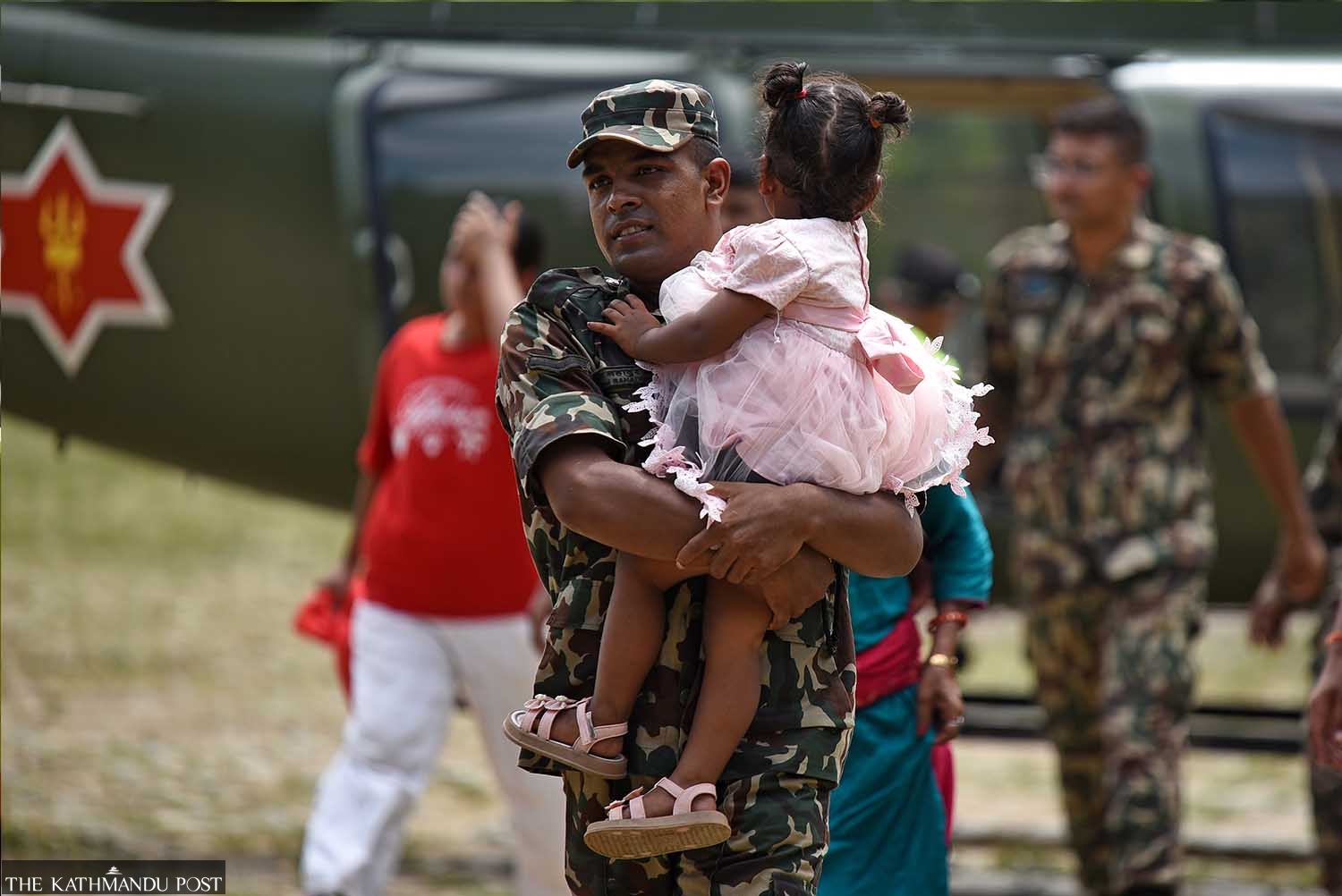
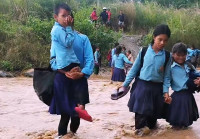
A Nepali Army soldier carries a stranded child to safety. Angad Dhakal/TKP
Former Inspector General of Police Achyut Krishna Kharel wrote in his 2018 autobiography about repeated difficulties securing helicopter support during the Maoist conflict in the 90s. Proposals for police helicopters were submitted in 1996 and 1997, and a purchase was approved by the government in 2000 before the decision was reversed.
Successive police chiefs, including Rabindra Pratap Shah, Kuber Singh Rana, Sarbendra Khanal and Dhiraj Pratap Singh, later renewed calls for dedicated aviation assets.
“The lack of dedicated air assets for the police remains a critical bottleneck,” Singh said.
The APF faces the same problem. A senior officer said the force had repeatedly sought light helicopters for disaster response, but the proposals had not been approved.
The need for specialised equipment is equally pressing.
Nepali Army’s former Colonel Ratindra Khatri, a disaster management specialist, said the first 72 hours after a disaster are the most critical for locating survivors, although people can survive much longer in exceptional circumstances.
“Statistically, the vast majority of life-saving extractions occur within the first 72 hours,” Khatri said. “That initial window closed on Saturday morning, meaning operations must maintain absolute, maximum intensity.”
As the window narrows, rescuers are also battling severe shortages of equipment.
Police teams in Rasuwa, Nuwakot, Dhading and Chitwan initially held 765 body bags and had used 194 by Saturday. Another 77 were being requisitioned from unaffected districts.
Field teams have also reported shortages of chainsaws, power tools and heavy-duty cutting equipment needed to clear trees, structures and debris.
Nepal has expanded the response by bringing in Nepal Red Cross volunteers and military recruits undergoing basic training for logistics and distribution work.
The government has also begun relying on specialised international assistance. After initially saying domestic forces had sufficient capacity, authorities later coordinated with India for a team of tunnel rescue specialists as the complexity of underground rescues became clearer.
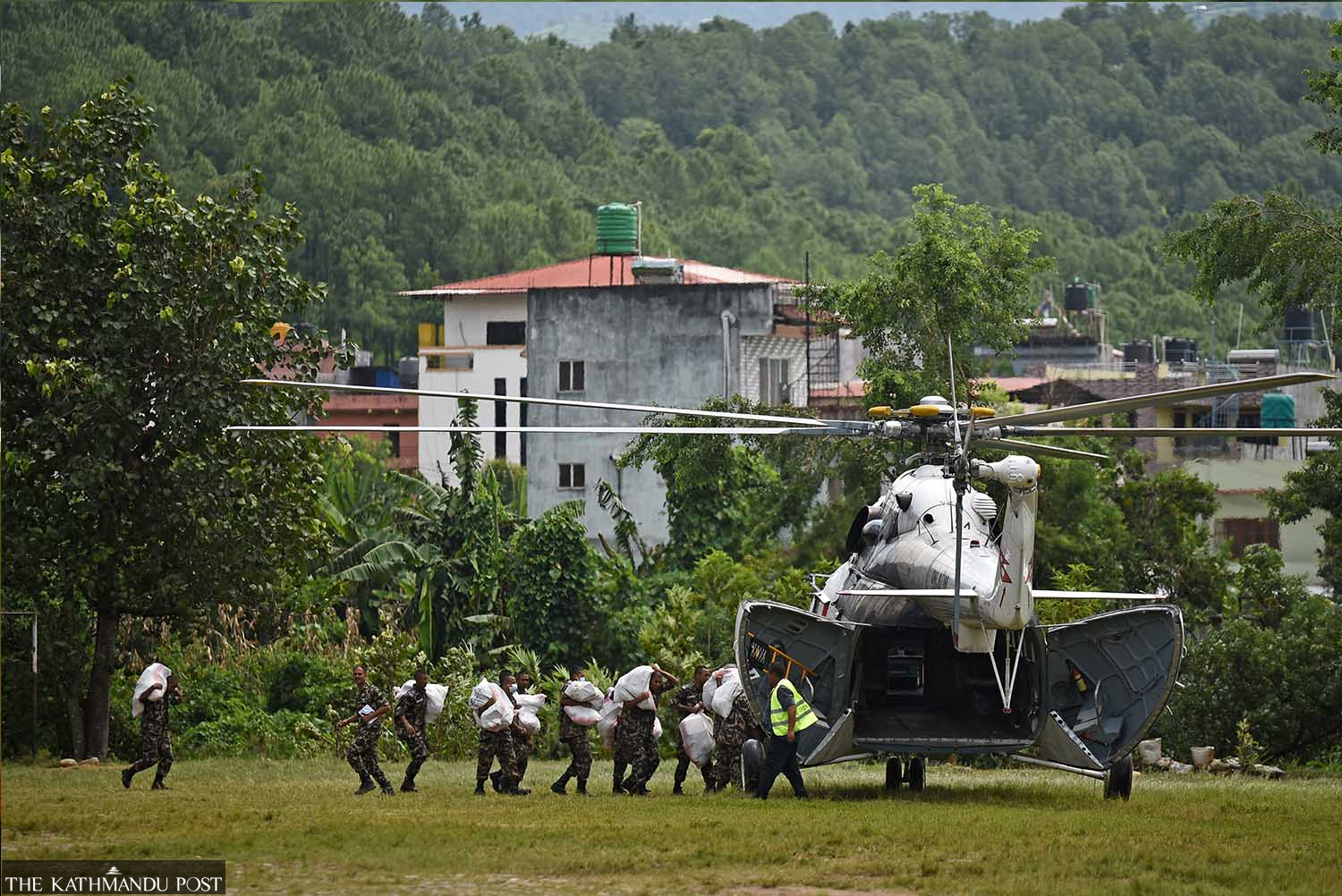
Nepali Army personnel load relief materials for flood victims on Saturday. Angad Dhakal/TKP
Former Additional Inspector General of Police Thule Rai, who specialises in disaster logistics, said the scale of the destruction required sustained deployments across the entire river corridor.
“We need maximum boots on the ground,” Rai said. “Because the Trishuli river corridor is devastated, from the high border passes all the way to the southern plains, small deployments are ineffective.”
He said rescuers also needed advanced technical skills because unstable riverbanks and damaged structures posed serious risks to rescue teams themselves.
Anil Pokhrel, former chief executive of National Disaster Risk Reduction and Management Authority, said specialised equipment capable of detecting survivors beneath mud and collapsed structures could significantly improve operations.
“When I headed the authority, we attempted to procure these systems, but faced acute global supply shortages,” Pokhrel said. “Securing such equipment now will not only aid current operations but build long-term national resilience.”
By 8 pm on Saturday, the NDRRMA said 7,514 people had been rescued or otherwise assisted nationwide. The authority said 191 people had been pulled from flooded hydropower tunnels, 517 stranded people had been airlifted on Friday alone and 717 foreign tourists had been evacuated from high-altitude trekking routes.
For military commanders, however, the priority remains the same: find those who may still be alive.
“Ranger units are deployed across virtually every accessible sector in Rasuwa,” Basnet said. “Our primary focus remains on search and rescue for the living, rather than body recovery.”




 15.68°C Kathmandu