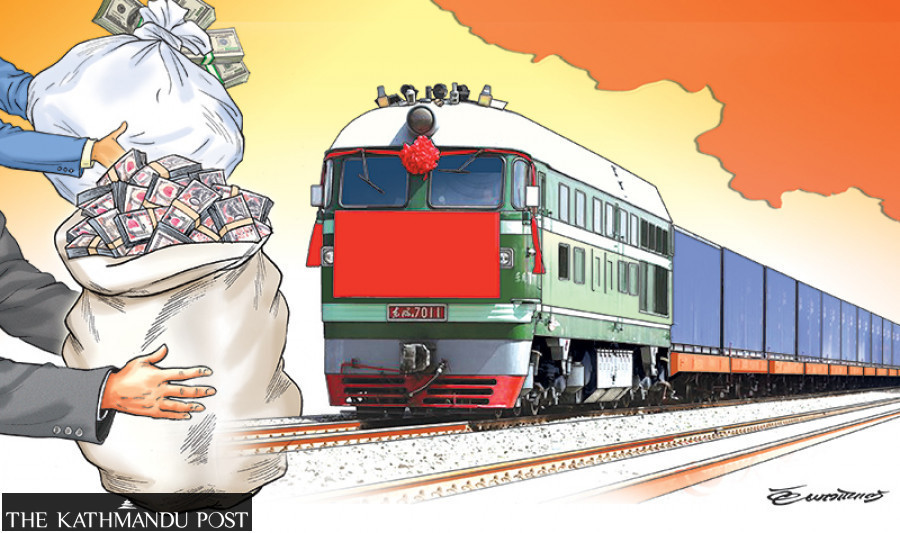
The long-awaited feasibility study of the Kerung-Kathmandu Railway, a project seen as a major geopolitical push by China to expand its presence in South Asia, is expected to be completed by the end of June.
The transnational railway project has been attracting global attention, as it will give China access to larger South Asian markets and cut through “complicated and arduous” Himalayan terrain.
It has been several years since Nepali politicians began promoting cross-border railways. Yet it took a long time to have the survey reports. The northern neighbour is completing the feasibility report, while the southern neighbour, India, has already completed a similar study for the Raxaul-Kathmandu railway line, according to officials at the Ministry of Physical Infrastructure and Transportation. These are viewed as rival efforts by China and India to expand their influence in Nepal and the wider region.
“They [Chinese] had completed the field study in April and are now drafting the feasibility study,” Bodh Bhandari, information officer at the Department of Railway, told the Post. But he did not specify which stage the drafting process had reached.
The Xi’an-based China Railway First Survey and Design Institute Group Co. Ltd was entrusted with carrying out the feasibility study, which was started in December 2022.
The same firm also conducted a pre-feasibility study of the project in 2018. The study concluded that the complex geological terrain and the laborious engineering workload will be the most significant obstacles to the project.
The railway line would pass through rugged Himalayan mountains, and require complex construction plans. The pre-feasibility study has already raised questions about the project’s viability, including the payback period, economic rate of return, among other things.
The study covers three districts: Kathmandu, Nuwakot, and Rasuwa.
Bhandari said that, with the department’s support, the Chinese firm conducted geological surveying, mapping, spatial technical studies, on-site surveys, construction condition studies, and engineering studies.
Before the start of the feasibility study, a Chinese technical team conducted a reconnaissance survey in December 2022, according to the railway department. The memorandum of understanding for the study was signed in March 2022, during Chinese foreign minister Wang Yi’s visit to Nepal.
Reconnaissance is the first engineering survey in previously unsurveyed territory for the purpose of project implementation. The Chinese technical team completed the first phase of the survey by the third week of January 2024.
The pre-feasibility study addressed initial aspects, and the current phase will finalise crucial details such as distance, tunnels, costs, bridge heights, stations, and other key factors.
This phase includes aerial and geological surveys and mapping, special technical studies, on-site surveying and mapping, construction condition assessments, engineering studies, and preparation of the feasibility report. The total cost of the feasibility study for the 72-km Nepal section of the railway is estimated at around Rs3.4 billion (180.47 million RMB).
The agreement had allotted 42 months to complete the feasibility study and the deadline is June 26, said Bhandari.
“The Chinese team is drafting the report, but they are currently out of communication with the department. Though the Chinese side conducted the entire field survey, the Railway Department provided logistical support and coordinated with various government agencies,” he said.
Nepal provided the Chinese team with the project’s basic data, environmental impact assessments, a resettlement plan in line with Nepali laws, and helped prepare the project pre-condition study report.
The feasibility report will recommend the total length, construction cost, the number of tunnels, bridges, and stations, and other details, said Bhandari. Based on this, the government will work towards financial closure and, if feasible, to project financing, according to Bhandari.
During Chinese President Xi’s visit to Nepal in 2019, Nepal and China agreed to conduct a feasibility study of the multi-billion-dollar railway project, to be funded by China. Work was delayed by the Covid pandemic, just two months after the visit.
The total investment needed for the project will be known once the feasibility study is completed, but the pre-feasibility study put the cost of the 72.25 km Nepali section at $2.75 billion.
As per the pre-feasibility study report, around 98.5 percent of the railway would either be bridges or tunnels, and the construction cost would be Rs3.55 billion per kilometre. According to the pre-feasibility report, engineers would build ramps along the northern and southern slopes leading to Lake Paiku, near Kerung, to connect the tracks to the Kathmandu section. The goal of the ramps would be to overcome the significant elevation difference between the southern and northern toes of the Himalayas.
The Kathmandu section of the railway lies in the “collision and splicing zone” along the Eurasian Plate, presenting six major geological challenges. First, hard rock bursts and large soft rock deformations would create extremely high stress.
Second, there is a problem of the fault effects of deep, active fractures in high-intensity seismic areas, and seismic activity could combine with high ground temperatures, slope instability, and debris as well as water erosion to complicate construction work, according to Bhandari, who participated in the field survey.
“The Himalayan region is geologically fragile and is situated in a seismic zone. The study accounted for these complications. If we decide to go ahead with the project, we have to consider project costs, the rate of return, and payback period. This will primarily be a freight railway with a small number of passenger cars,” Bhandari, the spokesperson, said.
China is extending the railway from Shigatse to Kerung. Once this is complete, construction from Kerung to Kathmandu would begin. The Kerung-Kathmandu railway will be part of the 550-km railroad connecting the Tibetan city of Shigatse with Kerung near the Nepal-China border.
When the first batch of Chinese technicians arrived in Kathmandu in December 2022, the Chinese Embassy in Kathmandu said the project was an integral part of the Belt and Road Initiative (BRI).
“China gives priority to Nepal’s aspirations and needs in this regard, and will proactively push ahead with the feasibility study with the China aid fund. The two countries will maintain close contact and coordination in jointly carrying out the work ahead with a view to building a trans-Himalayan multi-dimensional connectivity network,” the embassy had noted.
Bhandari said the Chinese company will submit the final report to both the Nepali and Chinese governments simultaneously.
“Based on the study, a decision will be made on whether to move forward with the project,” said Bhandari. He expressed confidence that the study would be structured to allow the project to proceed. A detailed project report (DPR) will be developed if the feasibility report establishes that the project is technically and financially viable.
Anil Giri is a Chief Sub Editor covering diplomacy, international relations and national politics for The Kathmandu Post. Giri has been working as a journalist for more than two decades, contributing to numerous national and international media outlets.




 15.26°C Kathmandu