Is door-to-door campaigning still relevant in the age of social media?
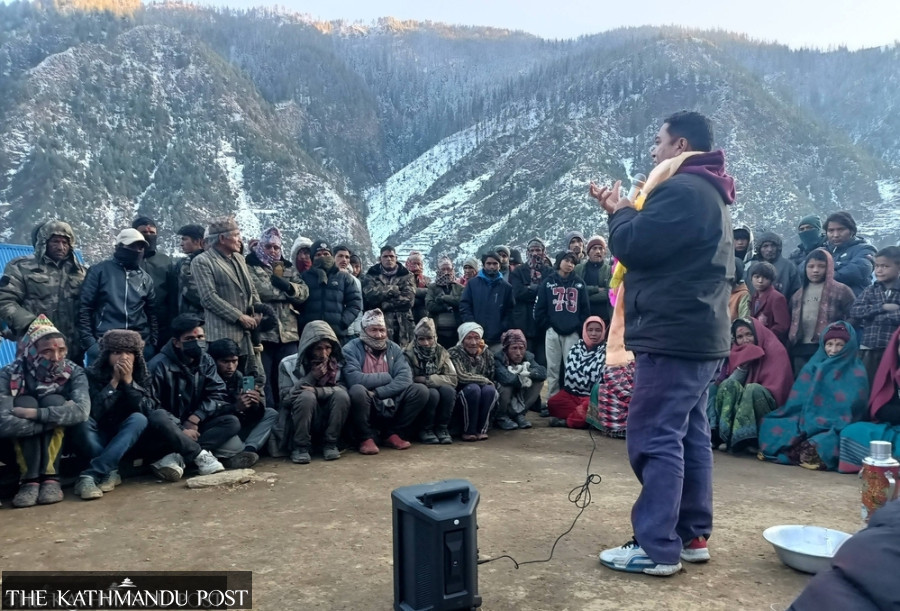
Experts and candidates say such a method of electioneering is outdated. But many voters still appear to prefer direct engagement with their potential representatives. POST PHOTO
Starting Monday, candidates began full-fledged electioneering with door-to-door campaigns ahead of the March 5 snap parliamentary polls, which are being held in the wake of the September 2025 Gen Z movement.
As a practice that has persisted for years, candidates aim to reach as many voters as possible. According to election rules, such campaigning is permitted until March 2, before the 48-hour electoral silence begins.
However, the continuity of traditional electioneering, even after the September youth uprising, when social media played a major role in shaping public opinion and creating the environment for the formation of the Sushila Karki-led government, has raised questions about the relevance and effectiveness of the practice.
Observers say the issue is even more pressing as digital content increasingly shapes voters’ perceptions.
For former chief election commissioner Neelkantha Upreti, the door-to-door campaigning is largely a ritual. “In an era where social media drives much of the public narrative, door-to-door election campaigning is unlikely to significantly influence voters in favour of any particular candidate,” Upreti said.
Nevertheless, it remains a conventional and widely practised campaign method. The commission has allotted a 12-hour span (7am - 7pm) for campaigning, while also setting limits on candidates’ spending and the number of vehicles they can use. These rules aim to ensure a level playing field for all aspirants.
In Upreti’s view, the practice has persisted because of the perception among the contestants that failing to interact face-to-face with voters could erode their support base.
Even as questions are being raised about the effectiveness of door-to-door campaigning, veteran leaders of established parties contesting the March 5 elections as well as first-time contenders continue to rely on the approach.
Surendra Bajagain, the Rastriya Swatantra Party candidate from Lalitpur-1, said he has started a house-to-house campaign even as he agrees with Upreti’s view.
“Door-to-door campaigns have become redundant. Yet, I am doing it because my contenders are doing the same,” Bajagain said.
He added that he believes there is still expectation among voters that candidates should personally visit their homes, and such interactions still carry political significance.
Those who have long observed Nepal’s elections say door-to-door campaigning was adopted when alternative ways to reach voters were limited. There were no social media platforms that could take the parties’ and candidates’ messages directly to the voters.
“It may have continued not so much because it is helpful in attracting voters, but rather because it is a long-established practice that candidates have followed for years,” said Ujwal Adhikari, executive director of the Election Observation Committee Nepal.
Adhikari, however, doesn’t fully dismiss the method’s relevance. He believes that voters have a range of considerations when deciding whom to support. These may include personal proximity to a candidate, the candidate’s political ideology, religious identity, gender, and regional affiliation.
But the committee has not specifically studied the usefulness of door-to-door campaigning.
The former chief election commissioner, Upreti, adds that unruly activities, which are not permitted and are sometimes carried out by candidates in the final days of door-to-door campaigning during elections, have at times influenced electoral outcomes.
Then CPN (Maoist) added momentum to such campaigning, which was not common before the party entered mainstream politics. Its candidates adopted it as the main strategy in the 2008 Constituent Assembly elections, a practice that continues today.
Surendra Pandey, former vice-chair of CPN-UML, says growing internet penetration has further reduced the campaigns’ effectiveness.
“When people feel informed, even without verifying the accuracy of the information, door-to-door campaigns appear less effective,” said Pandey.
Still, voters expect candidates to visit their communities during elections.
Khushi Pandey, a resident of ward 5 of Kirtipur Municipality which falls under Kathmandu Constituency-10, said such campaigning is still meaningful because it allows people to directly inform candidates about community problems.
She added that when candidates fail to fulfil promises made in previous elections, it becomes difficult for them to face voters again. For this reason, she believes door-to-door campaigning can still play an important role in making political leaders directly accountable to the public.
“Technology is advancing, but it is still not accessible to everyone. Because of this, door-to-door campaigning remains a useful way for voters to get familiar with their candidates,” she said.
And Upreti concurs.
Voters themselves may prefer the continuation of door-to-door campaigning as it offers them a rare opportunity to interact with candidates, extract promises on various issues, and hold the candidates to their word, he said.




 14.4°C Kathmandu