What Routine of Nepal Banda gets right, and what it gets wrong
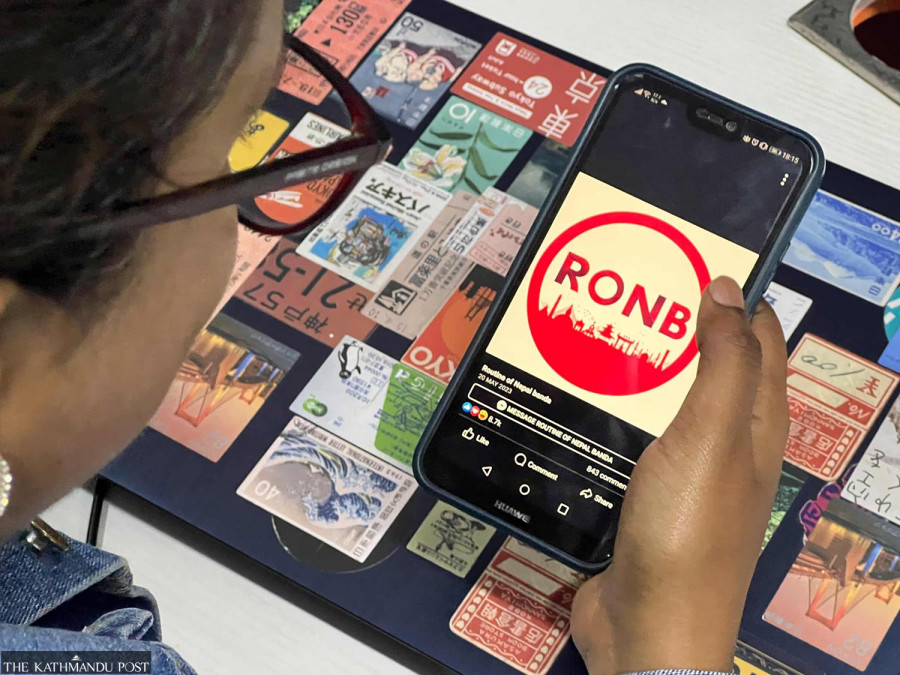
RONB, which bills itself as a news media outlet, is perhaps the most widely followed social media page in Nepal today. Why is it so popular—and controversial? RONB has become a go-to source of information for many Nepalis. Biken K Dawadi/TKP
On June 22, 2022, Arzu Rana Deuba, wife of the then prime minister Sher Bahadur Deuba, made a stunning allegation against Balendra Shah, then mayor of the Kathmandu Metropolitan City.
A couple of months earlier, Shah had upset candidates from established parties, including Deuba’s Nepali Congress, to win the election in the country’s most populated local unit. Naturally, this hadn’t sat well with Deuba.
“If you look at Balen Shah and his social media [presence]...,” Arzu Rana Deuba said, addressing a party event in Pokhara. “Routine of Nepal Banda. I don’t want to say it openly but [at what price] did he hire Routine of Nepal Banda? Routine of Nepal Banda is such a large outlet and he mobilised it… It’s politics and as they say, everything is fair in politics.”
It’s not uncommon for Nepali politicians to make unfounded allegations and target the mainstream media. But here, Deuba had taken aim at a social media page that was fast emerging among young Nepalis as the outlet of choice to get updated on current events. If the success of a media outlet is to be judged by its ability to irk the powerful, Routine of Nepal Banda had scored a victory.
Since privately-owned media outlets began to proliferate in Nepal after the restoration of multi-party democracy in 1990, the mainstream media enjoyed unchallenged influence for well over two decades. But with the increase of internet penetration in the country, social media pages that have billed themselves as news media outlets began to mount a challenge, if not in terms of impact, then definitely in terms of social media engagement.
Routine of Nepal Banda, which opened as a Facebook page in 2011, is at the forefront of this change. Commonly known as RONB or simply Routiney, it is one of the most widely followed social media accounts in the country today, with a cumulative total of over 9.5 million followers across major social media platforms, including 4.9 million followers on Facebook, 1.7 million on Instagram, 1.1 million on X, 1.4 million on TikTok, and 414,000 on Youtube.
With a reach of this scale, it goes without saying that the page holds a huge influence over Nepalis. But with great power comes great responsibility. And how well has RONB wielded that power and shouldered the responsibility?
***
Routine of Nepal Banda posted its first status on Facebook on August 28, 2011. “Call for Limbhuwan Region Bandh,” the post read. “Bandh called by
Federal Limbuwan State Council.”
During the years following the elections of the first Constituent Assembly in 2008, strikes and shutdowns were common in Nepal as the country struggled through constitution-drafting and political transition. Students were among the worst affected. Often, mainstream media failed to report shutdowns (bandas) in time, leaving students to learn that schools were closed only after buses failed to arrive.
One of those students was Victor Poudel, then a 16-year-old from Baglung district of Gandaki Province. After he completed the School Leaving Certificate exam and moved to Kathmandu, he saw students returning home without attending schools, with bags on their backs. Many people would get stranded on the roads with heavy loads.
“Seeing ordinary people suffer just because they lacked information bothered me deeply,” Poudel recalled in a conversation with the Post recently. “A friend once invited me to join the ‘Nepal is Open’ campaign. From that day, I felt I should be part of the rebellion against bandhas.”
Internet penetration was expanding rapidly, and the number of Facebook and Twitter users was rising. “I felt there should be a platform dedicated to providing information about strikes,” Poudel said. “That’s how I started the Facebook page Routine of Nepal Banda. But we didn’t just post about shutdowns—we also wrote that the impact of many bandhas was minimal.”
Gradually, RONB became the primary source for bandha-related updates. Its follower count steadily increased. After the promulgation of the constitution in 2015, general strikes became less frequent, and public defiance to bandhas grew. RONB began diversifying its content beyond shutdown notices.
“When we received overwhelming support in a short time, we started sharing other information as well, using simple language,” says Victor. “At one point, we posted appeals for blood donations for patients who were struggling to find donors. That genuinely helped many people.”
Later, Poudel began publishing load-shedding schedules on the page. Over time, RONB evolved into a daily information hub, covering issues directly affecting citizens’ lives. It also expanded into humanitarian work, posting notices about missing persons and fundraising appeals for medical treatment. Its reach grew exponentially after the devastating earthquakes of 2015.
“During the earthquakes, people desperately wanted updates of every moment,” recalls Victor. “I updated the page even as the ground was shaking. Sometimes I asked friends abroad to post when I couldn’t. That period massively increased our followers.”
The information which was overlooked or ignored by mainstream media became the primary content of the RONB.
According to media researcher Ujwal Acharya, who has long observed the evolution of Nepal’s media sector, such platforms emerged by occupying the space left vacant by traditional news outlets. “When mainstream media failed to provide small yet important information for people such as load-shedding schedules, these pages stepped in to fill that void,” Acharya said.
As credibility grew, followers themselves began sending news, photos and updates to Routine of Nepal Banda. Publishing citizen-supplied information further strengthened public trust. Eventually, the volume of content became too much for one person. “We rented a small room in Banasthali and started an office,” Poudel recalled. “More friends joined to help post updates.”
What began in a modest rented room has now become a primary information source for millions.
***
Poudel believes only few people now read full news stories. “What I knew was most people come to conclusions just by reading headlines,” said Poudel, who previously practiced sports journalism. “Keeping that habit in mind, we began sharing information in two or three sentences.”
He consciously adopted a language style familiar to younger social media users. As posts increasingly resembled everyday online chat, the page’s reach and engagement soared.
However, relying on open submissions also created the risk of misinformation. “In the beginning, we sometimes posted whatever information came in, and some of it turned out to be wrong,” Poudel admits. “We learned from that. Now, we don’t post anything without verification.”
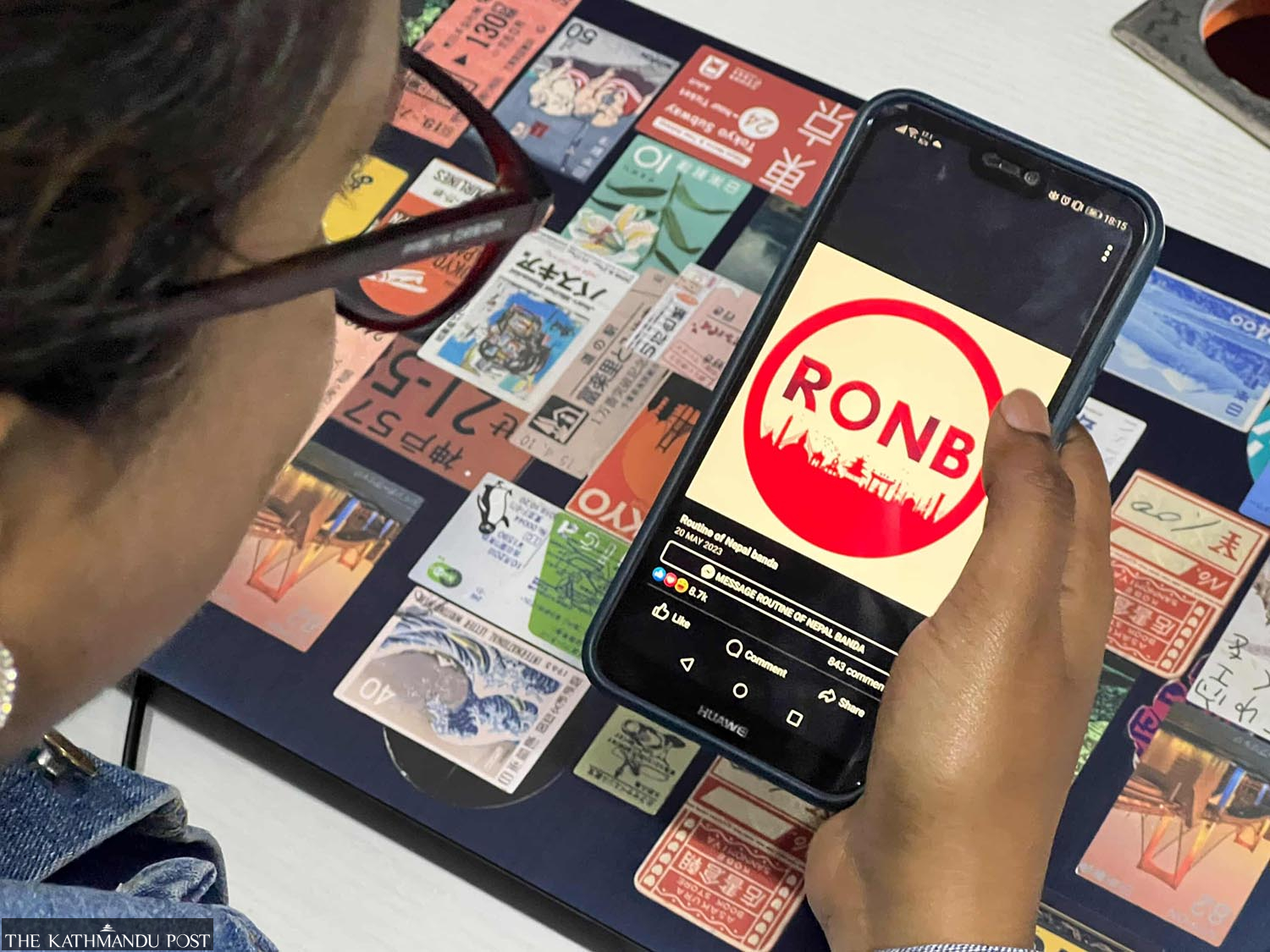
RONB has become a go-to source of information for many Nepalis. Biken K Dawadi/TKP
Experts have raised concerns over this issue. Acharya argues that the content shared by RONB is often only an “item of information”—a small fragment of information that people cannot easily transform into meaningful knowledge. “Incomplete information presented without context is, in a way, a form of misinformation,” Acharya says. “No matter how brief a news item is, it should contain the minimum essential elements—the 5W1H [Who, What, When, Where, Why, And How]—so that citizens can form opinions based on complete information.”
Sudhanshu Dahal, a professor at Kathmandu University, points to another risk—lack of verification. According to him, the growing tendency of publishing information immediately after receiving it creates a major risk in today’s digital space. “The practice of critically examining and verifying information appears extremely weak and this has created a significant risk factor,” he said.
RONB’s influence among young voters has been so big that it has prompted leaders of established political parties like Arzu Rana Deuba to accuse it of playing a decisive role in the mayoral victory of Balendra Shah in Kathmandu.
Poudel rejects the allegation. “We posted content about all candidates—Srijana Singh from the Nepali Congress and Keshav Sthapit from the CPN-UML as well,” he says. “But Balen Shah’s posts got more engagement. Personally, I supported him, but RONB as a platform did not.”
Suspicion deepened after another controversy on September 2, 2023, when Mayor Shah posted a provocative status saying he would “burn Singha Durbar.” On the same day, RONB posted congratulatory content saying Shah had become father of a daughter. It later emerged that Shah’s wife had given birth earlier, prompting accusations that RONB had tried to divert attention.
Amid intense backlash, RONB didn’t post any content for several days. “There was abuse from all sides—online bullying and even political threats,” Poudel says. “I hadn’t created RONB for myself but for society. When society rejected it, I thought of shutting it down.”
But Poudel later decided to continue with the page after realising the depth of public support.
Since then, the role played by RONB in supporting Balen Shah during the mayoral election has remained a subject of public discussion. While Poudel has described it as merely a matter of personal support, Professor Dahal considers the RONB-Shah link an “open secret”. In his analysis, such pages are often “politically charged” and possess the ability to amplify particular individuals or agendas, effectively maximising the visibility of specific issues or candidates.
***
Routine of Nepal Banda now has a team of 10 people in Kathmandu collecting information, along with some volunteers. A separate team manages Facebook posts. In total, around 20 staff members are involved, Poudel says.
What began as a Facebook noticeboard is now active across all major social media platforms, including X, TikTok, YouTube and Instagram. Despite hundreds of online media outlets competing for advertisements, major companies are willing to pay thousands for a single RONB post.
Still, the platform rejects around 60 percent of advertising proposals, Poudel claims. He adds that they post around 40 percent of the total advertisements they receive and also flag ‘promotional content’. “Too many ads hurt and annoy readers,” Poudel says. “That’s why we’ve been focusing more on events than advertising.”
Meanwhile, professor Dahal argues that it has become increasingly difficult to distinguish between paid content and organic posts in pages like Routine of Nepal Banda. Posts congratulating the newly-wed and notices highlighting personal successes often raise eyebrows with people wondering what purpose they are trying to serve.
“Unlike mainstream media—which clearly discloses advertisements—such platforms often fail to follow the minimum ethical standards of journalism,” Dahal says. RONB often posts photos without credits and the sources of information often remain undisclosed. Basic rules of grammar and syntax are done away with. Snippets of information are routinely editorialised, often categorised as ‘good news’ or ‘bad news’, ‘sad news’ or ‘wow’ news.
But that doesn’t seem to have caused a dent to RONB’s rise. It has recently branched out to livestreaming and sponsoring events as its influence and reach grows.
It livestreamed the Nepal-West Indies cricket match on September 27 last year. It continues to livestream other tournaments and partner with events as a publicity collaborator.
The platform’s popularity has also spawned similar other pages. It makes Poudel happy and concerned at the same time. “I don’t mind people following our style,” he says. “But it hurts when others misuse our name to collect money illegally, as has happened sometimes in the past.”
Poudel envisions RONB as an agent of social transformation. “The RONB was born as a form of rebellion,” he says. “It openly takes positions on issues. Its object is not only to disseminate information. We want it to be a forum for public debate among young people.”
He now aims to develop RONB as a non-profit ‘citizen journalism’ platform. To fund it, he has launched a separate digital media consultancy and a startup called E-Karmakanda, which helps arrange Hindu religious rituals. His long-term plan is to make RONB advertisement-free with the income from the startup.
“I want it to remain a noticeboard, forever,” Poudel insists. While RONB also runs RONB Post as an online platform and maintains a strong video presence, its online and video content increasingly follows the news formats of mainstream media, signalling how far Nepal’s most influential digital noticeboard has evolved.
RONB has also opened sister pages such as Routine of Nepali Films, Routine of Nepali Music, Routine of Share Market, Routine of Tech, RONB Sports, and Routine of Nepali Politics that post niche content.
A RONB representative said these sister pages were launched to manage the crowd on the main page and to allow targeted audiences to access more specialised content. “We continue to update major content and key events on the main page,” he added.
The growing popularity of RONB appears to be pushing mainstream media to stray from their traditional path. Professor Dahal said the influence of such new platforms has driven even established online media outlets to clickbait. “When media organisations fail to strike a balance between their responsibility and audience demand, they end up becoming victims of the same trend,” he said.
Researcher Acharya goes further, describing the phenomenon as a threat to journalism. Acharya claims that serious media outlets are increasingly abandoning depth and rigour in an attempt to resemble tabloid-style publications and worse, social media pages—an approach he believes is harmful to society. “In an attempt to compete with social media pages, mainstream media are chasing virality and clickbait,” Acharya says. “This is like a slow poison for journalism.”




 14.81°C Kathmandu