Starting Sunday, the Election Commission is launching a voter education campaign to inform citizens about voting rights and procedures ahead of the March 5 elections.
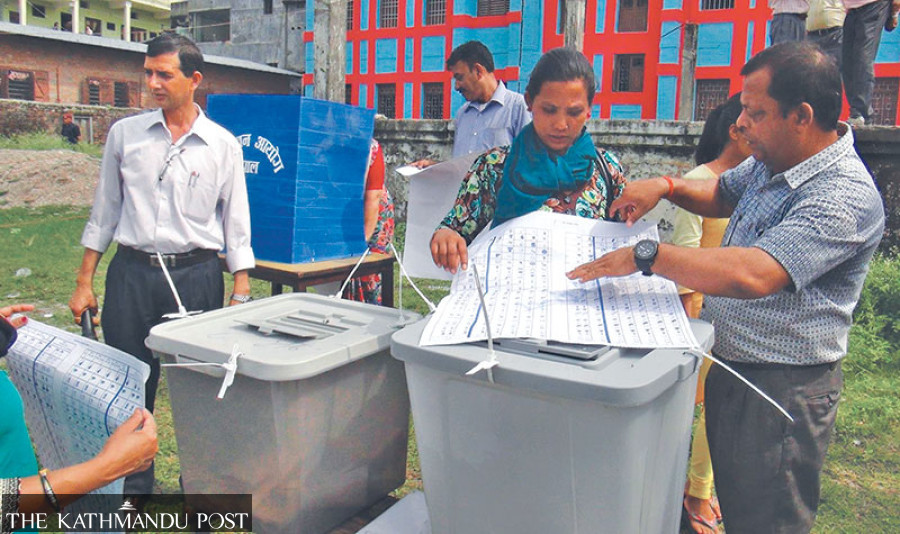
Under the campaign, the commission will mobilise one voter education volunteer in each of the 6,743 wards across all 753 local units nationwide for 15 days. They have been tasked with visiting voter communities and households and using sample ballot papers to educate voters about the importance of elections and the voting process.
“They are reaching people’s doorsteps after receiving orientation from the experts,” said Kul Bahadur GC, assistant spokesperson at the commission. The constitutional poll management body conducted training and orientation sessions at the district and local levels for volunteers and election observers separately.
GC said that, in addition to in-person education, the commission is disseminating educational materials through its social media pages. The commission plans to broadcast public service messages on national and local radio and television channels. Information will also be disseminated via newspaper advertisements, digital news platforms, YouTube videos, and various social media outlets.
“We understand that effective voter education plays an important role in increasing voter participation in elections and reducing the proportion of invalid votes,” said GC, adding that the education programmes have been designed accordingly.
Voter education generally focuses on teaching the fundamentals of the voting process, including voter registration, the correct placement of the stamp on the ballot paper, and the proper way to fold the ballot before inserting it into the ballot box. Many voters remain unaware that even a minor deviation, such as placing the stamp slightly outside the designated box for a candidate’s symbol, can invalidate their vote.
These volunteers will assist voters by explaining the correct voting process to help ensure their ballots are not rendered invalid.
Records at the commission indicate that 5.06 percent of votes cast in the previous House of Representatives election were declared invalid. Of the total ballots cast under the proportional representation system, 6.55 percent were invalid, while the invalid vote rate under the first-past-the-post system stood at 4.07 percent.
Province-wise, Sudurpashchim recorded the highest proportion of invalid votes at 5.7 percent, whereas Bagmati had the lowest at 4.16 percent. In some local units during the last local elections, the proportion of invalid votes reached as high as 13 percent.
As per the commission’s report, 18,903,689 citizens are eligible to vote in March. This marks an increase of 915,119 voters, most of whom are youths, compared to the 2022 elections.
Observers say that while imparting information on the technicalities of the voting process is important, voter education should also prioritise why to vote and why it matters. They suggest that the poll management body should distinguish between voter information and voter education. Only proper education can make people understand that voting is both a right and a responsibility, giving citizens the power to choose who will govern, they say.
“The commission’s voter education is largely confined to disseminating information on how to vote, missing equally important aspects such as what kind of person to vote for and why,” said Shree Krishna Subedi, chair of the Election Observation Committee, Nepal (EOC), a poll monitoring organisation. “Such programmes have been more ritualistic than substantive.”
Poll observers say the commission could have partnered with other poll observation committees to ensure the campaign's effectiveness. As many as 40 domestic organisations have been permitted to monitor the March 5 elections. They will mobilise thousands of people across the nation before and after the poll. “We have experts with sound knowledge on different facets of elections who could have contributed to making the voter education drive effective. However, the commission has chosen to proceed solo,” said Subedi.
The commission’s officials, however, claim they are committed to making the education campaign effective. They say the commission has designated one contact person at each local level as its liaison to monitor whether the education has reached the targeted groups. “Our volunteers will impart the maximum information they can priorating the illiterates and the first-time voters,” said GC.
Binod Ghimire covers parliamentary affairs and human rights for The Kathmandu Post. Since joining the Post in 2010, he has reported primarily on social issues, focusing on education and transitional justice.




 14.82°C Kathmandu