As Nepal heads into parliamentary elections in three weeks, the Trump administration has expressed confidence in a peaceful vote and said it is prepared to work with the next government.
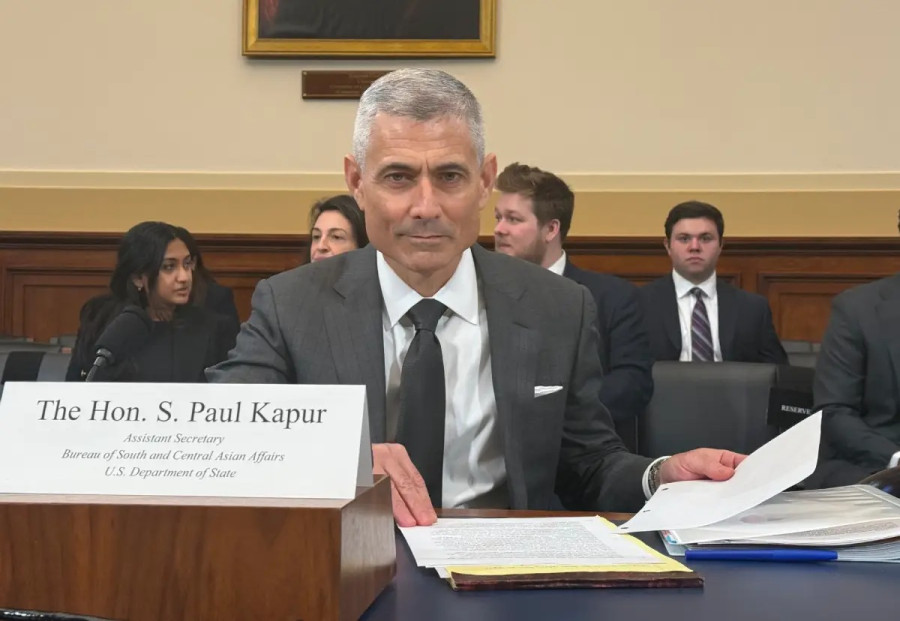
While testifying before the House Foreign Affairs subcommittee on South and Central Asia, US Assistant Secretary of State for South and Central Asian Affairs Paul Kapur stated, “With Nepal, we also trust that we’ll have a secure and peaceful electoral process, and we’re prepared to work with whoever wins.”
In February last year, US President Trump nominated Kapur, an expert on South Asian security, as assistant secretary of state for South Asian Affairs, replacing Donald Lu.
Exactly one year after his nomination, Kapur appeared before the House Foreign Affairs Subcommittee on South and Central Asia in Washington on Wednesday and briefed lawmakers on the US position in the region, including Nepal and Bangladesh, where youth-led protests had overthrown governments.
“These are both examples of youth movements overthrowing older governments and now creating the opportunity for democratic participation in their country,” said Kapur, referring to the regime change in Nepal in September and last year in Bangladesh.
Bangladesh held elections on Thursday, and Nepal is voting on March 5.
Kapur said Washington expects a smooth process in both the countries.
According to IANS, India’s private news agency, the discussion in the US House subcommittee reflected bipartisan recognition that Nepal—strategically located between India and China—occupies a sensitive geopolitical position. Kapur earlier emphasised that preventing domination by any single power in South Asia is a core US objective.
“A hostile power dominating South Asia could exert coercive leverage over the world economy,” he said, adding the US must prevent this from happening and keep the region free and open.
Washington views Nepal’s political reset not only as a domestic democratic development but also as part of the larger strategic contest shaping South Asia, he said. Countries including Bangladesh, Nepal, the Maldives, Sri Lanka, and Bhutan hold outsized strategic importance due to their locations but are also vulnerable to coercive pressures, according to Kapur. He warned of the risks posed by ‘debt-driven influence strategies’ in the region, an apparent reference to US concerns about China’s lending practices.
According to Kapur, key US priorities in the region include expanding trade relationships with South Asian nations, along with increasing defence co-operation and targeted investment. He also emphasised the need for diplomacy and support to help regional partners build strategic capacity.
“Bangladesh, Nepal, Maldives, Sri Lanka and Bhutan’s strategic locations afford them outsized importance, but also can make them targets for coercion,” he said before the House panel. “Defense cooperation with the US helps them protect their borders and waterways against encroaching powers. And carefully targeted investment can provide these states with high-quality, transparent, non-coercive support for critical infrastructure like ports, telecom networks and energy portals, helping them to avoid the dangers of debt-trap diplomacy.”
Opening the testimonial session, House Foreign Affairs South and Central Asia Subcommittee Chairman Bill Huizenga said that how the US engages will define America's role in Asia for decades to come.
“No surprise that through its Belt and Road Initiative, China engages in predatory lending to further its security interests and trap smaller nations in debt,” Huizenga said in his opening statement. “Furthermore, China has hardened its border with India, Nepal, and Bhutan, building infrastructure to support its military aspirations.”
Despite its distance from US shores, maintaining a free and open Indian Ocean is a priority for Washington’s national and economic security, he said. The Indian Ocean is one of the busiest maritime corridors on earth, carrying the lifeblood of global commerce and energy, including more than 80 percent of global seaborne oil trade.
“Our strategy in South Asia must be comprehensive, anchored in strong partnerships, economic engagement, and a commitment to democratic values. Our engagement in the region must advance American interests, but also continue to contribute to a more secure, prosperous and free Indian Ocean,” said Huizenga.
Speaking in the same event, Democratic Ranking Member Sydney Kamlager-Dove described the broader transitions as opportunities. “These major political transitions present a rare opportunity for the US to strategically leverage our democracy assistance to support growing regional demand for accountable government governance,” she said.
Kapur made extensive remarks about India, the future of India-US ties, and the future of India.
“India alone has well over 1 billion people and occupies a subcontinental landmass. A hostile power dominating South Asia could exert coercive leverage over the world economy. The United States must prevent this from happening and keep the region free and open,” he added.
Pressed on China’s growing reach, Kapur made clear the US objective. “What we’re trying to do fundamentally is not to keep China out of the region but to prevent China or any single hegemon from taking over or imposing coercive leverage on the region,” the IANS news report quoted Kapur as saying. Kapur argued that India’s strategic autonomy serves Washington’s interests.
“An India that is able to be independent and preserve its freedom of action, takes a huge swath of the Indo-Pacific off of China’s plate and almost by definition prevents it from becoming the dominant power in the region,” he added.
Ranking Member Kamlager-Dove, in her statement, said that in September, Nepal experienced widespread anti-corruption protests that led to the prime minister’s resignation and new elections next month.
“Bangladesh has gone to the polls to decide on a new constitution and choose its leadership for the first time since Sheikh Hasina’s ouster. These major political transitions present a rare opportunity for the US to strategically leverage our democracy assistance to support growing regional demand for accountable governance.”
Yet, she said, the State Department’s rejection of democracy programming and the decimation of USAID have stripped them of the very tools that are needed to advance their interests.
“Further hamstringing our engagement in the region, in December, Trump took the unprecedented step of recalling career ambassadors in Nepal and Sri Lanka, weakening our diplomatic leadership in two key states,” she said.
Anil Giri is a Chief Sub Editor covering diplomacy, international relations and national politics for The Kathmandu Post. Giri has been working as a journalist for more than two decades, contributing to numerous national and international media outlets.




 15.34°C Kathmandu