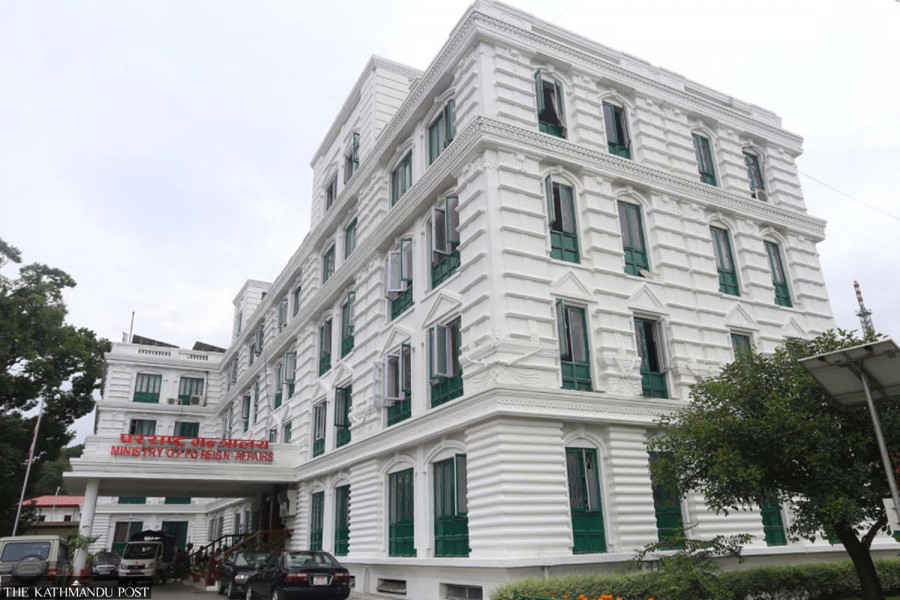
The Ministries of Finance, Federal Affairs and General Administration, and Foreign Affairs are odds over changing the rule of procedure for India’s High Impact Community Development Projects (HICDP), which was earlier known as small development projects and first launched in 2003.
Initially the budget for each small development project was NRs30 million, and this was later increased to NRs50 million. In 2023, the budget for each HICDP was further increased to NRs200 million where the Nepali side was required to bear an additional 20 percent of the total project cost.
Currently, only local governments through the district coordination committee can seek economic assistance under the HICDP scheme as per the agreed arrangement between Nepal and India.
However, a proposal has been made by various line ministries to allow the federal and provincial governments to access HICDP funds as well.
Recently, a proposal was initiated from the Ministry of Federal Affairs and General Administration and sent to the Ministry of Foreign Affairs via the Ministry of Finance.
But the Ministry of Foreign Affairs has been sitting on it for a month.
The ministry, according to officials, maintains that allowing federal and provincial governments to access such funds “will weaken the country's sovereignty and force them to depend on India” for grants for every single project.
Officials at the Ministry of Finance and Ministry of Federal Affairs, on the other hand, argue that as the HICDP funds are channeled through the national budget and treasury, such aid does not compromise sovereignty or create unwanted loyalty or patronage.
“We have been receiving assistance from India since 2003 under this scheme with no strings attached, as far as we know,” an official at the Ministry of Finance told the Post. “We have taken economic assistance for many projects in the past, and it has never weakened our sovereignty.”
A senior official at the Ministry of Foreign Affairs said that the finance ministry sent correspondence around a month ago seeking its opinion on changing HICDP procedures.
“Then we sent a letter back to the finance ministry, asking them to be specific. There are other issues besides allowing provincial and federal governments to get funds under the HICDP scheme. First, the agreement on HICDP was made at the Nepal-India foreign minister-level joint commission meeting. So why are we taking the initiative to change it? Also, if India is interested in helping with federal and provincial projects, the proposal should come from their side,” said the official.
Although the proposal originated at the Ministry of Federal Affairs and General Administration, the Indian side is reportedly aware of the development.
“The rule of procedure cannot be changed unilaterally. We can only give our recommendation. We need to sit with the Indian side too. This is a bilateral issue, and we must seek India’s concurrence if they will permit expanding the scope of the HICDP,” the official at the foreign ministry added, speaking on condition of anonymity.
The official further said that since a new government will soon take office after the elections, the decision should be left to it.
“We want to discuss this with India before expanding HICDP’s scope, and we believe that the elected government will make the final decision,” he said.
There is a huge pressure on government agencies and the Indian Embassy to extend financial assistance to projects under the HICDP, according to officials. In recent years, out of 400 proposals, only 40 projects were approved and moved ahead, another government official familiar with the HICDP said. “India is not freely injecting funds, unlike what some think.”
According to the Indian Embassy website, it has completed 502 projects of different nature across Nepal since the scheme was launched in 2003.
However, there is an interesting backstory to how government agencies recommended amendment of HICDP rules.
In mid-December, Health Minister Sudha Sharma visited India and decided to seek Rs400 million Indian assistance for infrastructure upgrade of the BP Koirala Institute of Health and Sciences.
During the visit, she tabled a proposal with the Indian side, who advised her to use two tranches of HICDP to cover the cost for the hospital upgrade.
“She discussed the proposal with the health ministry. Then the health ministry forwarded it to the finance ministry and federal affairs ministry, seeking the budget from HICDP. The finance ministryin turn responded that only local governments are allowed to seek financial assistance under the HIDPC, while the federal and provincial governments cannot,” a federal affairs ministry official privy to the development, told the Post.
After this, the Ministry of Finance and Ministry of Federal Affairs and Local Development decided to revise the rules to allow federal and provincial governments to propose budgets under the HICDP scheme.
A proposal was sent to the Ministry of Foreign Affairs around a month ago, seeking its consent for a revision, but the ministry is unmoved and no decision has been made, two officials at the finance and local development ministries told the Post.
Meanwhile, an official at the Prime Minister’s Office told the Post that some provincial governments have also shown an interest in using HIDPC funds.
On Tuesday, Indian Ambassador Naveen Srivastava met Prime Minister Sushila Karki and Finance Minister Rameshore Khanal and discussed the matter.
According to a finance ministry official, Finance Minister Khanal discussed the matter in the presence of foreign secretary Amrit Bahadur Rai.
Although the matter has been discussed at the Prime Minister’s Office and various line ministries, no decision has been made.
The official at the Prime Minister’s Office, meanwhile, said reviewing the scope ahead of the elections could invite controversy.
Launched in November 2003, the projects are popularly known as ‘umbrella agreement’, and have provided Indian assistance to various projects. The scheme has faced controversy for allegedly enabling Indian influence over local communities in Nepal.
As the Indian aid has come through the budgetary system, it now falls under the purview of the Office of the Auditor General, which will now audit how the local governments spent it.
Ever since the new constitution was promulgated in 2015, the government had been insisting that this Indian aid scheme should come under the budgetary system. The constitution bars donors from providing funds directly to local governments.
Following the introduction in 2020 of the new implementation modality, in which the Ministry of Federal Affairs and General Administration coordinates project proposals from local governments through the national budget to India and back, three new projects are now being implemented.
After the constitution required foreign assistance to be channelled through the national budget to ensure transparency, the Sher Bahadur Deuba-led government in November 2017 extended the tenure of the scheme with the caveat that funds pass through Nepal’s national system and the Nepal government decides which agency implements the project.
In July 2018, a Cabinet meeting made it mandatory for India to sign an agreement with Nepal’s finance ministry to implement projects under the scheme and route funds through the central government account.
Later, in 2023, HICDP budget per project was raised to NRs200 million, paving the way for building lower-middle-level projects.
Anil Giri is a Chief Sub Editor covering diplomacy, international relations and national politics for The Kathmandu Post. Giri has been working as a journalist for more than two decades, contributing to numerous national and international media outlets.




 14.81°C Kathmandu