As Nepal gears up for the March 5 elections, the Federation of Nepalese Chambers of Commerce and Industry (FNCCI) has urged political parties to remove the phrase “socialism-oriented economy” from the country’s Constitution, arguing it deters investment, confuses the private sector, and fails to reflect the country’s economic realities.
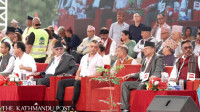
Addressing a discussion on ‘economic agendas in political party manifestos’ held earlier this week in Kathmandu, FNCCI President Chandra Prasad Dhakal said the wording no longer reflects Nepal’s economic realities or aspirations.
“The socialist-oriented economy and the three-pillar [public, private, and cooperative] policy have not been able to make a significant contribution to entrepreneurship, employment, or revenue. The private sector has always been sceptical. This has especially worried foreign investors,” Dhakal said addressing the event on February 1.
Not just Dhakal, but FNCCI senior vice president Anjan Shrestha and others also oppose labelling Nepal a socialism-oriented economy and call for the Constitution to recognise competitive markets. The FNCCI has long advocated a free-market approach.
Although the three-pillar economic policy enshrined in the Constitution appears balanced in theory, it has long been criticised for failing to deliver. Since its inclusion in the preamble, the phrase ‘socialism-oriented economy’ has remained at the centre of the debate.
This debate has intensified after the FNCCI, the umbrella body of the Nepali private sector, urged political parties to remove both this provision and the three-pillar economic policy from the Constitution.
Not only leaders from the FNCCI, but also Rastriya Prajatantra Party (RPP) leader and former finance minister Prakash Chandra Lohani have criticised the socialism-oriented economy enshrined in the Constitution, dismissing it as an ideological narrative that only confuses the public and has failed to deliver tangible results.
Lohani argues that political parties included the phrase in the Constitution merely to project themselves as progressive, even though, in his view, such an approach is neither practical nor suitable for Nepal.
“Nepal’s current economic environment is extremely unfavorable. The main reason for this is the inclusion of the phrase ‘socialism-oriented’ in the preamble of the Constitution, Lohani told the Post. “Before investing, foreign investors study a country’s constitution, its law and order situation, and the stability of its government. The socialism-oriented economy mentioned in the constitution discourages investors from democratic countries from investing in Nepal.”
He added that the lack of alignment between the economic system Nepal is actually practicing and the one written into the nation’s supreme law only creates confusion.
Meanwhile, former lawmaker Radheshyam Adhikari from the Nepali Congress who chaired the Parliament Regulation Draft Committee in the second Constituent Assembly, said the phrase ‘socialism-oriented economy’ was included in the Constitution’s preamble as part of a consensus reached with the two communist parties—the CPN-UML and the then CPN (Maoist Centre)—during the constitution-drafting process.
Adhikari notes that although the term ‘Nepal is an independent, indivisible, sovereign, secular, inclusive, democratic, socialism-oriented economy’ is mentioned in the preamble, the phrase ‘socialism-oriented economy’ has become the focus of public discourse.
Adhikari added that although the Nepali Congress also considers socialism a core principle, the party’s understanding of socialism differs from that of the communists. “To clearly position itself on a distinct ideological footing, separate from communist thought, Congress should now move to revise this phrase in the Constitution’s preamble,” Adhikari said.
Echoing RPP leader Lohani, Adhikari said the provision in the Constitution has made it difficult for Nepal to attract foreign investment and suggests that the phrase be revised.
However, Marxist scholar Khagendra Prasain disagrees. He argues that calling for the removal of ‘socialism-oriented economy’ from the Constitution simply because Nepal currently follows a capitalist approach is misguided. “It is like saying that, because corruption is widespread, the Commission for the Investigation of Abuse of Authority should be replaced with an institution that protects corruption,” he said.
“It is natural for capitalists to reject the concept of a socialism-oriented economy. But the constitution does not belong to any single group, and calling for changes on such grounds is misguided.”




 19.27°C Kathmandu