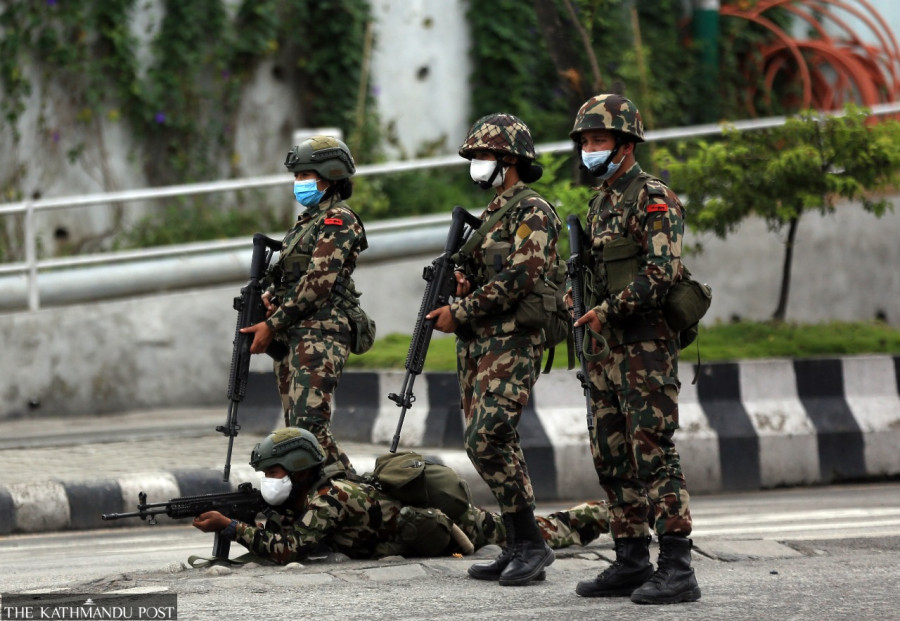
The Nepali Army is coming out of the barracks on Wednesday, a month before the March 5 elections, as government assessments indicate a higher number of polling stations are sensitive from a security perspective as compared to the previous election.
A total of 79,727 army personnel are set to be mobilised across the country to support the Nepal Police, Armed Police Force, and election police in holding the polls peacefully.
“In line with the Integrated Election Security Plan and an earlier Cabinet decision, the Nepali Army will be mobilised for election security from Wednesday,” said Army spokesperson Rajaram Basnet.
The army will replace police forces in airports, prisons, and other sensitive areas, freeing police personnel to be mobilised in the field. Apart from guarding those sensitive areas, the army will provide security in the third layer while also patrolling as and when needed.
As many as 338,000 security personnel, including the election police, are being deployed in the election period.
The authorities have classified 3,680 of the country’s 10,967 polling stations as “highly sensitive”.
According to the Nepal Police, among those polling stations, 2,845 have been placed in the “normal” category based on the level of security risk, while 4,442 have been designated as “sensitive” and 3,680 as “highly sensitive”.
Across the Kathmandu valley’s 15 constituencies (10 in Kathmandu, three in Lalitpur, and two in Bhaktapur), 12 polling stations of the total 527 have been classified as highly sensitive.
In Koshi Province, 449 of the 1,907 polling stations across 28 House of Representatives constituencies have been designated as highly sensitive. The chair of CPN-UML and former prime minister KP Sharma Oli and senior leader of Rastriya Swatantra Party, Balendra Shah, are contesting the Jhapa-5 seat.
In Madhesh Province, 1,246 of the 2,160 polling stations across 32 constituencies have been classified as highly sensitive. This means more than 55 percent of total polling stations in the province are deemed highly sensitive.
Outside the Valley, in Bagmati Province, 354 of the 1,288 polling stations across 18 constituencies have also been classified as highly sensitive.
According to Nepal Police data, in Gandaki Province, 328 out of the 1,297 polling stations across 18 constituencies have been classified as highly sensitive.
In Lumbini Province, 462 of the 1,671 polling stations across 28 constituencies fall under the highly sensitive category.
In the remaining two provinces—Karnali and Sudurpashchim—358 and 481 polling stations have been designated as highly sensitive, out of a total of 941 polling stations in 12 constituencies and 1,176 polling stations in 16 constituencies, respectively.
There are more highly sensitive stations than in the 2022 election, according to Nepal Police data.
In the previous election, 3,412 polling stations were classified as highly sensitive. This time, the number has risen to 3,680. In total, 268 more polling stations, compared to the last election, have been classified under the highly sensitive stations.
In the previous election, there were a total of 10,892 polling stations. This time, the number has increased to 10,967.
Following the Gen Z movement, nearly a million new voters registered themselves. With the rise in voter registration, the Election Commission had indicated that the number of polling stations could increase. Compared to the last election, the total number of polling centres has gone up by 75.
According to a senior officer of Nepal Police, “conflict-prone stations, station distance from the reach of security personnel due to the demographic difficulties, and the places where there have been conflicts in the past” are some of the benchmarks to designate the stations as highly sensitive.
In the higher sensitive areas classified by the securities agencies, more election security personnel apart from the regular security personnel will be deployed, the DIG, who does not want to be identified, said. The Nepal Army will also look after the security of the stations, which are categorised as the most sensitive apart from the other sensitive areas.
The decision comes against the backdrop of potential security risks following the Gen Z uprising on September 8 and the subsequent vandalism on September 9. During those incidents, hundreds of weapons were looted from various police posts and which continue to be unaccounted for, while thousands of detainees are also still at large. Citing these concerns, the government says the army deployment is necessary to prevent any security lapses during the election.
As the government and security agencies designate polling centres as sensitive based on the security risks they face, and given the higher number of such ‘at risk’ centres, experts on security affairs warn that the polls might face both conventional and unconventional security challenges.
They caution that at a time when the society is vertically divided following the Gen Z uprising, provocative statements from the political leaders during the election campaigns could heighten security risks.
“Beyond the traditional concerns like risk of booth capture, authorities must also remain alert to challenges that may arise from inflammatory political rhetoric,” said Hemanta Malla, a former DIG of Nepal Police.
Meanwhile, Nepal Police has said preparations for election security are in the final stage, with specialised election policing training almost over.
For the security of the March 5 election, Nepal Police has recruited 150,000 election security personnel whose appointment letters were issued on February 1. After the 10 days of basic training, they will then be deployed to designated areas from February 10. The recruits will complete their duties by March 9.
According to officers, the police want to borrow around 4,000 bits of weapons from the army for election duty in light of the need for heightened security measures, particularly in the districts of Koshi and Madhesh provinces.




 14.81°C Kathmandu