Domestic air traffic hits record high in 2025 despite airport curbs and pollution
But slower growth reflects Kathmandu airport restrictions, stagnant tourist arrivals and worsening haze across the Tarai and tourist hubs. The Tenzing Hillary Airport in Lukla, Solukhumbu. The number of domestic air travellers has surged more than fourfold since 2000. POST FILE PHOTO
Domestic air traffic movement recorded a modest growth in 2025, constrained by infrastructure bottlenecks at Kathmandu airport, sluggish growth in tourist arrivals and worsening pollution in the Tarai plains.
Nepal’s domestic airlines—seven fixed-wing operators and 12 helicopter companies—carried 4.56 million passengers last year, up 2.20 percent year on year. Despite the slowdown, this was the highest passenger traffic ever recorded by domestic airlines.
The number of domestic air travellers has surged more than fourfold since 2000, when only 853,000 passengers flew domestically, at a time when air travel was widely considered a luxury.
According to Tribhuvan International Airport (TIA) statistics, domestic airlines carried only 98,613 additional passengers in 2025 compared to the previous year.
Despite the poor condition of highways connecting the capital, one of the key factors driving travellers to choose air transport, the growth has not been phenomenal, airline officials say.
Airlines also point to operational disruptions at Kathmandu airport. TIA was closed from 10pm to 8am for three months until March 31 to facilitate the construction of taxiway infrastructure, a move that significantly affected morning flight schedules. March heralds Nepal’s peak tourist season.
Airlines estimate that the cascading effect of restricted morning operations, which were cut by 10-15 percent, weighed heavily on overall passenger growth.
“The restriction at the Kathmandu airport was obviously one of the key factors behind the slowed growth. Pollution was another factor,” said Ghanashyam Raj Acharya, managing director of Sita Air.
Airline officials say flights to and from Janakpur, Pokhara, Chitwan and other tourist destinations are frequently cancelled or delayed due to haze, particularly during spring, one of Nepal’s busiest tourism seasons. In Pokhara, locals say even the mountains—the city’s primary attraction—are often obscured.
Dipendra Karna, media manager at Buddha Air, said forest fires and stubble burning have disrupted flights with increasing frequency. “Last year, forest fires significantly affected flights, particularly in Chitwan, Simara and Pokhara. This trend has been increasing slowly but steadily,” he said.
He added that growth in tourist arrivals has also slowed. Nepal welcomed 1.15 million foreign visitors in 2025, a marginal increase of 1 percent from 2024.
Statistics show that flight movements also edged up slightly to 103,556 in 2025, an increase of 0.81 percent year on year. This translates to an average of 284 take-offs and landings daily at the Kathmandu airport.
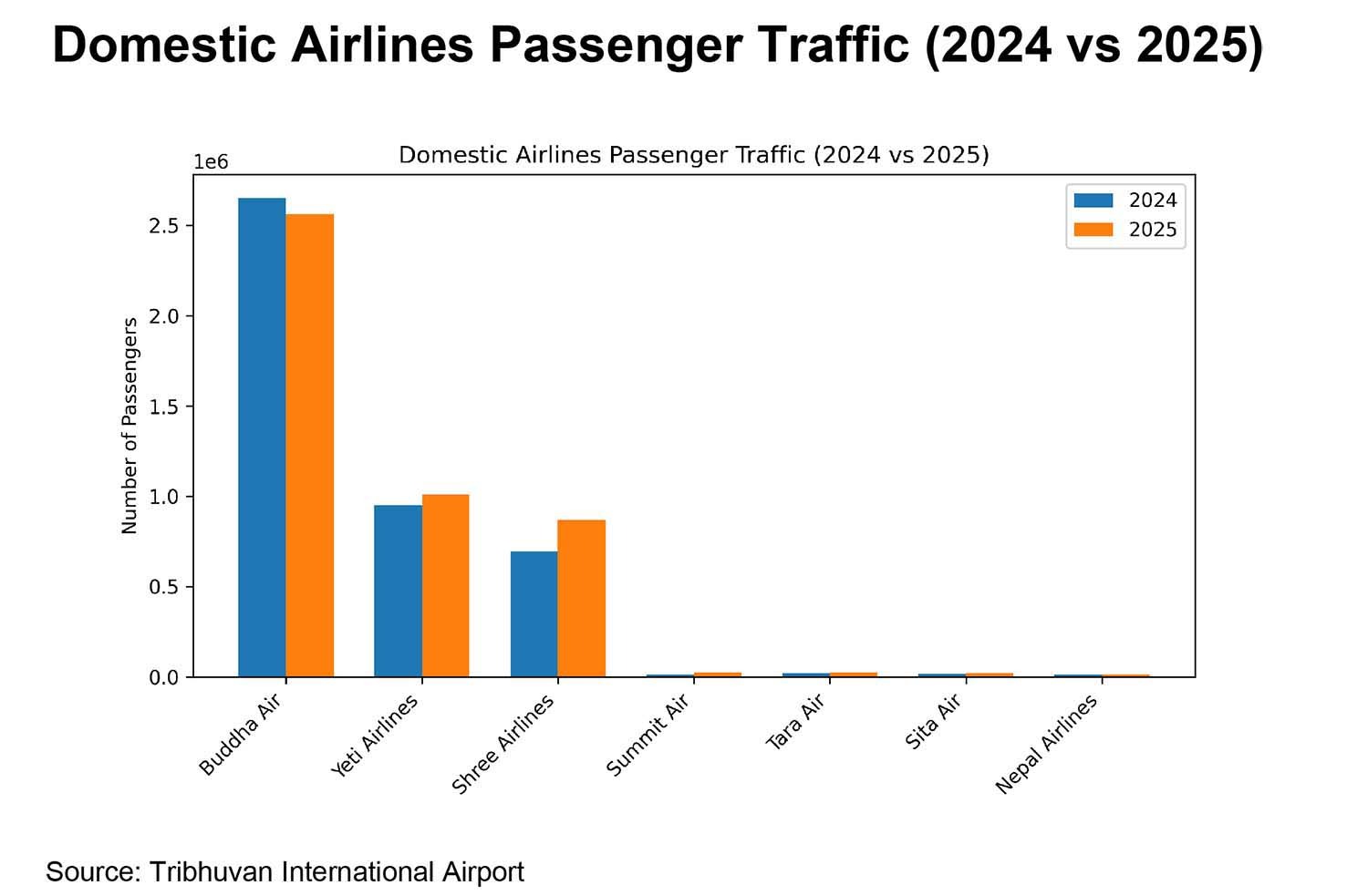
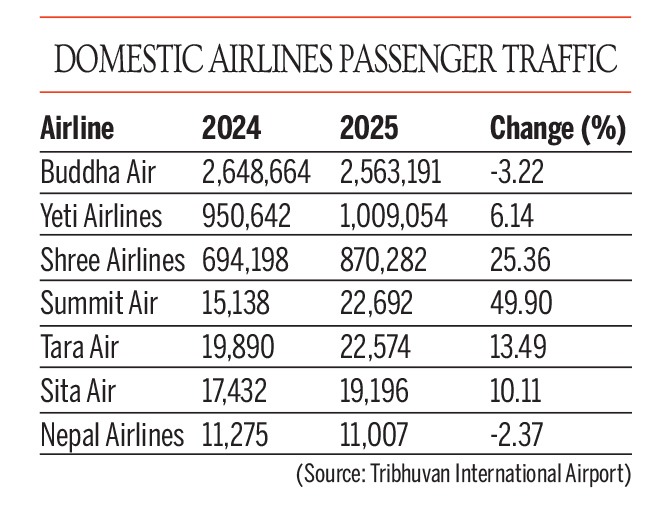
A breakdown of passenger numbers shows that Buddha Air remained the dominant player in domestic aviation in 2025. However, the airline recorded a passenger decline for the first time in many years, flying 2.56 million passengers, down 3.22 percent year on year.
In September 2024, Buddha Air retired its ATR 42 aircraft after clocking its full economic life of 70,000 cycles. “As a result, our passenger numbers dropped too,” Karna said.
Its main rival, Yeti Airlines, crossed the one-million-passenger mark last year, recording a 6.14 percent growth year on year.
Shree Airlines posted the strongest growth among major carriers, flying 870,282 passengers, a jump of 25.36 percent. Summit Air, which serves remote routes, also recorded robust growth, carrying 22,692 passengers, up 49.90 percent.
Yeti’s subsidiary Tara Air, which also focuses on remote destinations, saw a 13.49 percent increase in passenger numbers, flying 22,574 passengers from Kathmandu airport in 2025.
Sita Air recorded double-digit growth of 10.11 percent, carrying 19,196 passengers last year.
Nepal’s national flag carrier, Nepal Airlines, however, continued to lose passengers. The airline carried 11,007 passengers in 2025, down 2.37 percent year on year. Nepal Airlines began losing passengers after grounding five Chinese aircraft. In July 2020, the airline’s board unanimously decided to stop operating the Chinese planes, citing operating costs that exceeded revenue.
According to the statistics, 12 helicopter companies together flew 51,428 passengers in 2025.
Sangam Prasain is Business Editor at The Kathmandu Post, covering tourism, agriculture, mountaineering, aviation, infrastructure and other economic affairs. He joined The Kathmandu Post in October 2009.




 25.92°C Kathmandu