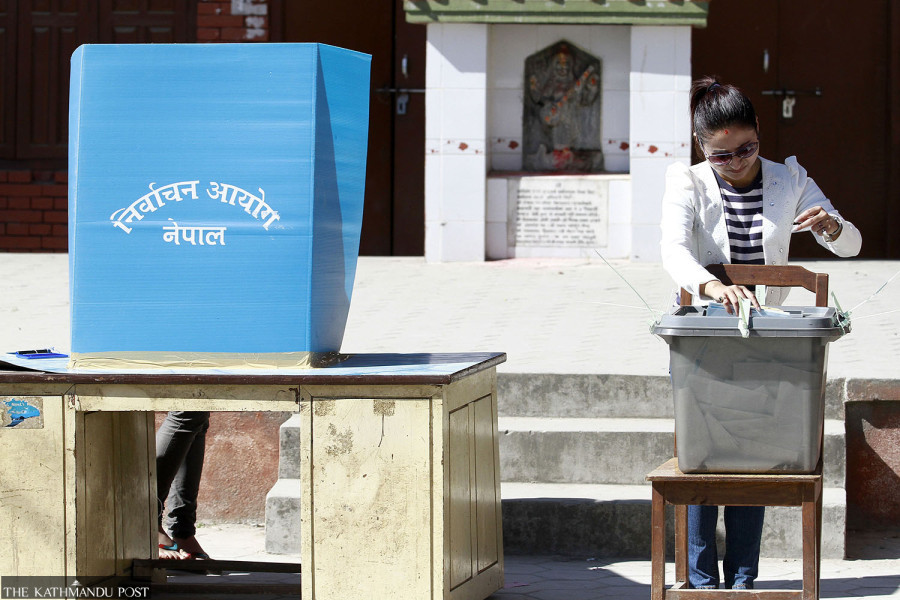
On March 5, Nepal will hold its ninth democratic election for the House of Representatives. The first one happened in 1959.
In this period, Nepal conducted two Constituent Assembly elections, first in 2008 and second in 2013. Moreover, including the upcoming March 5 poll, Nepal will have witnessed two mid-term elections, with the previous one taking place in 1994.
As Nepal heads towards the March elections, the country’s electoral landscape has undergone big change. In earlier elections, political parties largely centred their campaigns on ideological debates, system change, and constitutional questions. Today, however, election issues have shifted more towards governance, economic hardship, unemployment, service delivery and livelihood concerns.
There has also been a noticeable transformation in the style and medium of election campaigning. Traditional methods such as public rallies, pamphlets, and door-to-door outreach once dominated. In recent elections, social media, digital platforms and personalised messaging have become central tools, reshaping how parties communicate with voters and how voters engage with politics.
So how has the agenda and style of campaigning changed over the years?
Hari Narayan Maharjan, 84, a resident of Kirtipur and a retired employee of Nepal Telecom was just 17 when Nepal held its first parliamentary election. On Monday morning, speaking to the Post on the premises of the famed Bagh Bhairav Temple in Kirtipur, he recalled that historic election.
Although there had been a few local elections during the Rana era and even after the restoration of democracy in 1950, Maharjan says it was the 1959 parliamentary election that gave him a real sense of what an election meant. It was then, he recalls, that he first experienced the excitement, curiosity and public participation that come with a nationwide democratic exercise.
Comparing the elections of the past with those of today, Maharjan says that despite Nepal’s long electoral journey, the slogan of development has remained a constant of the electoral agenda. While some progress has certainly been made over the years, he notes that much of it has fallen short of the promises made by leaders during election campaigns, leaving many commitments unfulfilled even decades later.
“Back then, what leaders like BP Koirala, Pushpa Lal Shrestha and Bharat Shamsher said in their speeches felt credible,” Maharjan recalls. “Today, however, it has become difficult to believe anything our leaders say.”
“Though there could be differences in intensity, the development agenda has been consistent from the first election right up to the upcoming one,” he added.
Meanwhile, Jagat Nepal, author of the book Pahilo Samsad (‘First Parliament’) and an assistant professor of mass communication, tries to explain Nepal’s changing electoral landscape from a broader perspective.
According to Nepal, the practice of publishing election manifestos began from the first parliamentary election and has continued since. However, he notes that their effectiveness has gradually declined, even though the tradition itself remains intact.
Due to the lack of roads and transport facilities at the time, it was extremely difficult during the first election to reach all areas for campaigning. Even so, BP Koirala, then president of the Nepali Congress, was among those who campaigned extensively across the country. He later went on to be prime minister. After him, Bharat Shamsher Rana—leader of the Gorkha Parishad, a party which has since become extinct—was another figure known for vigorous election campaigning, Nepal says.
He adds that strengthening democracy, abolishing the birta system (where the state granted land to individuals on a tax-free and inheritable basis as a reward for service or loyalty), and the slogan ‘jasko jot usko pot’ (land belongs to the one who tills it) were among the key issues that dominated the electoral agenda.
After the first parliamentary election, it took nearly three decades for Nepal to hold another. Around two years after the 1959 election, then king Mahendra introduced a partyless Panchayat system, which halted the practice of periodic multiparty elections.
Following the successful people’s movement of 1990 that restored multiparty democracy, elections again started to be held, and the practice of presenting party agendas to the public through election manifestos continued, carrying forward a tradition that had begun with Nepal’s first parliamentary poll, Nepal says.
He argues that, compared to earlier elections, the relatively improved road and transport access during the 1991 election allowed campaign activities to expand significantly. “It was from this election,” he says, “that practices such as wall paintings, the widespread use of party flags, and the extensive use of songs and music for campaigning began.”
Similarly, he believes that the culture of holding large public rallies during elections—and the common perception that the candidate or party able to draw the biggest crowd would win—also emerged from that election.
While the issues and campaign styles of the elections held in 1991, 1994 and 1999 were largely similar, a noticeable shift in campaigning began with the 2008 election for the first constituent assembly. That election marked the start of media-based election campaigning, along with public debates centred on party manifestos, signalling a new phase in Nepal’s electoral practice.
After the first constituent assembly failed to deliver a constitution, the subsequent elections held in 2013 saw the emergence of new campaign strategies, including the use of social media and the practice of hiring professionals to run election campaigns, marking a big shift in how parties reached voters, according to observers.
“Although development agendas have consistently taken priority over local needs in every election, people have stopped believing what leaders say, which has led politicians to make relatively fewer grand promises or lofty commitments during campaigns,” Nepal says, echoing Maharjan. “When the leaders fail to live up to their promises and recycle old pledges during the new campaigns the public trust in them goes down.”
Yubaraj Gyawali, former vice-chairman of CPN-UML, who recently retired from active politics citing age, acknowledges that the widespread use of information technology and improved transport has significantly changed the style of election campaigning.
Commenting on the electoral agendas of old and new political parties, Gyawali says that older parties tend to inspire the public with grand visions during elections, but often fail to fully deliver on them.
These parties traditionally presented long-term goals to voters. By contrast, the newer parties focus on immediate, achievable actions and often follow through on them, Gyawali adds, however, these newer parties generally lack concrete long-term agendas.
“In the past, people voted simply on trust when leaders made promises,” Gyawali told the Post. “Today, voters expect delivery—not in arithmetic but in geometric ratio.”




 14.82°C Kathmandu