Three years after the Nagdhunga–Naubise–Malekhu–Muglin road widening project began, electricity poles are finally being removed from construction sites.
Delays in clearing the poles have slowed work, with construction on stretches with poles coming to a halt. Awarding contracts without completing preparatory work left pole relocation and compensation issues unresolved.
The Nepal Electricity Authority and other government agencies have blamed each other for the delays. Contractors say problems arose because contracts were awarded before preparatory work was completed, despite the project being funded through a concessional World Bank loan.
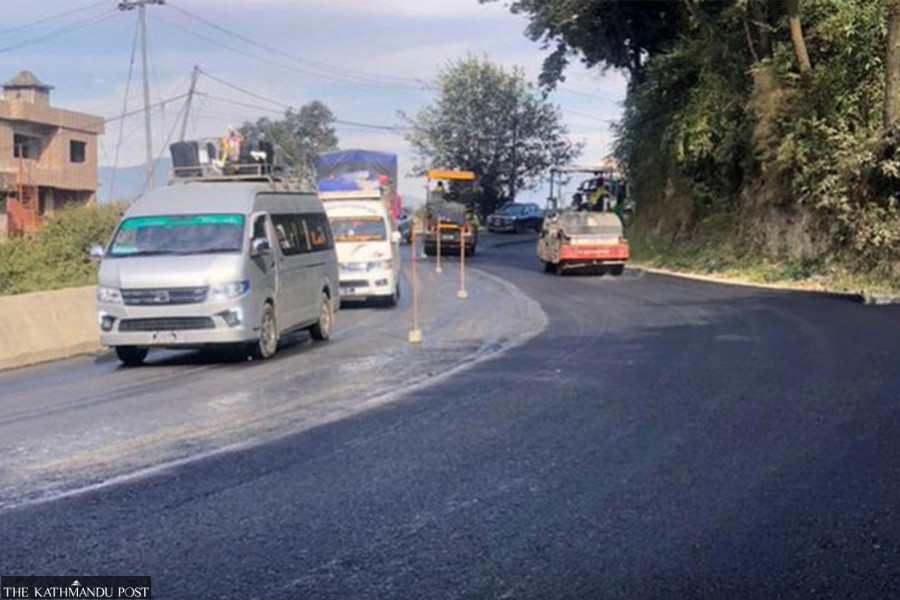
On the first 12.26 km Nagdhunga–Naubise section, second-layer paving is complete except for 100 metres at Jhyaplekhola, where paving is ongoing. Keshav Prasad Ojha, chief of the eastern section of the road project, said work is near completion, and third-layer paving is underway. The contract, awarded to Jiangsu–Sagun JV at Rs1.3 billion, also includes an overhead pedestrian bridge at Khanikhola. Although the contract was signed on April 12, 2022, work began only on June 9, 2022. Deadlines have been repeatedly extended, most recently to mid-March 2026.
Utility poles have yet to be removed on the 43.54 km Naubise–Malekhu section. First-layer paving had been completed on a 15-km stretch before the end of the previous fiscal year. Pole relocation has just started on the Naubise–Mahadevbesi and Adamghat–Malekhu stretches. Immediate past minister for physical infrastructure and transport Kulman Ghising, who resigned on Wednesday, directed sufficient manpower to accelerate pole removal, after which work began.
“Utility poles are finally being removed. Paving was impossible where poles stood, and contractors had to repeat work that could have been done once,” Ojha said, adding that delays were caused by the electricity authority. “A single contractor is responsible for pole relocation nationwide, and progress began only after payment was made and a construction company selected.” He added that work would speed up once the poles are removed.
Of the 13 bridges on this section, nine are complete, and the overall progress of the project stands at 49 percent. The contract, valued at Rs5.3319 billion, was awarded to JICG–Sharma–Lama JV on April 27, 2022. The original deadline of mid-June has been extended to mid-October 2026.
Project manager Gyanendra Ghimire of JICG–Sharma–Lama JV said, “Pole removal is finally starting, but paving is still obstructed where poles remain. Awarding contracts without preparatory work caused this issue.” He added that working in a joint venture with a Chinese company has allowed smoother progress despite the challenges.
Nepal Electricity Authority spokesperson Rajan Dhakal said delays arise when projects start and request pole removal at the last minute. “There is a standard procedure for relocating electrical structures applicable to all projects. Surveys should identify the number of poles and relocation timeline, but this is often not done,” he said. Dhakal added that pole relocation begins only after cost estimates are prepared, funds are deposited, and contractors are selected.
Widening work continues across the entire 94.66 km Nagdhunga–Muglin road, used by over 12,000 vehicles daily. The worst delays are on the Malekhu–Muglin section, where progress is very low. Roads are damaged with potholes, and traffic management is insufficient, causing daily congestion.
The 38.86 km third section has only 36 percent progress. Sharma–JICG JV was awarded the contract worth Rs4.8059 billion on December 30, 2022. Deadlines were extended to June 29, 2026. Shortages of construction materials have slowed work, said Western Section chief Sajana Adhikari.
“Although an Environmental Impact Assessment was approved allowing extraction of materials from Lamabagar, the work has been halted due to locals’ opposition,” Adhikari said. “The target is 20 km of paving this fiscal year, but material shortage makes this difficult.”
Pole relocation remains a major challenge in this section. Of 136 poles, only 50 have been removed. The remaining 86 poles, including those at Muglin, Malekhu Bazaar, and Mauwakhola Bridge, are blocking paving. So far, only the Fisling–Chumlingtar stretch has been cleared. Requests to the electricity authority have repeatedly been delayed.
Krishna Bahadur Thapaliya, chairperson of Benighat Rorang Rural Municipality, said local opposition to material extraction from Lamabagar has also slowed work. “The federal government has been informed in this connection. If the ministries of physical infrastructure and transport and home affairs intervene, the issue can be resolved,” he said.
So far, 8.1 km of four-lane paving has been completed in this section. Due to the terrain, some stretches have two, three, or four lanes. Most paving has been completed in Benighat, Fisling, and Kurintar markets. Of six bridges, four are complete.




 19.62°C Kathmandu