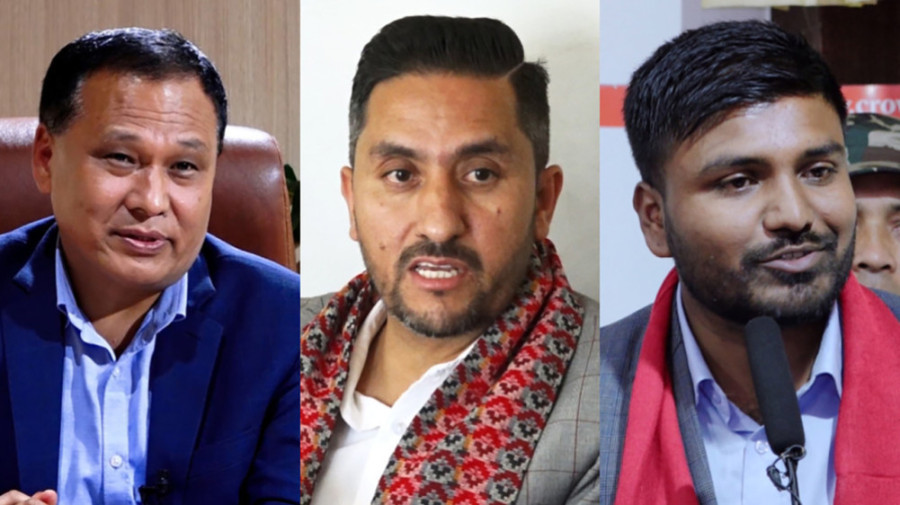
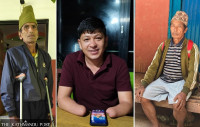
The prime minister cites public perception and the non-partisan nature of her government. From left, Ministers Kulman Ghising, Jagadish Kharel and Bablu Gupta
Prime Minister Sushila Karki has again told some Cabinet ministers who are aligned with political parties to leave the government.
During a Cabinet meeting on Monday, she told some ministers including Energy Minister Kulman Ghishing to quit the government after he joined the Rastriya Swatanta Party. This followed the merger of his Ujyalo Nepal Party with the RSP.
The Karki government, which was formed on September 12 following the Gen Z movement and which claims to have ushered in the spirit of “civilian government”, is widely seen as neutral, impartial and free from political baggage.
But some ministers including Ghising, Minister for Youths and Sports Bablu Gupta, and Minister for Information and Communication Technology Jagadish Kharel have tilted towards different political parties. The prime minister sensitised them to the public perception and asked them to quit the government, one minister told the Post on condition of anonymity.
“This is not the first time that the prime minister has instructed Ghising to quit the government,” the minister said. “She did so again on Monday.”
The prime minister also inquired whether Minister Gupta was planning to contest elections on March 5. Gupta did not clearly state his position but told the prime minister that he is considering the possibility.
Another minister, Kharel, was not present at Monday’s Cabinet meeting, but he too has shown an inclination towards the Rastriya Swatantra Party. “The prime minister is also not comfortable with Kharel’s proximity to the RSP,” the minister told the Post.
Although the prime minister did not mention any minister by name, she indicated that those affiliated with political parties should understand the situation and act accordingly. She told the ministers to assess the situation and make decisions on their own.
“Those running for the coming election should quit—this was the message from the prime minister,” the minister added.
In the meeting, Karki said that until now the ministers had contributed well while being in the government.
“But now, we are entering a new phase. In this situation, some colleagues have clearly shown their desire to enter politics and contest elections. Therefore, it would be better for them to detach themselves from the government,” the minister quoted the prime minister as saying at the meeting.
The prime minister kept insisting that this is a citizen government built on the foundation of the Gen Z movement, but that some ministers have become involved in political activities. “Now, please make it easier for me,” she said.
According to another minister, there was a lengthy debate on the issue as soon as Monday’s meeting began. Quoting the prime minister, the minister said, “If you want to get involved in political activities, you can go ahead, I have nothing to say about that. But remember, this is a citizen government.” At the end of the meeting, she again reminded the ministers concerned of the issue as they were leaving.
But the three ministers have yet to make up their minds about quitting the government.
Minister Ghising says he won’t quit
Energy Minister Kulman Ghising has responded that he won’t quit the government since he’s not currently a member of a political party.
Speaking at an interaction with engineers in Lalitpur on Tuesday, Ghising clarified that he does not hold the membership of any political party.
At a Cabinet meeting on Monday, Prime Minister Sushila Karki had told ministers to quit if they were to be involved in political activities eying the upcoming parliamentary elections.
Ghising served as a patron of the Ujyalo Nepal Party (UNP). The party has been active since November.
However, following a seven-point agreement to merge with the Rastriya Swatantra Party (RSP) on December 29, Ghising was said to be given the position of senior vice-chairperson in the unified party.
According to a source close to the prime minister, Karki explicitly asked Ghising in Monday’s Cabinet meeting to leave the government if he wishes to remain politically active.
Although the prime minister’s remarks were directed at Ghising, the message equally applies to other members of the Cabinet who want to be actively involved in party politics, said a source at the Prime Minister’s Office.
According to people familiar with the developments, the prime minister’s position is that serving ministers, by virtue of their authority, could potentially use state resources to influence the electoral process.
Anil Giri is a Chief Sub Editor covering diplomacy, international relations and national politics for The Kathmandu Post. Giri has been working as a journalist for more than two decades, contributing to numerous national and international media outlets.




 14.81°C Kathmandu