Rampaging elephants force Kachanakawal farmers to slash sweet potato cultivation
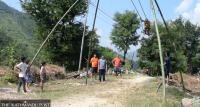
Farmers’ efforts to deter the pachyderms have failed. Experts say the area lies on elephant corridor and growing human encroachment has worsened conflicts. Farmers digging up sweet potatoes in a field in Kachanakawal, in this recent photo. These tubers are typically harvested around December. Photo: Courtesy of Navin Upreti
Mohammad Atim, a farmer from ward 1 of Gherabari in Kachanakawal Rural Municipality, is quite busy now harvesting his sweet potatoes. His field has produced a good yield this season, but nightly raids by wild elephants have left him distressed.
“The elephants come after dark and dig up the sweet potatoes,” said Atim while harvesting his crop. “They attack wherever the yield is good. Just last year, elephants destroyed the entire sweet potato crop grown on 14 kattha [0.47 hectares] of my land.”
Despite favourable production, the persistent threat of elephant incursions has made farming increasingly uncertain for Atim and other farmers in the area.
The Kachankawal area in southern Jhapa has long been known for sweet potato, called sakharkhanda in Nepali, cultivation. However, in recent years, farmers have been forced to scale back production due to the persistent menace of wild elephants.
“I have been growing sweet potatoes for the past ten years. Earlier, I used to cultivate between two and two-and-a-half bigha (1.35-1.7 hectares) of land. This year, because of the fear of elephants, I planted only 10 kattha [0.34 hectares]. There is no point in planting more when the elephants end up eating everything,” lamented Atim.
Wild elephants usually enter the villages after 10 pm and continue rampaging through farmlands until around 3 or 4 in the morning, leaving farmers distressed and exhausted. Like Atim, another farmer Ghanesh Rajbanshi from ward 1 of Kachankawal, has also been forced to cut back his sweet potato cultivation. He had planted sweet potatoes on 10 kattha of land until last year, but reduced the area to just eight kattha this season. “Because of the fear of elephants, it is impossible to cultivate on a larger scale. The losses are simply too high,” he said.
Sweet potatoes are typically planted from mid-August and harvested after December, which means farmers are currently busy digging up their crops. However, this is also the period when elephant attacks intensify. Farmers have tried various measures to protect their fields, including installing electric lights and fencing, but none have been effective. Despite all efforts, elephants continue to breach these barriers and destroy the crops.
According to Rajbanshi, sweet potatoes are ready for harvest around three months after planting. He said that cultivating eight kattha this year cost him around Rs18,000. In a good season, each kattha yields 160 to 200 kg. Traders now come directly to the fields to purchase the crop, paying between Rs45 and Rs48 per kg.
Most of the product is supplied to markets in Birtamode in Jhapa and to various markets in neighbouring Sunsari district. Farmers say they prefer selling in Sunsari, where prices are relatively better than in Jhapa. Despite decent market demand, growers complain that they have received no government subsidies or special support for sweet potato farming.
Sweet potato is a traditional crop, commonly consumed as a snack and during festivals. In the eastern Tarai, it is locally known as suthuni. Once famed as a “sweet potato hub,” the Kachankawal area is now witnessing a steady decline in cultivation due to frequent elephant incursions and what farmers describe as prolonged government neglect.
Jhapa is one of the worst hit districts by human-elephant conflict. The farmers have to bear huge losses as the wild elephants destroy their crops like paddy, maize, sweet potatoes, vegetables among others. The destruction caused by these herds is not limited to crops alone. Sometimes they destroy houses, other properties and kill people sometimes.
According to the directive issued by the government, if the elephant destroys the crops, or damages the house, cattle sheds, the victims get up to Rs10,000. The compensation is not only insufficient, it’s also difficult to come by, with the victims being forced through several administrative hurdles to get it. For most residents, the compensation amount does not even cover the cost of visiting the district headquarters.
Over the years, locals have experimented with multiple deterrence strategies in Jhapa. Many started beekeeping, believing that the buzzing of bees might repel the elephants. Others tied ropes coated with chilli powder around their fields. Hundreds of trees believed to discourage elephant entry, locally called "Hatti bar” were planted along field borders. Some even dug trenches. But none of these methods have provided a sustainable solution.
According to conservationists, Jhapa is the corridor for elephant movement. Studies show that elephants from Assam and West Bengal in India travel to Koshi Tappu Wildlife Reserve in Nepal through the area. Experts say that instances of human-wildlife conflict are recurring because of the encroachment of the bio-corridor by humans over the years.




 13.76°C Kathmandu